
ChatGPT for Paragraphs, But What About Entire Korean Books?
When translating Korean books into English, ChatGPT and BookTranslator.ai serve different purposes. Here's the bottom line:
- ChatGPT works best for short translations. It’s great for translating paragraphs, adjusting tone, and explaining phrases like "오빠" on the spot. But for longer texts, its context limitations and manual splitting make it inefficient.
- BookTranslator.ai is designed for full-length books. Upload an EPUB, and it handles everything - translation, formatting, and consistency across chapters. Pricing is straightforward: $5.99–$9.99 per 100,000 words.
Key Takeaway: Use ChatGPT for small, interactive tasks. For translating entire books, BookTranslator.ai is faster, more consistent, and easier to manage.
Quick Comparison
| Feature | ChatGPT | BookTranslator.ai |
|---|---|---|
| Best For | Short texts, quick edits, tone tweaks | Full-length books, maintaining consistency |
| Workflow | Manual splitting and pasting | Upload EPUB for automated processing |
| Formatting | Strips formatting | Retains original layout |
| Pricing | Free/variable subscription or API costs | $5.99–$9.99 per 100,000 words |
| Limitations | Context window, manual effort | Less flexible for sentence-level tweaks |
The choice depends on your needs: short, flexible translations or efficient book-length projects.
1. ChatGPT
Translation Workflow
ChatGPT tackles Korean-to-English translation through an interactive, conversation-based process. You input a section of text - like a paragraph - and specify your preferences, and it quickly generates a translation. This makes it convenient for handling smaller, focused text segments.
However, translating an entire Korean book is a different story. Due to ChatGPT's limited context capacity, you’d need to break the manuscript into smaller parts and manually copy, paste, and save each one. This piecemeal approach demands significant effort and contrasts with the automated, end-to-end functionality provided by platforms like BookTranslator.ai. These limitations highlight the differences between ChatGPT and tools specifically designed for book translation.
Consistency of Style and Terminology
Ensuring consistency in style, terminology, and character names throughout a full-length book can be tricky with ChatGPT. For instance, a character's name might be translated slightly differently across sessions. Similarly, Korean honorifics like "오빠" or "선배" require thoughtful decisions about whether to keep their romanized forms or translate them into English equivalents. To address these challenges, you can create detailed style guides and reference materials to include with each prompt, though this adds another layer of work.
Preservation of Formatting
When you paste Korean EPUB text into ChatGPT - complete with headings, scene breaks, and style markers - it outputs plain text, stripping away formatting like bold, italics, and section dividers. This means you’ll need to manually compare the source and the output to restore formatting. Additionally, EPUB files often include metadata, a table of contents, and embedded images, which require separate tools to properly reconstruct the final ebook for publication.
Cost and Scalability
While ChatGPT offers both free and subscription-based plans with varying usage limits, the manual effort required for segmenting and reassembling text makes it difficult to scale for larger projects like books. This labor-intensive process limits its practicality for translating lengthy works.
2. BookTranslator.ai
Translation Workflow
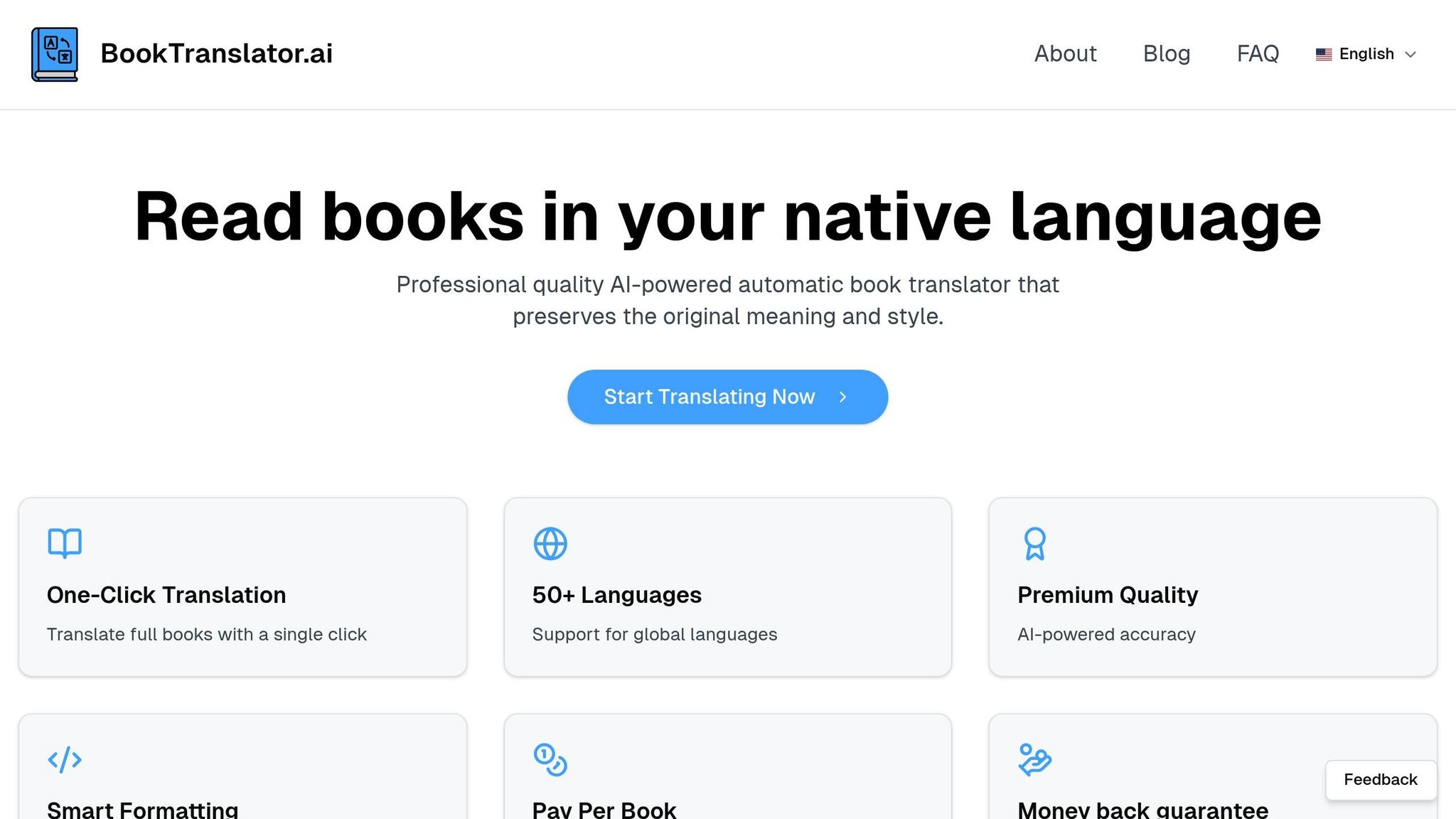
BookTranslator.ai simplifies the process of translating Korean books. All you need to do is create an account, upload your EPUB file (up to 50MB), and let the platform handle the rest. With just one click, it processes the entire manuscript, offering seamless Korean-to-English translation. This automated system eliminates the need for manual segmentation - a common hassle with general-purpose translation tools.
In early 2024, Korean web novel enthusiasts and translators turned to BookTranslator.ai to tackle lengthy works, such as a 300,000-word web novel from Novelpia. The platform efficiently translated multi-chapter EPUBs, keeping the chapters in order and preserving basic formatting. The results were fluent English translations, and users saved hours compared to manually pasting individual chapters into tools like ChatGPT. That said, minor edits are still needed for refining idiomatic expressions and polishing character-specific dialogue.
Consistency of Style and Terminology
BookTranslator.ai isn’t just about speed - it also prioritizes consistency. Its AI model is designed to retain the original meaning and style of the source text while understanding context across an entire book. This ensures uniformity in translating character names, Korean honorifics, and recurring terms throughout the novel. For example, culturally nuanced words like "오빠" or "선배" are handled with care, addressing one of the toughest challenges in Korean-to-English translation. Users have praised the platform for capturing the essence of the original work and preserving the author’s voice across every chapter. By treating the book as a cohesive project, the platform delivers translations that feel consistent and authentic.
Preservation of Formatting
Another standout feature is its ability to maintain the original layout. BookTranslator.ai’s Smart Formatting ensures that structural elements like chapter headings, scene breaks, italics, and other styling details are preserved during translation. This is especially valuable for Korean web novels and literary works, where formatting enhances tone, emphasis, and narrative flow. While the platform generally does an excellent job of retaining these elements, users might occasionally need to make small tweaks to perfect the final presentation.
Cost and Scalability
BookTranslator.ai also offers a straightforward pricing model based on word count. The Basic Plan costs $5.99 per 100,000 words, while the Pro Plan is $9.99 per 100,000 words, with a minimum charge of $5.99. For example, translating a 300,000-word Korean novel would cost between $17.97 and $29.97, depending on the plan you choose. The platform also includes a money-back guarantee, making it a low-risk option for trying out the service. Whether you’re an individual reader diving into Korean literature or a professional translator managing larger projects, this pricing structure makes it an accessible and scalable solution.
sbb-itb-0c0385d
Advantages and Disadvantages
Let's dive into a comparison of ChatGPT and BookTranslator.ai when it comes to translating Korean books. Each tool has its strengths, and understanding these can help you decide which one suits your needs best.
ChatGPT shines when it comes to conversational, flexible translation. You can paste a Korean paragraph into its chat interface and receive a natural U.S. English translation almost instantly. If you're familiar with messaging apps, you'll find it intuitive to use. Plus, ChatGPT allows for on-the-spot adjustments - you can ask it to tweak the tone, make dialogue more casual for American readers, or explain cultural nuances like the meaning of "오빠" in a specific context. This makes it particularly useful for short texts, quick translations, or situations where tone and cultural context need real-time fine-tuning.
That said, ChatGPT isn't designed for handling book-length projects. It has a context window limit, which means you'll need to break the text into smaller chunks manually. This can lead to inconsistencies in things like character names or terminology, especially as the conversation progresses and earlier context is lost.
On the other hand, BookTranslator.ai takes a more structured, automated approach. It’s specifically designed for translating entire books. Simply upload your Korean book in EPUB format, and the platform processes the entire manuscript - chapters and all - while keeping the formatting intact. This eliminates the hassle of manual segmentation and ensures that the same model and instructions are applied consistently across the whole text. As a result, it excels at maintaining uniformity in style, terminology, and character names, making it a better fit for long-form projects.
However, BookTranslator.ai lacks the real-time flexibility of ChatGPT. While ChatGPT lets you refine individual sentences interactively, BookTranslator.ai relies on project-level settings that apply across the full book. This trade-off in flexibility is often outweighed by the platform's focus on consistency, especially for large-scale translations.
When it comes to translation accuracy, both tools perform similarly, producing fluent, natural-sounding U.S. English. ChatGPT’s edge lies in its ability to adapt tone and explain cultural references interactively. Meanwhile, BookTranslator.ai’s strength is in maintaining that same level of quality consistently over hundreds of pages, with better support for cross-chapter terminology and formatting.
Pricing is another factor to consider. ChatGPT offers a free tier for occasional use, but costs can add up for larger projects. ChatGPT Plus provides a flat monthly fee, while API usage is billed per token, which can range from a few dollars to much more depending on the length of the book and the model you choose. In contrast, BookTranslator.ai charges a fixed rate of $5.99–$9.99 per 100,000 words, making it easier to predict costs for a one-off book translation. The platform also includes a money-back guarantee, which adds peace of mind for first-time users.
Here’s a quick side-by-side comparison:
| Factor | ChatGPT | BookTranslator.ai |
|---|---|---|
| Ease of Use | Intuitive chat interface; requires manual splitting for longer texts | Upload-based workflow; handles chapters automatically; better for large projects |
| Translation Accuracy | Fluent U.S. English; allows interactive tone adjustments and cultural explanations | Similar quality; excels at maintaining consistency across chapters |
| Handling Large Projects | Limited by context window; manual segmentation needed; prone to inconsistencies | Designed for full books; processes entire manuscripts; preserves formatting and terminology |
| Pricing | Free tier available; ChatGPT Plus monthly subscription; variable API costs for book-length work | $5.99–$9.99 per 100,000 words; predictable costs; pay-per-project model |
| Best For | Short texts, quick translations, tone adjustments, and multi-purpose tasks | Full-length books, web novels, and projects needing consistent terminology and formatting |
Both tools have their place. If you're working on a short translation, experimenting with tone, or already using ChatGPT for other tasks, its conversational design and subscription model make it a convenient choice. However, for translating an entire Korean book - especially when consistency and formatting matter - BookTranslator.ai offers a streamlined workflow, predictable pricing, and a focus on long-form accuracy that makes it the better option.
Conclusion
Deciding between ChatGPT and BookTranslator.ai ultimately depends on your specific translation needs. Both tools provide fluent, natural-sounding U.S. English translations from Korean, but they cater to very different purposes. Here's a closer look at when each tool shines.
ChatGPT is ideal for quick, short translations. If you're trying to grasp a few paragraphs from a Korean web novel, translate snippets of dialogue, or get the gist of social media posts, ChatGPT's conversational interface is incredibly handy. It's especially helpful for research or "gist" reading - situations where understanding the general meaning takes priority over literary precision. Plus, its interactive nature lets you refine translations by asking follow-up questions like, "Can you simplify this idiom?" or "Keep the honorifics but make the rest sound natural in en-US." This flexibility makes it a go-to for shorter tasks.
That said, ChatGPT isn't built for translating entire books. Its limited context capacity means you'll need to break longer texts into smaller chunks, which can lead to inconsistencies in terminology or character names as the translation progresses.
BookTranslator.ai steps in for larger projects. If you're tackling a full Korean book - whether for publication, sharing with readers, or personal enjoyment - this platform is designed to handle the workload. It processes entire manuscripts, including EPUBs, while maintaining formatting and ensuring consistent terminology throughout. With pricing between $5.99 and $9.99 per 100,000 words and a money-back guarantee, it offers a straightforward, efficient way to get professional-quality results without the hassle of managing lengthy texts manually.
When to choose each tool: ChatGPT is your best bet for translating 1–5 pages quickly, experimenting with tone, or when minor imperfections are acceptable due to budget constraints. On the other hand, BookTranslator.ai is the better choice for full-length books, where consistent quality and ease of use are critical. By aligning your project's scope and quality requirements with the right tool, you can ensure the best outcome for your translation efforts.
FAQs
How does BookTranslator.ai maintain consistent style and terminology when translating entire Korean books?
BookTranslator.ai applies cutting-edge AI algorithms to deliver consistent translations for full-length Korean books, maintaining both the style and terminology throughout. By using customizable glossaries and style guides, the platform ensures that translations stay true to the author’s original intent and tone.
What sets this system apart is its context-aware processing. It evaluates the entire text holistically, ensuring coherence across chapters and sections. Recurring terms, names, and cultural references are handled with precision, resulting in a smooth and accurate translation that feels polished and seamless.
What challenges does ChatGPT face when translating entire Korean books, and how can these be addressed?
AI tools like ChatGPT encounter several hurdles when translating full-length Korean books. These challenges arise from the difficulty in capturing emotions, cultural nuances, and subtle connotations - all of which are vital in literary works. On top of that, intricate sentence structures and references unique to Korean culture are often misinterpreted or overly simplified by AI systems.
One way to tackle these problems is by blending AI with human expertise. This approach allows translators to add the necessary context and cultural awareness that machines alone might miss. Breaking the text into smaller, manageable sections for translation can also help maintain focus and accuracy. By using AI as a supportive tool rather than a standalone solution, the quality of translations can be significantly improved. Despite advancements in AI, human involvement remains essential to ensure literary translations are done well.
How does the cost of using BookTranslator.ai for translating full Korean novels compare to other approaches?
The cost of translating large Korean novels with BookTranslator.ai varies depending on factors like the book's length and the complexity of its text. AI-powered tools like this often offer a faster and more budget-friendly option compared to traditional human translation services. However, the exact pricing will depend on your specific requirements.
To get a clearer picture, check out BookTranslator.ai's pricing details and weigh them against the time and cost of manual translation. While AI systems can make large-scale literary translations more accessible, it's crucial to consider the balance between cost, speed, and the quality of the translation for your particular project.