
Case Study: AI and Nushu Language Translation
AI is helping to preserve Nüshu, a rare phonetic script created by Yao women in China over 400 years ago. With only 500 digitized sentence pairs available (as of 2025), translating Nüshu is a challenge due to its limited documentation and unique one-to-one mapping with Chinese characters. However, researchers from Dartmouth College have developed the "NüshuRescue" framework, which uses advanced AI models like GPT-4-Turbo to automate translations and expand datasets for this endangered language.
Key Highlights:
- Nüshu's Background: A syllabary with 600-700 characters, used historically by women to communicate in a male-dominated society.
- Challenges: Limited surviving texts, no standardized dictionary, and characters with no direct modern Chinese equivalents.
- AI's Role:
- NüshuRescue Framework: Combines FastText and Seq2Seq models for translation, starting with a 500-sentence dataset (NCGold).
- GPT-4-Turbo: Achieved 48.69% accuracy on unseen Nüshu sentences using only 35 examples.
- Datasets:
- NCGold: 500 manually curated Nüshu-Chinese sentence pairs.
- NCSilver: 98 additional translations generated by AI.
- Future Goals: Expanding translations to include physical artifacts like embroidered handkerchiefs and fans using multimodal AI.
By blending AI automation with expert review, this project not only supports linguistic preservation but also ensures accurate and respectful translations of this endangered script.
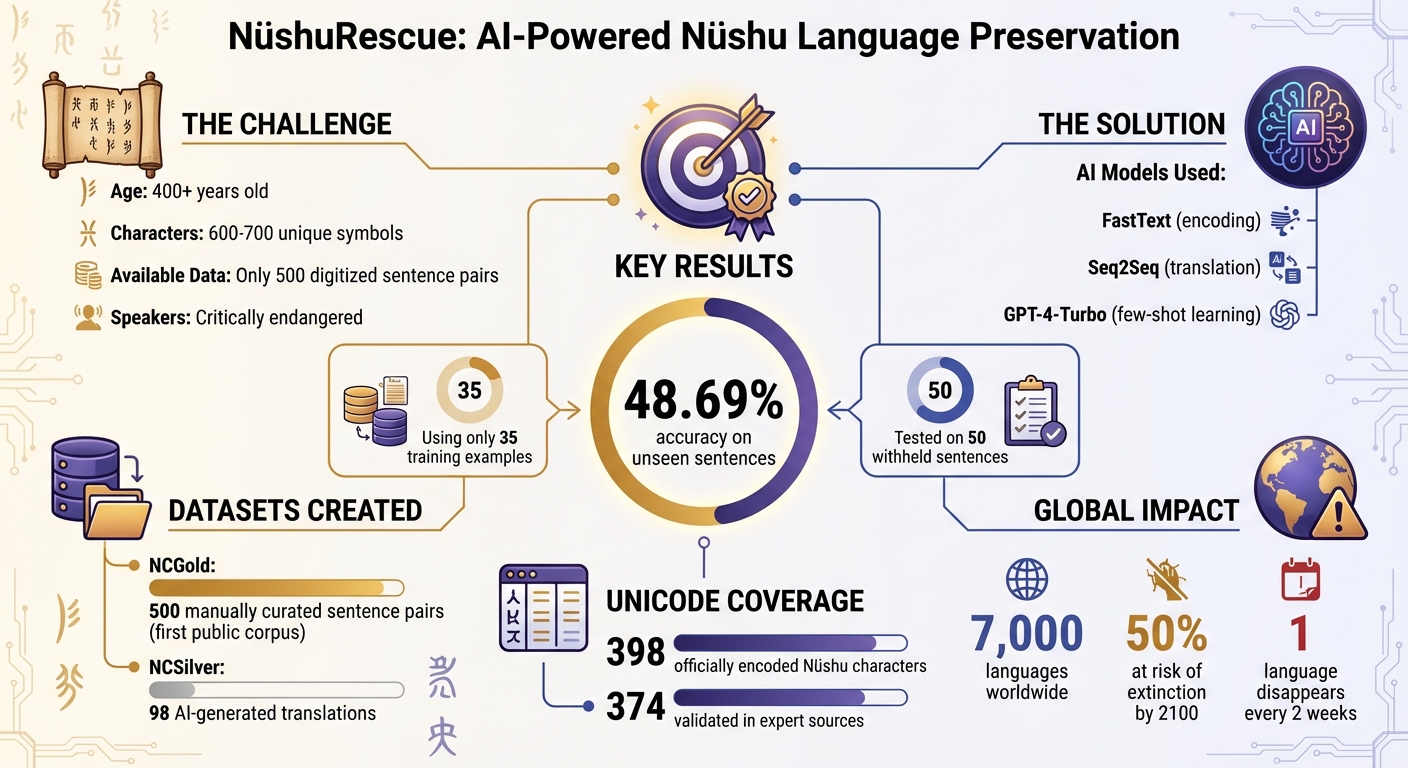
NüshuRescue AI Translation Framework: Key Statistics and Results
Can AI save endangered Indigenous languages? | The Take
sbb-itb-0c0385d
How AI Translates and Preserves Nüshu
AI has become a key player in preserving Nüshu, especially since there are so few human experts proficient in the language. Translating this low-resource language manually is both expensive and time-intensive, which has pushed researchers to explore new methods. One standout example of this effort was presented at COLING.
In January 2025, researchers Ivory Yang, Weicheng Ma, and Soroush Vosoughi from Dartmouth College introduced the NüshuRescue framework at the 31st International Conference on Computational Linguistics (COLING). This system leverages advanced AI to automate translations and grow linguistic resources with minimal human input. As they described:
"NüshuRescue provides a versatile and scalable tool for the revitalization of endangered languages, minimizing the need for extensive human input." [1]
The framework tackles a critical issue: the lack of Nüshu speakers and scholars capable of producing the volume of translations needed to preserve the language. Using iterative learning and data augmentation, the system started with a 500-sentence seed corpus (NCGold) and expanded it by generating NCSilver - a secondary dataset of 98 newly translated modern Chinese sentences. This automated process fills the gap left by the scarcity of human experts, making large-scale translation efforts feasible.
How AI Models Process Nüshu
Training AI to work with Nüshu comes with its own set of challenges. The script has a unique one-to-one character mapping with Chinese - each Nüshu character corresponds precisely to a single Chinese character. To ensure this mapping remains accurate, the system employs specialized validation rules, such as length validation, to maintain linguistic accuracy throughout the process [3].
The NüshuRescue framework uses a combination of AI technologies to handle these complexities. FastText models are used to encode the bilingual relationships between Nüshu and Chinese, while Sequence-to-Sequence (Seq2Seq) models manage direct translations between the two scripts. This hybrid approach allows the AI to understand Nüshu's unique structure, even with a limited dataset [3].
While human input is still part of the process - bilingual annotators consult online converters and reference printed works like A Compendium of Chinese Nüshu - the majority of the translation work is handled by AI. This dramatically reduces the cost and time needed to preserve the language, making the effort more practical and sustainable [3].
GPT-4-Turbo's Role in Nüshu Translation

Building on these methods, advanced models like GPT-4-Turbo bring even greater efficiency to Nüshu translation. Using a technique called "few-shot" learning, GPT-4-Turbo can achieve impressive results with very limited data. Unlike traditional systems that require thousands of examples, GPT-4-Turbo can start producing accurate translations with as few as 35 seed examples. For example, the Dartmouth team exposed the model to 35 sentences from the NCGold corpus and achieved a 48.69% translation accuracy on 50 withheld Nüshu sentences [1][4].
This approach highlights the potential for preserving languages with scarce data. GPT-4-Turbo demonstrated that it could generalize Nüshu's linguistic patterns and structure from just a handful of examples. This makes it possible to work with languages that have little to no digital presence - a category that includes Nüshu and many Indigenous languages worldwide [1].
As the model processes more translations, it refines its understanding of Nüshu's unique features, creating a feedback loop that improves accuracy over time. This automated cycle of learning and improvement is something manual efforts alone would struggle to achieve, given the limited number of Nüshu experts available [3].
Results: Progress in Nüshu AI Translation
The project has made strides in balancing scalability with preserving the essence of Nüshu. Using the NüshuRescue framework, researchers achieved a 48.69% translation accuracy on 50 unseen Nüshu sentences with GPT-4-Turbo, relying on just 35 NCGold examples [1]. This demonstrates how few-shot learning can be effective for endangered, low-resource languages. Unlike traditional translation systems that demand thousands of examples, NüshuRescue proves that meaningful progress is possible with limited data. As Soroush Vosoughi, Assistant Professor of Computer Science at Dartmouth College, noted:
"Our work demonstrates that generative AI and large language models significantly lower barriers to revitalizing endangered languages, rapidly producing valuable linguistic resources even from minimal data." [2]
Dataset Expansion with NCGold and NCSilver
The success of this initiative owes much to two key datasets. First, NCGold, the cornerstone of the project, is a collection of 500 manually curated Nüshu-Chinese sentence pairs - the first publicly available parallel corpus for Nüshu [1].
Building on NCGold, the team created NCSilver, a secondary dataset generated using GPT-4-Turbo. It includes 98 modern Chinese sentences translated into Nüshu [1]. This step bridges historical script with modern contexts, paving the way for future translation efforts. To ensure precision, an automated length validation process was employed, maintaining a one-to-one character correspondence between Nüshu and Chinese.
Both datasets are now accessible on GitHub, enabling researchers worldwide to contribute to and expand this work. By feeding NCSilver translations back into the model, the team creates a feedback loop that enhances future accuracy. These datasets also play a crucial role in safeguarding the cultural nuances of Nüshu.
Preserving Cultural Context in AI Translations
The framework goes beyond technical achievements to address cultural preservation. Nüshu, a phonetic script traditionally used by Yao women in Jiangyong County, Hunan Province, was a medium of self-expression [1]. The NüshuRescue framework combines automated translation with human oversight to honor this heritage. Bilingual annotators refine AI-generated translations, resolving ambiguities and correcting errors, particularly for terms absent from standard dictionaries.
To maintain authenticity, the training data is drawn from verified historical texts rather than modern reinterpretations. This ensures the AI captures the language's original usage and avoids imposing contemporary linguistic patterns on an ancient script.
Looking ahead, the team aims to expand beyond text. Ivory Yang, a graduate student in Computer Science at Dartmouth College, shared the next steps:
"There are handkerchiefs and floating fans that have Nüshu writings on them. So the next step would be to build multimodal models that can use computer vision to capture these images and train a model to recognize and translate the characters for us." [2]
This future direction could enable AI to analyze physical artifacts, extending preservation efforts to items beyond digitized texts.
Ethical Challenges in AI-Powered Nüshu Translation
AI has made it possible to generate Nüshu text quickly and at a scale that human teams alone could never achieve. However, ensuring that this technology respects the cultural depth of Nüshu is no small task. Originally created by Yao women in Hunan Province as a private script to communicate in a society that denied them formal education, Nüshu carries a profound history of resilience and sisterhood. Each translation decision has cultural significance, and treating the language as just another dataset risks stripping away its unique essence. This is why blending AI automation with human expertise is crucial in safeguarding Nüshu’s legacy.
Combining Human Expertise with AI Automation
The NüshuRescue framework demonstrates the importance of human involvement in ethical translation efforts. Bilingual annotators play a key role here, meticulously reviewing AI-generated translations and comparing them to authoritative printed sources. This step is essential because Nüshu’s phonetic system allows a single symbol to represent as many as 35 Chinese characters with identical pronunciation but different meanings [7][8]. AI alone cannot resolve such complexities.
Soroush Vosoughi, an Assistant Professor of Computer Science at Dartmouth College, emphasized this point:
"Active participation from native speakers and linguists is essential to ensure linguistic authenticity and cultural fidelity. AI and community expertise are both fundamental for meaningful preservation efforts." [2]
This collaboration between humans and AI is not just about accuracy - it’s about addressing deeper issues, like biases within AI models, which are explored further below.
Addressing Biases in AI Training Models
AI models often inherit biases from the dominant cultures and high-resource languages they are trained on. When applied to a low-resource script like Nüshu, these biases can lead to subtle, yet damaging, distortions. Vosoughi underscored this challenge:
"These models inherently carry the risk of introducing biases from dominant cultures, potentially distorting or oversimplifying nuanced cultural identities." [2]
To tackle this, the NüshuRescue team relied on expert-validated historical texts rather than modern reinterpretations for training data. They also implemented strict length validators to ensure AI outputs matched the character count of the source material. Out of 398 officially Unicode-encoded Nüshu characters, the most comprehensive expert-validated source accounts for only 374 unique characters [7][8]. This highlights the gaps in the official record, where human expertise remains essential to responsibly bridge those divides.
How BookTranslator.ai Supports Endangered Language Preservation

NüshuRescue showed us how AI can breathe life into endangered scripts, but BookTranslator.ai takes it a step further by making these efforts accessible to everyone. The challenges outlined in the NüshuRescue framework remind us that saving endangered languages isn’t just about reconstructing them - it’s about sharing them widely. AI-powered platforms like BookTranslator.ai bridge the gap between academic research and public access, opening up endangered language literature to readers around the world. This shift from niche academic circles to global audiences highlights how AI can help democratize access to these cultural treasures.
Expanding Access Through AI-Powered Translations
UNESCO warns that nearly half of the world's 7,000 languages could disappear by the end of this century, with an indigenous language vanishing roughly every two weeks. A major factor in this decline? The absence of these languages on digital platforms. When a language isn’t represented online, its cultural materials become harder to access, share, and study [6].
BookTranslator.ai tackles this issue head-on by offering one-click EPUB translation in over 99 languages. For endangered languages like Nüshu, this capability ensures that their stories and cultural narratives can reach a global audience - without the need for highly specialized translation teams.
The significance of this work is echoed by the NüshuRescue researchers:
"The preservation and revitalization of endangered and extinct languages is a meaningful endeavor, conserving cultural heritage while enriching fields like linguistics and anthropology." - Ivory Yang, Weicheng Ma, and Soroush Vosoughi [4]
Preserving Cultural Context and Style
Building on the foundation laid by NüshuRescue, BookTranslator.ai goes a step further by ensuring that translations don’t lose the cultural essence or stylistic nuances of the original text. It carefully maintains the meaning, tone, and formatting of each work, preserving the unique voice and structure that hold immense cultural value. Instead of a dry, literal translation, it delivers a result that respects and reflects the depth of the original material.
Conclusion
The NüshuRescue framework shows how AI can help preserve endangered languages, even with very limited data. In January 2025, researchers achieved 48.69% accuracy using only 35 examples, demonstrating that even small datasets can support meaningful AI-driven translation efforts[1][5]. Their work with the 500-sentence NCGold corpus and the AI-generated NCSilver dataset offers a practical method for protecting thousands of languages at risk.
The stakes couldn't be higher. Nearly half of the world's 7,000 languages are predicted to vanish by the end of this century, with one indigenous language disappearing approximately every two weeks[6].
These advancements highlight a deeper responsibility:
"Language is a living thing... requiring living speakers, cultural context, and human relationships." - Unnamed Indigenous Innovator, Smithsonian Magazine[9]
AI tools like BookTranslator.ai are pushing these efforts further by making endangered language literature accessible to global readers. With one-click translation across 99+ languages, it preserves stylistic nuances and cultural depth, bridging the gap between academic research and public engagement. While the technology handles the heavy lifting of translation and dataset expansion, human experts remain essential for ensuring cultural sensitivity and linguistic authenticity.
This partnership between technology and tradition offers a way for everyone to contribute to protecting human heritage. If you're passionate about saving endangered languages, consider using AI-powered translation tools to share their literature. Every translation helps keep these cultural treasures alive for future generations.
FAQs
Why is Nüshu so hard to translate?
Nüshu presents unique hurdles for translation. It’s a low-resource language with a small character set, historically used by women in specific contexts. Its script is unlike most others, and its meanings are deeply tied to the social and historical experiences of its users. These factors make it tough for AI systems to handle, as they require extensive effort to reconstruct and interpret the language accurately.
How can GPT-4-Turbo translate Nüshu with so little data?
GPT-4-Turbo demonstrates its few-shot learning capability by translating Nüshu with nearly 49% accuracy using only 35 short examples from NCGold. What's impressive is that it accomplishes this without any prior exposure to the language, highlighting its ability to work effectively with low-resource languages.
How do humans verify AI Nüshu translations for meaning and culture?
Humans check AI-generated Nüshu translations by evaluating their accuracy, ensuring the length aligns with the original text, and cross-referencing expert-approved sources and annotated datasets like NCGold. This process helps guarantee the translations stay true to the original language while respecting its cultural context.