
So, what are book translation services, really? At its core, it’s the art and science of taking your manuscript from its original language and carefully reshaping it for a brand new international audience. This goes way beyond a simple word-for-word swap. It's about capturing your unique authorial voice, preserving tricky cultural nuances, and ensuring the rhythm of your story doesn't get lost in translation. These days, the best services mix sophisticated technology with a skilled human touch to get it just right.
How Book Translation Services Take Your Story Global
It helps to think of a translator less like a human dictionary and more like a cultural bridge builder. Their real job is to make sure the soul of your story—its emotional heart, distinct voice, and narrative pulse—makes the journey intact. When done well, this process turns a manuscript meant for one market into a globally accessible book, unlocking sales in countries you could previously only dream of reaching.
The whole game has changed. What used to be a slow, expensive, and frankly painstaking process—mostly reserved for literary giants and big-name publishing houses—is now within reach for practically every author. Digital publishing platforms and new translation technologies have leveled the playing field.
The Modern Paths to a Global Audience
Today, authors have a few different routes they can take to get their work translated, and each comes with its own set of pros and cons. Figuring out these options is the first step to choosing a path that fits your book, your budget, and your overall goals.
The main approaches you'll encounter are:
- Human Translation: This is the classic method. You're relying on a professional literary translator who brings deep linguistic knowledge and cultural understanding to the table. It's often the gold standard for complex literary fiction where every word choice matters.
- AI Translation: A purely technology-driven approach that uses powerful algorithms to translate text at an incredible speed. For genres with more straightforward prose, like many non-fiction books or fast-paced thrillers, this has become a surprisingly effective and affordable option.
- Hybrid Model: This approach aims for the best of both worlds. An initial AI-powered translation creates a strong first draft, which is then passed to a human editor for a final polish to catch subtleties and refine the language.
A translation that is concerned only with literal accuracy and not with literary vitality would be a diminishment of its source. The goal is to produce a work of literature that reads with the same ease and nimbleness as the original.
Picking the right path is a big deal. A clumsy translation can make your characters sound flat, muddle important plot points, or completely erase the unique voice that makes your writing yours. On the flip side, a brilliant translation feels so natural that readers would never guess it wasn't originally written in their language.
As you weigh these methods, you’ll see that some are better suited for specific situations. To dig deeper, you can learn more in our guide on using AI book translation for global reader engagement. This will give you the context you need to choose the service that will truly do your work justice.
The World Wants Your Story
Once upon a time, getting your book published in another country was a herculean task, reserved for the Stephen Kings and J.K. Rowlings of the world. It meant navigating a labyrinth of foreign rights agents and hoping a traditional publisher overseas would take a chance on you. Today? That world is gone.
Digital publishing, led by platforms like Amazon KDP, blew the old system apart. Now, any author can upload their book and, with a few clicks, make it available to a global audience. The gatekeepers have been kicked to the curb. This shift has created a direct line between you and millions of potential new readers, empowering authors to build international careers entirely on their own terms.
This isn't just a small trend; it's a seismic shift. Readers are more curious than ever, actively looking for stories that take them beyond their own backyards. And authors finally have the power to give them what they want.
A Market Hungry for New Voices
Let's be blunt: the English-language book market is crowded. It’s tough to stand out. But what if I told you there are massive, underserved audiences in Spanish, German, French, and Japanese just waiting for a story like yours?
This is the real opportunity for independent authors and small presses. We're not just talking about a handful of extra sales. We're talking about discovering whole new fanbases, creating new and stable income streams, and building a brand that truly spans the globe. I've seen it happen time and again—a thriller that did okay in the U.S. absolutely explodes in Germany, a country that devours crime fiction.
Investing in translation is no longer a luxury reserved for the literary elite. It’s become a core business strategy for any author serious about growing their readership and getting the most out of their work.
The numbers back this up. The entire global translation services market, which of course includes book translation services, was recently valued at an incredible USD 41.78 billion. Even more telling, it’s expected to climb to USD 50.02 billion by 2033. That kind of steady growth tells you one thing: people are connecting with stories across borders more than ever before. If you want to dig into the data, you can check out the full translation service market report.
The Business Case for Going Global
It's easy to see translation as just another expense. The smart way to look at it? It's an investment in the future of your book and your career. Yes, there's an upfront cost, but the potential return is huge. By launching your book in a new language, you can literally double, triple, or even quadruple your potential readership overnight. This is about playing the long game with your intellectual property.
Let's break down what that opportunity really means:
- Expanded Readership: You get to connect with millions of people who would have never found your story otherwise.
- Increased Revenue: Open up new income streams, often in markets that are far less competitive than your primary one.
- Enhanced Author Platform: A global footprint builds your reputation and can lead to things you never expected, like international speaking gigs or film rights inquiries.
For authors, academics, and publishers, the path forward is clear. The barriers are down, and the demand for unique, compelling stories has never been higher. Professional book translation services are your bridge to meeting that demand, helping you turn a local success into a global one.
AI vs. Human Translators: Which Is Right For Your Book?
Deciding how to translate your book is a huge step. It’s a bit like choosing between commissioning a hand-carved piece of furniture from a master artisan or using a high-precision machine to build it. Each route has its own pros and cons, and the best choice really boils down to your book, your budget, and what you’re trying to achieve.
Let’s get into the nitty-gritty of the three main options you have: old-school human translation, modern AI-powered tools, and the hybrid approach that combines the two. Once you understand what each brings to the table, you'll be in a much better position to pick the right path for your project.
The Human Touch: Traditional Translation
When it comes to pure literary artistry, nothing beats a skilled human translator. This is the gold standard for a reason. A great translator doesn't just swap words from one language to another; they become a cultural interpreter for your work. They painstakingly capture your unique voice, your sense of humor, and all the subtle subtext that makes your writing yours.
This level of detailed craftsmanship is absolutely essential for literary fiction, poetry, or any book where clever wordplay and deep cultural nuances are part of the magic. The catch? This process is both expensive and slow. A professional might charge several cents per word, and translating a full novel can easily take months. For a lot of indie authors, the cost alone puts this option out of reach.
The AI Revolution: Speed and Affordability
This is where technology has completely changed the game. Modern AI, specifically Neural Machine Translation (NMT), is light-years ahead of the clunky, literal translations you might remember from a decade ago. Today’s AI can understand context, maintain a consistent style, and produce surprisingly fluid and readable text.
The best part is that it does all this at a speed and cost that was simply impossible before. This makes AI-powered book translation services a lifeline for authors who couldn't otherwise afford to go global. It’s a perfect fit for genres where a clear, fast-paced story is more important than delicate literary flourishes—think non-fiction guides, thrillers, sci-fi, and romance novels.
The Hybrid Model: Getting the Best of Both Worlds
The hybrid model is exactly what it sounds like: a smart combination of AI efficiency and human expertise. It’s quickly becoming the go-to choice for many authors for good reason.
Here’s how it works: the AI does the initial heavy lifting, creating a solid first-draft translation. Then, a professional human editor steps in to review and polish the text. They'll smooth out any awkward phrasing, fix subtle errors, and make sure your authentic authorial voice truly comes through. This approach dramatically cuts down on the cost and time compared to a fully human translation, but it adds that critical layer of human quality control that you don't get with pure AI.
For a deeper dive into how this synergy works, check out our guide on how AI and human editors improve book translation.
To help you visualize these options, we've put together a handy comparison.
Comparing Book Translation Methods
Deciding on a method can feel overwhelming, so let's lay out the key differences side-by-side. This table breaks down how each approach stacks up on the factors that matter most to authors: cost, speed, quality, and the types of books they're best suited for.
| Feature | Human Translation | AI Translation (e.g., BookTranslator.ai) | Hybrid (AI + Human Editor) |
|---|---|---|---|
| Cost | High (often prohibitive for indie authors) | Low (a fraction of the cost of human services) | Moderate (balances affordability with quality) |
| Speed | Slow (can take several months for a full novel) | Extremely Fast (minutes or hours) | Fast (significantly quicker than human-only) |
| Quality | Highest Potential (nuance, creativity, cultural fit) | Good to Excellent (highly readable, context-aware) | Very High (combines AI accuracy with human polish) |
| Best For | Literary fiction, poetry, complex narratives, high-budget projects | Genre fiction, non-fiction, rapid market entry, budget-conscious authors | Most projects seeking a balance of quality, speed, and cost |
Ultimately, the table shows there's no single "best" option—only the best option for your specific book and goals.
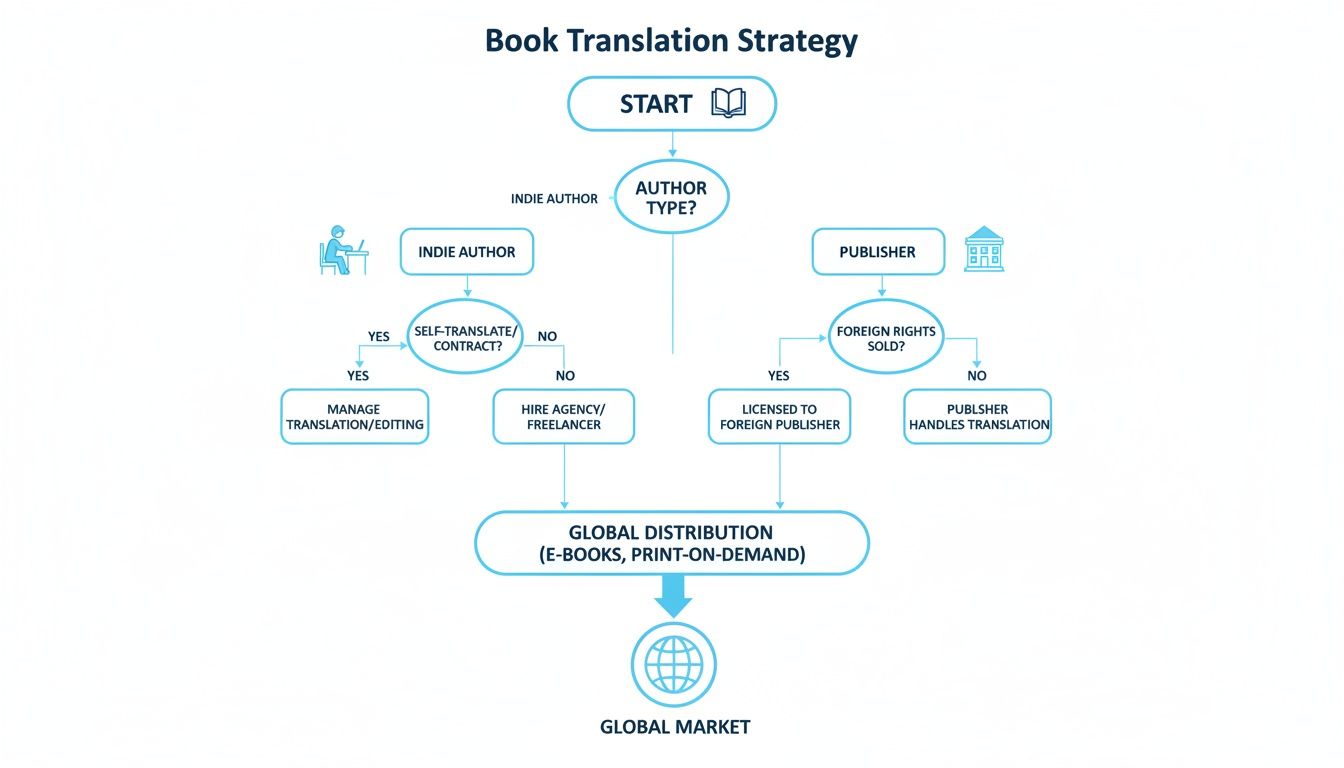
The strategy you choose can unlock a global audience. This decision tree shows how both indie authors and publishers can find their path to international distribution.
The market for translation is booming, largely thanks to these new technologies. The industry is projected to be worth over $70 billion by 2025, and AI has already helped slash translation costs by as much as 90% in some situations. This has made global publishing a realistic goal for more authors than ever.
If you're leaning toward an AI-first workflow, you might also consider using an AI humanizer tool as a final step. These tools are designed to refine machine-generated text, making it sound even more natural and engaging—a great way to get maximum quality from a modern workflow.
How to Preserve Your Book's Quality and Formatting
A great translation doesn't feel like a translation at all. It reads as if your book was born in that new language, flowing naturally from page to page. Anything less, and you risk a final product that feels clunky, flat, or just plain wrong—and that's a surefire way to lose a new audience before you've even had a chance to connect with them.
So, how do you make sure your book’s soul doesn’t get lost in translation? It really comes down to protecting three key areas: your voice, the cultural context, and the book's physical layout.
Preserving Your Unique Authorial Voice
Your voice is your literary DNA. It's the unique rhythm, tone, and word choice that makes your writing yours. A lazy, literal translation can completely steamroll that personality, leaving behind a bland, soulless text.
Think about a thriller with a witty, sarcastic narrator. If you translate that word-for-word into Japanese, that character might just come across as rude or nonsensical, killing the humor you worked so hard to create. This is where truly expert book translation services shine. They don't just translate words; they find stylistic equivalents to make sure your narrator’s charm hits home with readers in a completely different culture.
It’s all about capturing the feeling of your prose, not just the dictionary definition.
Adapting Cultural Nuances and Idioms
Languages are packed with idioms, inside jokes, and cultural shortcuts that simply don't have a direct equivalent elsewhere. Trying to literally translate a phrase like "spill the beans" or "break a leg" would just confuse readers.
A smart translation process uses what we call transcreation. Instead of a direct swap, the translator recreates the intent of the phrase with something that feels natural in the target language. For instance, the English saying "it's raining cats and dogs" might become "il pleut des cordes" (it's raining ropes) in French. Both paint a picture of a heavy downpour, but each does it in a way that’s instantly familiar to a native speaker.
A translation that is concerned only with literal accuracy and not with literary vitality would be a diminishment of its source. The goal is to produce a work of literature that reads with the same ease and nimbleness as the original.
Without this thoughtful adaptation, your book can feel awkward and alienating. You end up building a wall instead of a bridge to your new readers.
Maintaining Layout and Formatting Integrity
For most authors today, especially in the world of ebooks, the visual presentation is just as critical as the words themselves. The way you’ve structured your chapters, used italics for emphasis, or designed your headings is all part of the intended reading experience, particularly in formats like EPUB.
A clumsy translation workflow can absolutely destroy that structure, leaving you with a digital mess of broken paragraphs and scrambled chapters. Fortunately, modern tools are built to handle this. They can intelligently deconstruct an EPUB file, translate the text within its coded structure, and then perfectly reassemble it—all without messing up your formatting.
This technical precision means you get back a translated ebook that mirrors the professional layout of your original. It’s ready to publish right away, saving you countless hours of tedious manual fixes. If you're dealing with particularly complex layouts, this guide to translating Chinese PDFs with accurate OCR and layout offers some great insights.
Ultimately, keeping your ebook’s structure intact is non-negotiable. To get a better handle on the nuts and bolts of it, check out our in-depth EPUB translation guide on preserving format and style. It's the best way to ensure readers in any language get the seamless experience you designed for them.
Understanding Book Translation Costs and Value
Let's pull back the curtain on what it actually costs to translate a book. For many authors, the price tag feels like a complete mystery, making it hard to know if they're making a smart investment. Once you understand the different ways services are priced, you can budget effectively and see the incredible value that modern tools bring to the table.
Traditionally, professional literary translators charge by the word. This rate can be all over the map—from a few cents to over twenty cents per word, swinging wildly based on the translator's experience, reputation, and the complexity of the languages involved.
Think about it: for a standard 80,000-word novel, even a mid-range rate of $0.10 per word lands you with an $8,000 bill. For most independent authors, that's a non-starter.
New Pricing Models for a New Era
This is where technology has completely flipped the script. AI-driven platforms have introduced a model that makes sense for today's authors: pay-per-book.
Instead of getting nickel-and-dimed for every word, you pay a simple flat fee based on your book's total word count. For example, a service like BookTranslator.ai has plans that start at just $5.99 per 100,000 words. This approach offers two massive wins for authors:
- Clarity: You know the final cost from the very beginning. No surprises, no hidden fees.
- Accessibility: The price is a tiny fraction of what you'd pay for a traditional translation, making a global launch a real possibility for pretty much any writer.
This shift isn't just about saving money; it's about leveling the playing field and opening up the global market to authors who were previously locked out.
Factors That Influence Translation Costs
No matter which route you take, a few key things will always affect the final price. Knowing what they are will help you make sense of quotes and plan your project.
- Language Pair: It's a simple matter of supply and demand. Translating between common languages like English and Spanish is cheaper because there's a huge amount of linguistic data and talent available. Going from Icelandic to Japanese? That's a much more specialized, and therefore expensive, task.
- Turnaround Time: Need it yesterday? Expect to pay for it. Traditional services will add a hefty surcharge for a rush job. AI services, on the other hand, deliver incredible speed as a standard part of the package.
- Genre Complexity: Translating a dense academic paper or a poetic novel filled with clever wordplay is a much taller order than a straightforward how-to guide. For human-led projects, that specialized skill set comes at a premium.
"A translation that is concerned only with literal accuracy and not with literary vitality would be a diminishment of its source. The goal is to produce a work of literature that reads with the same ease and nimbleness as the original."
This really gets to the heart of it. Value isn't just about the lowest price—it's about getting a finished book that feels as alive and authentic as the one you wrote. The exciting part is that modern AI-powered services can now deliver that vitality at a cost that actually makes sense.
And the demand is definitely there. The global literary translation market, which is the engine behind all book translation services, was valued at USD 4.12 billion and is expected to soar to USD 7.11 billion by 2033. This isn't just a niche market; it's a massive, growing appetite for stories from around the world. You can explore the full literary translation market analysis to see the data for yourself.
By understanding both the costs and the enormous opportunity, you can choose a path that gets your story in front of a global audience without emptying your bank account.
A Step-By-Step Guide to Translating Your Book
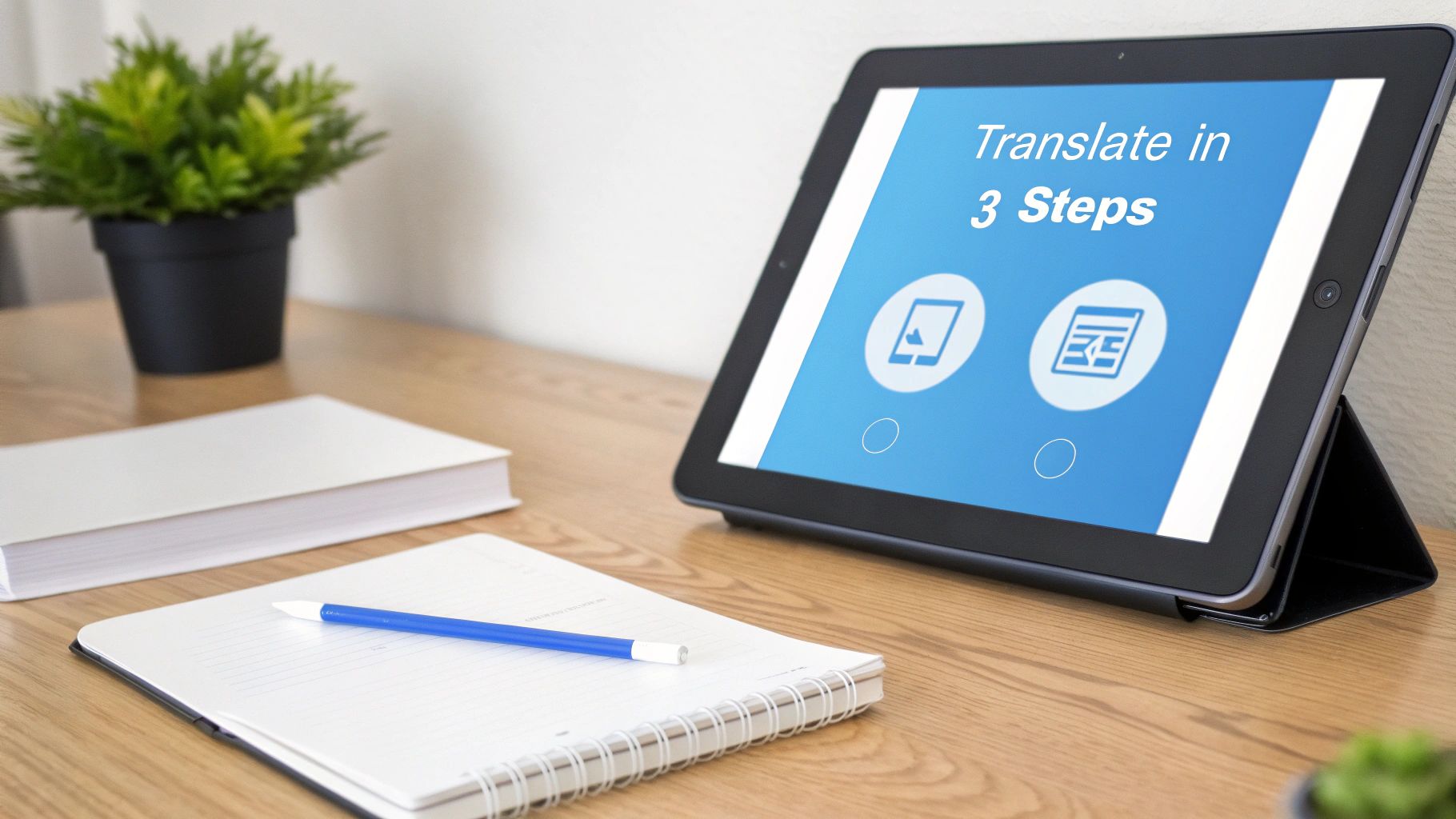
So, you're ready to take your book global. The good news is that the process isn't nearly as complicated as it used to be. Gone are the days of endless back-and-forth with traditional agencies. The best modern book translation services have boiled it all down to a simple, three-step workflow: upload, translate, and download.
This guide will walk you through that exact process. We'll start with prepping your manuscript and end with you holding a ready-to-publish file for a new international market. It’s a lot more straightforward than you might think.
Step 1: Get Your Manuscript Ready
A little prep work on the front end makes a huge difference. Think of it this way: the cleaner your original file, the smoother the translation process will be. Run one last spellcheck and make sure all your formatting—chapter breaks, headings, italics—is consistent and correctly applied.
While today's translation AI is incredibly powerful, it's not a mind reader. A final proofread of your manuscript is the single best thing you can do to ensure a high-quality result. The gold standard for most ebook translation platforms is the EPUB format, so converting your book to this file type is a crucial first step.
Step 2: Choose Your Service and Start the Translation
With your polished manuscript in hand, it's time to pick your translation partner. You'll want to find a platform that actually specializes in books, not just general documents. They’ll understand the nuances of preserving your layout and, most importantly, your authorial voice.
Here’s a quick checklist for making your choice:
- File Format Support: Does the service work directly with EPUB files? This is non-negotiable for protecting your formatting.
- Clear Pricing: Can you get a clear, upfront cost? Look for a flat fee per book or a simple per-word rate. No surprises.
- Language Options: Does it offer the specific languages your new readers speak?
- Simplicity: Is the platform easy to navigate? The process should feel as simple as uploading a file and clicking a button.
Once you’ve found a service that fits, like BookTranslator.ai, the rest is easy. You’ll just upload your EPUB, pick your target language, and hit "go." The platform's tech takes over from there, translating the text while carefully preserving the original structure of your book.
"I had a duty not just to retain the specificity of the language on the page but also to produce a work of literature that read with the same ease, nimbleness, and vitality as the original."
Step 3: Review and Publish Your New Edition
This is the exciting part. Instead of waiting months, modern services can turn around an entire novel in just minutes or hours. You’ll receive a brand-new EPUB file, fully translated into your chosen language.
Your final job is to give it a read-through. Check that the flow feels right and that key passages land with the emotional impact you intended. Once you're happy with it, your book is officially ready for distribution on global platforms like Amazon KDP. Just like that, you've opened your story to a whole new world of readers.
Your Top Questions About Book Translation, Answered
If you're looking into book translation for the first time, you probably have a lot of questions running through your mind. That's completely normal. Let's walk through some of the most common ones we hear from authors and publishers to give you the clarity you need to move forward.
How Good Is AI Translation Compared to a Human?
Today’s AI, especially the advanced neural networks, can be stunningly accurate. It’s gotten very good at understanding context, grammar, and even stylistic elements, which means it can produce translations that read smoothly.
While you’d still want a human translator for something like complex literary fiction or poetry where every word is freighted with cultural nuance, AI provides near-human quality for a tiny fraction of the cost and time. This makes it an incredibly practical option for most writers.
It really shines in genres like:
- Science Fiction and Fantasy
- Romance and Thrillers
- Non-Fiction and Self-Help Guides
- Academic and Research Texts
For these types of books, a good AI-powered book translation service can deliver a seamless reading experience that truly keeps your original voice intact.
Will I Lose My Book's Formatting in the Process?
That’s a big—and very valid—concern. The good news is that the best services are built to prevent this exact problem. Unlike a simple copy-paste text translator, specialized ebook translators are designed from the ground up to work with complex files like EPUB.
When you use a service built specifically for books, you aren't just translating words; you're preserving the entire reading experience. The technology is smart enough to ensure your original layout—chapters, headings, bold text, and paragraph breaks—is perfectly mirrored in the translated file.
This means you get back a book that's ready to publish and looks just like the original. It’s a huge plus that saves you from hours of painful manual reformatting.
What Kinds of Books Are the Best Fit for Translation?
Any book with universal themes is a fantastic candidate for a global audience. Genres that dig into relatable human experiences tend to do exceptionally well because their appeal isn't limited by cultural borders.
Think about sci-fi, fantasy, romance, and thrillers—their stories often tap into fundamental emotions and narrative arcs that resonate everywhere. On the other end of the spectrum, self-help and academic books are also perfect, as they offer practical knowledge that people all over the world are actively searching for. If your story connects with readers on an emotional level or gives them useful information, there's an audience waiting for it in another language.
Who Owns the Copyright to the Translated Book?
You do. Period. When you, the author or publisher, pay for a translation, you retain 100% of the copyright to that new version. Legally, it's considered a "derivative work" based on your original intellectual property.
Working with a professional book translation service doesn't change your ownership at all. The translated book is yours to market, distribute, and sell however you wish, just like your original manuscript.
Ready to share your story with readers around the world? BookTranslator.ai provides a fast, affordable, and high-quality solution that protects your authorial voice and your book's formatting. Translate your book today.