
AI Translation for Families: Sharing Books Across Generations
Language barriers can make it hard for families to share meaningful moments, especially through books. Many grandparents prefer reading in their native language, while younger generations often stick to English. This gap can limit shared experiences, like discussing a favorite novel or passing down family stories.
Manual translations are slow, expensive, and often impractical for families. Free tools frequently fail to capture the tone, meaning, or formatting of books, leaving much to be desired.
Enter AI translation. Tools like BookTranslator.ai make it easy to translate entire books quickly and affordably, retaining the original style and structure. With support for over 99 languages, families can now enjoy the same stories in their preferred languages, creating opportunities for deeper connections across generations.
Key Points:
- Problem: Language barriers disrupt family bonding over books, especially in multilingual households.
- Traditional Solutions Fall Short: Manual translations are costly and slow; generic tools lack accuracy and formatting.
- Solution: AI-powered platforms like BookTranslator.ai translate books in hours, preserving style, tone, and layout.
- Cost: Starting at $5.99 for 100,000 words, it's an affordable option for families.
Sharing stories across languages is no longer a challenge. AI translation bridges the gap, letting families connect through books in ways that were once impossible.
I Used AI to Translate My Grandfather's WWII Letters
sbb-itb-0c0385d
Language Barriers Between Generations
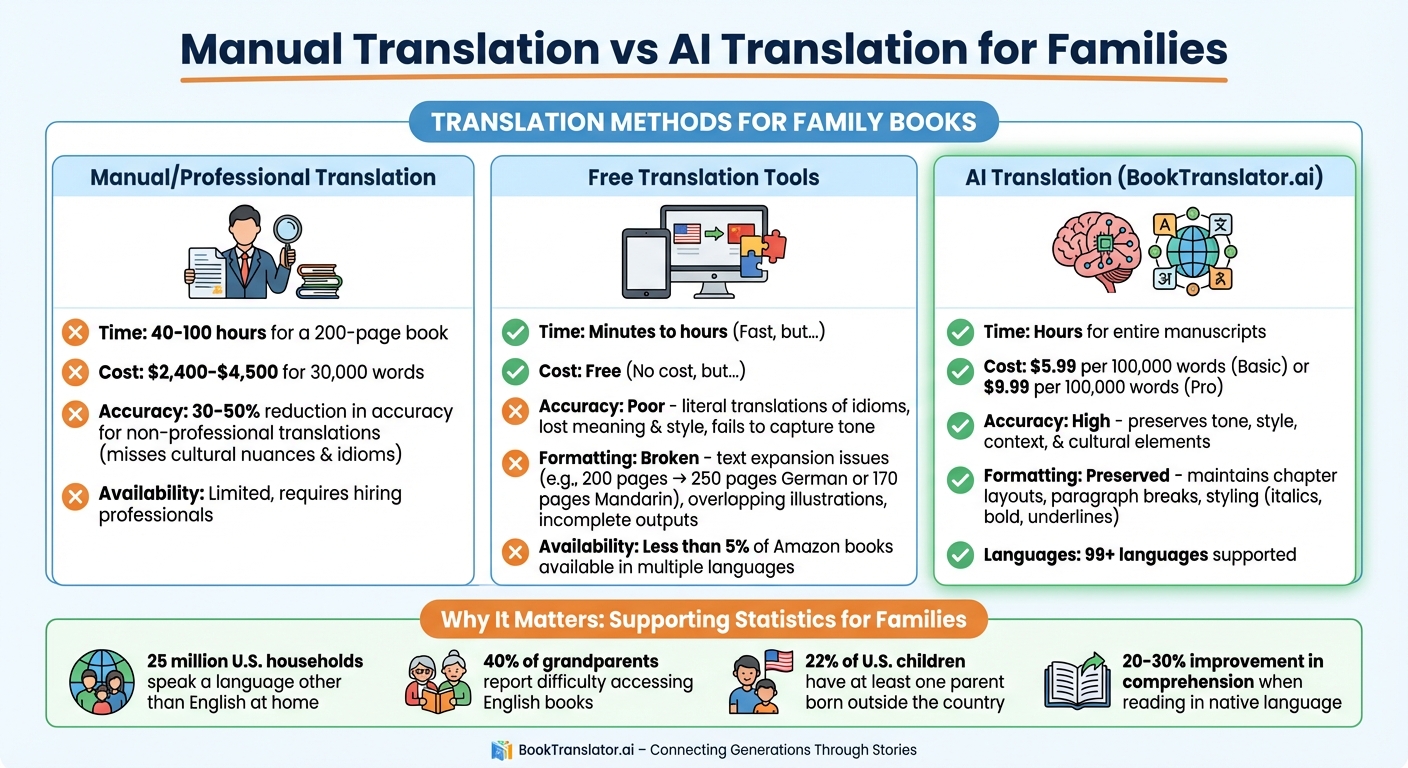
Manual Translation vs AI Translation: Cost, Time, and Accuracy Comparison
In the United States, 25 million households speak a language other than English at home [3][5]. This creates unique challenges for families, especially when generations attempt to connect through shared activities like reading. Imagine a Korean grandmother struggling to understand her granddaughter’s favorite bestseller or a Polish grandfather unable to participate in bedtime stories. For many immigrant families, this is a daily reality - 40% of grandparents report difficulty accessing English books [3][5], often leaving them out of cherished reading moments.
These language barriers don’t just disrupt reading - they cut bonding opportunities in half [3][6]. Grandparents are left on the sidelines, while children miss the chance to hear family stories or heritage tales in their native language. With 22% of U.S. children having at least one parent born outside the country [3][5], millions of families face the challenge of maintaining strong intergenerational connections.
This highlights why reading in one’s native language is more than a convenience - it’s a way to preserve emotional ties and cultural identity.
Why Native Language Reading Matters
Reading in a native language does more than make the words easier to understand - it deepens emotional connections. For older generations, their first language is tied to memories, a sense of identity, and even comfort [3][6]. For example, when a grandmother reads an Italian folktale in Italian, the experience feels more genuine and meaningful than a translated version ever could.
Studies show that reading in one’s native language improves comprehension by 20–30% for non-native speakers [3][4]. This reduces the mental strain of decoding text, which is especially beneficial for older adults who may face cognitive challenges. Beyond comprehension, native language reading helps preserve traditions, idioms, and cultural values. For instance, Indian-American families sharing Hindi epics like the Ramayana in their original form not only pass down stories but also reinforce family customs and a shared sense of heritage [2][6].
Why Manual Translation Doesn't Work
Some families attempt to bridge the gap by manually translating books, but this often proves impractical. Translating a single 200-page book can take 40–100 hours [2], time that could otherwise be spent together as a family.
Professional translation services aren’t much better. At rates of $2,400 to $4,500 for a 30,000-word book [2], they’re out of reach for most families, especially when the median U.S. household income hovers around $75,000 per year. Even when families try to handle translations themselves, the results often fall short. Non-professional translations miss important cultural nuances and idiomatic expressions, reducing accuracy by 30–50% [2][4]. For instance, a literal translation of the phrase "kick the bucket" fails to convey its meaning of "to die" [2][4].
The time, cost, and inaccuracies of manual translation make it an unreliable solution for families looking to share stories across generations. This underscores the need for accessible ways to connect through reading in one’s native language.
Problems with Standard Translation Tools
Free translation tools often fall short when it comes to translating books. Shockingly, fewer than 5% of book titles on Amazon.com are available in more than one language [9]. This leaves families dependent on generic tools that strip away the nuances and richness that make reading special. These tools introduce two major problems: lost meaning and disrupted formatting.
Lost Meaning and Style
Standard translation tools focus on converting words but fail to capture the deeper meaning, tone, or style of the original text. For families sharing literature across generations, maintaining the author’s voice is critical. Unfortunately, generic tools often translate idioms literally, turning colorful expressions into baffling phrases. As educators Heejung An, Holly Seplocha, and Woonhee Sung point out, "Currently, ChatGPT is limited in its ability to fully understand the depth of cultural contexts and societal nuances as well as idiomatic expressions" [7]. For instance, an idiom like "it's raining cats and dogs" might be translated word-for-word, leaving readers scratching their heads [10,12].
Errors don’t stop at idioms. Some AI models misinterpret numerals, symbols, or even skip over details they deem unimportant - removing sentences that are vital to the story’s flow and meaning.
Broken Formatting
Translation tools don’t just distort meaning; they can also wreak havoc on a book’s layout. Translated text often grows or shrinks unpredictably. For example, a 200-page English book could balloon into 250 pages in German or shrink to 170 pages in Mandarin [8]. These changes can result in text spilling off pages, overlapping with illustrations, or leaving awkward gaps of white space.
On top of that, basic translation apps struggle with handling entire EPUB or PDF files, often producing incomplete or empty outputs. Formatting details like date styles, time notations (a.m./p.m. versus 24-hour clocks), and page numbers can also be botched in the process [7]. For families eager to share a treasured book with a loved one, these technical issues can turn a heartfelt gesture into a frustrating ordeal.
BookTranslator.ai: AI-Powered Book Translation for Families
BookTranslator.ai tackles the unique challenges families face when sharing books across generations. Unlike generic translation tools, the platform uses advanced Neural Machine Translation (NMT) to capture context, stylistic details, and natural dialogue. This approach ensures the translation resonates with native readers while maintaining the narrative tone and subtle cultural elements that make family stories special. The result? Every family member can enjoy the book as if it were originally written in their language, keeping shared traditions and memories alive on every page.
The platform also includes a specialized formatting engine that preserves the original structure of the book. Chapter layouts, paragraph breaks, and text styling - like italics, bold, and underlines - are all retained. Uploading files is easy with a drag-and-drop interface, and your translated book is ready in just hours. Families can also use the glossary feature to customize translations, ensuring key terms like character names, family-specific phrases, or culturally significant locations stay consistent throughout the text.
Features and Benefits
BookTranslator.ai bridges language gaps in over 99 languages, making it possible for every family member to enjoy books in their native language. At just $5.99 for a 100,000-word manuscript, it offers professional-quality translations at a price accessible to families. Plus, users retain full copyright ownership of the translated work, treating it as a derivative of the original intellectual property.
The platform also includes a side-by-side editor, allowing families to review and refine translations together. This is especially helpful for fine-tuning cultural expressions while staying true to the author’s voice. By using validated EPUB files, the platform ensures the structure and formatting of the original book are preserved.
Pricing Plans
BookTranslator.ai offers two straightforward pricing tiers to suit different needs:
| Plan | Price | AI Model | Best For |
|---|---|---|---|
| Basic | $5.99 per 100,000 words | Standard AI | General-purpose books, non-fiction, family memoirs |
| Pro | $9.99 per 100,000 words | Advanced AI (GPT-4, DeepL Pro) | Fiction with complex emotions, literary works, poetry |
Both plans deliver fast turnaround times, translating entire manuscripts in hours instead of the weeks or months required for human translators. The Pro plan is ideal for books that demand a higher level of nuance, such as novels with intricate storytelling or deeply emotional content. It’s perfect for sharing cherished stories with grandparents or other family members who want to experience every layer of the original narrative.
How AI Translation Brings Families Together
AI translation is reshaping how families connect, especially through storytelling. By preserving the essence of language and culture, it creates opportunities for shared experiences across generations.
Creating Shared Experiences Across Generations
Reading in one’s native language strengthens cultural bonds and fosters deeper understanding. Platforms like BookTranslator.ai are transforming family relationships by allowing members to enjoy the same book in their preferred languages. Imagine a grandmother and granddaughter reading the same novel - one in her native tongue, the other in hers. The platform ensures the narrative voice and emotional depth remain intact, making the experience feel authentic and shared.
"BookTranslator.ai started as a personal project with a heartfelt purpose - I wanted my parents to enjoy the latest books without waiting for official translations in their native language." - Ainars, Creator of BookTranslator.ai [10]
This quote highlights a common desire: families want to share stories without waiting for years-long official translations. With rapid translation capabilities, the platform makes it possible to enjoy trending books, new releases, or even timeless classics together almost instantly. This immediate access fosters meaningful discussions about the stories, bridging language gaps in real time.
Such advancements open the door to practical and emotional benefits for families.
Family Use Cases
One standout use is translating children’s books. Parents can take cherished childhood stories and convert them into their parents' native language. This allows grandparents to read these tales aloud to grandchildren, creating an intimate and educational experience. Since children’s books often feature simple language and universal themes, they translate seamlessly. Plus, the platform preserves the original formatting, including illustrations and layouts, ensuring the stories remain visually engaging for young readers [12][13].
Another impactful use is bringing family history to life. By translating old letters, diaries, and family records, families can create rich narratives that offer a glimpse into the lives of their ancestors. These translations help connect the dots between historical dates and personal stories, deepening familial ties across generations. However, when working with historical documents, it’s crucial to cross-check AI translations with trusted sources to ensure accuracy, particularly for names and dates [1][11].
AI translation is proving to be a powerful tool for connecting families through both literature and history, enriching relationships in ways that transcend language barriers.
Conclusion
Sharing stories across languages within a family has never been simpler. Language barriers no longer stand in the way of enjoying beloved books together. With BookTranslator.ai, grandparents, parents, and children can read the same stories in their preferred languages, all without waiting weeks for translations. The platform ensures each story retains its essence across more than 99 supported languages.
"The best way for readers to read your book is in their preferred language. This is their first language: what they grew up speaking, and what they are most comfortable reading in." - Leanpub [14]
This tool tackles the challenge of maintaining family bonds through shared stories. Its affordable pricing and lightning-fast turnaround - delivering translations in just hours - make it an excellent choice for everyday use. Whether it's translating children's books for grandparents, sharing the latest novels with relatives abroad, or reviving old family documents, BookTranslator.ai ensures professional-quality translations in no time.
Want to bring your family closer through shared reading? BookTranslator.ai makes it easy. Just upload your EPUB file, pick the target language, and let the AI do the rest. Reconnect with your loved ones through the power of language and storytelling.
FAQs
Will my book’s layout stay the same after translation?
Yes, AI tools like BookTranslator.ai excel at preserving your book's layout with impressive accuracy. This means the formatting, images, and overall structure remain intact during the translation process, ensuring the final version mirrors the original.
Can AI translation keep names and family phrases consistent?
Tools like BookTranslator.ai are great at maintaining consistency when it comes to names and family-specific phrases. They analyze style and key elements to keep translations aligned. That said, some subtler nuances - like those tied to specific traditions or context - might still need a human touch to ensure everything feels accurate and natural.
Is it safe to upload private family documents for translation?
When deciding whether to upload private family documents for translation, it's crucial to consider the platform's privacy policies. Take the time to thoroughly review these policies to confirm how your data will be handled and safeguarded. Be especially careful with personal or sensitive materials to avoid potential risks.