
AI Tools for Workflow Coordination in Translation
Translation workflows often face delays and high costs due to manual coordination. AI tools are transforming these processes by automating up to 90% of routine tasks, reducing localization costs by 40%, and accelerating time-to-market by 5x. These tools integrate scheduling, resource management, and quality control, freeing up human experts to focus on complex decisions.
Key Benefits:
- Project Management: AI assigns tasks, predicts timelines, and identifies bottlenecks using real-time data. Tools like T-Rank™ streamline operations by analyzing translator performance and availability.
- Improved Quality: Automated quality checks reduce errors to 2.5 per 1,000 words, with AI systems learning from human corrections to achieve over 95% accuracy.
- Cost and Time Savings: Businesses report an 80% reduction in manual work, with translation memory reuse rates of 95%.
One standout platform, BookTranslator.ai, is designed for literary translation. It delivers high-quality translations in as little as six hours while preserving formatting and ensuring consistency in themes and style. For example, a publisher reduced translation costs by 90% using this tool, achieving a 98% accuracy rate.
AI is reshaping translation workflows, making them faster, more efficient, and cost-effective.
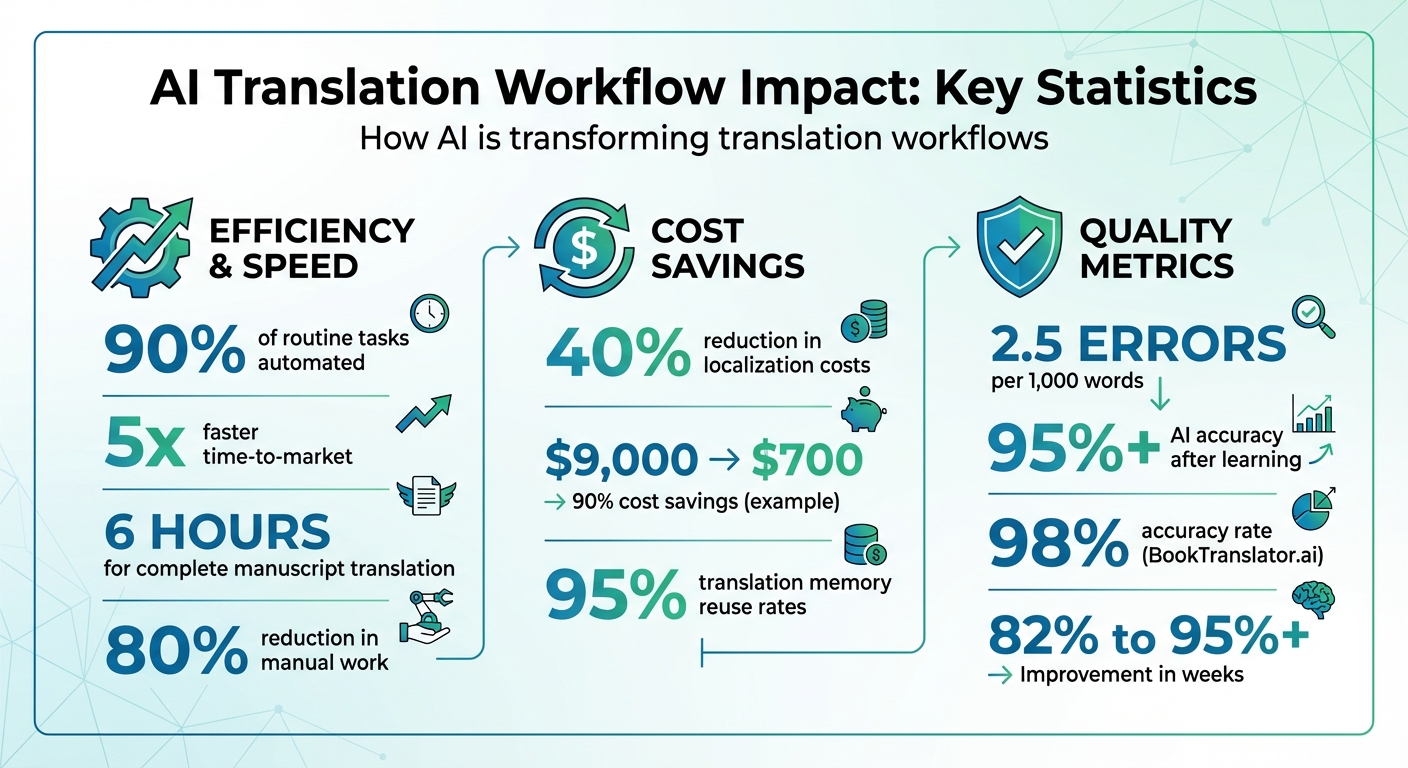
AI Translation Workflow Statistics: Cost Savings, Speed, and Accuracy Improvements
Benefits of AI for Translation Workflow Coordination
Better Project Management
AI streamlines project management by automating key tasks like assigning work and predicting timelines. Tools such as T-Rank™ analyze over 30 factors - like a translator’s past performance and current availability - to instantly match the right professional to each project [3]. Predictive analytics take it a step further by using historical data to forecast timelines and pinpoint potential bottlenecks before they disrupt progress [1] [3]. Managers can then proactively reallocate resources to keep everything on track.
Real-time dashboards also provide live updates on project status, helping teams address delays before they escalate.
"The role of the project manager is transforming from a manual coordinator to a strategic leader."
- Bianca Soellner, Marketing Manager, Translated [2]
These advancements not only improve workflow efficiency but also set the stage for more accurate translations.
Higher Translation Quality
AI doesn’t just make processes smoother - it also boosts the quality of translations. Automated tools perform quality checks throughout the workflow, flagging issues like inconsistent terminology, style guide errors, and grammar mistakes in real time. AI systems now achieve error rates of roughly 2.5 per 1,000 words, rivaling the accuracy of top-tier human translators [7]. Plus, these systems continually learn from human corrections, improving their initial accuracy from 82% to over 95% in just a few weeks [6].
These quality enhancements don’t just improve the end product; they also drive measurable savings in both time and costs.
Reduced Time and Costs
AI-powered workflows can slash localization costs by 40% and speed up time-to-market by as much as fivefold [4] [5]. By automating repetitive tasks and maximizing the use of translation memory, businesses have reported an 80% reduction in manual work, with translation memory reuse rates climbing to 95% in optimized operations [5].
Elisabeth Feulner, Project Manager at Allround Service, highlights the impact:
"Since implementing XTM Cloud, the volume of translated words for our most frequent language pairs has increased by approximately 10%" [5]
AI-driven continuous localization pipelines also allow businesses to translate content as it’s created, enabling faster entry into new markets and giving them a competitive edge.
sbb-itb-0c0385d
BookTranslator.ai: Book Translation Workflow Management

One-Click Book Translation
BookTranslator.ai can transform entire manuscripts in as little as six hours, thanks to its AI Literary Blueprint. This system maps out themes, character arcs, and writing style to ensure consistency throughout the translation - offering a speed and efficiency far beyond traditional methods [8].
In December 2025, Susan Curtis, a seasoned publisher at Istros Books with 14 years of experience, used BookTranslator.ai to translate a Bosnian novel. The platform reduced her translation expenses from about $9,000 to just $700 - a cost savings of over 90% [8]. Reflecting on the process, Curtis shared:
"Within twenty minutes I was presented with a translation that was fluent and nuanced, a quality translation which if I had been sent as a first draft of a completed translation by one of the translators I work with, I would have been pleased." [8]
The platform’s Iterative 5-Pass Refinement system ensures results that are nearly publication-ready, achieving an impressive 98% accuracy rate [8].
Preserves Meaning, Style, and Formatting
BookTranslator.ai doesn’t just translate quickly - it also prioritizes literary integrity. Its Threadweaver engine conducts a comprehensive review of the entire manuscript, ensuring consistency in key terms, character voices, and thematic elements [8]. The Finalizer tool flags potential issues like mistranslations, omissions, and factual inaccuracies, while the Naturalizer polishes the text to make it read as if it were originally written in the target language [8].
The platform's Formatting Preservation Engine is another standout feature. It processes EPUB and DOCX files, retaining chapter structures, text styling (like italics and bold), and even layout details like images and tables. Users can also upload a Smart Glossary, which allows them to define specific translations for names, places, or technical terms, ensuring uniformity throughout the book [8].
In 2026, a blind literary test conducted by Gemini 2.5 Pro compared BookTranslator.ai’s English translation of Dazai's No Longer Human to a well-regarded human translation. The AI-generated version was found to excel in tone, structure, and narrative fidelity [8].
99+ Language Support
With support for over 99 languages, BookTranslator.ai empowers publishers to reach audiences worldwide without juggling multiple translation vendors [8]. Its parallel AI architecture can process manuscripts in different languages at the same time, all while maintaining consistently high quality [8].
The platform’s AI Editorial Council - a collaborative system featuring advanced models like Gemini, Claude, and GPT-4o - debates stylistic choices to refine the prose further [9]. Additionally, project owners can invite team members to review AI-generated translations using the Context Viewer, which displays the original and translated texts side by side for easy comparison [9].
Pricing begins at $390 per manuscript with a pay-per-book model. Standard rates are $5.99 per 100,000 words for the Basic tier and $9.99 per 100,000 words for the Pro tier [8].
This all-in-one platform equips publishers with the tools they need to handle complex translation projects effortlessly.
AI Tools for Translation Workflow Coordination Compared
Feature Comparison Table
BookTranslator.ai takes translation workflow coordination to a new level, especially for literary projects. Its tools are tailored to streamline the entire process, from uploading a manuscript to delivering a publication-ready translation with impressive speed and accuracy.
One standout feature is the AI Literary Blueprint, which analyzes themes, character arcs, and writing style to ensure consistency throughout the manuscript. Thanks to this, complete translations can be ready in as little as six hours [8]. The Threadweaver engine reviews manuscripts to maintain uniformity in key terms, character voices, and thematic elements [8]. On top of that, the Finalizer tool flags potential errors like mistranslations, omissions, and inaccuracies [8].
Formatting is another area where BookTranslator.ai excels. Its Formatting Preservation Engine works with EPUB and DOCX files, keeping chapter structures, text styling, and even layout elements like images and tables intact [8]. Users can also upload a Smart Glossary to define specific translations for names, places, or technical terms, ensuring consistency across the entire text [8]. For a polished result, the Naturalizer fine-tunes the translation so it feels as though it was originally written in the target language [8].
The platform’s parallel AI system processes manuscripts in multiple languages simultaneously, maintaining high quality across its 99+ supported languages [8]. Additionally, the AI Editorial Council - which employs advanced models like Gemini, Claude, and GPT-4o - deliberates over stylistic choices to refine the prose [9]. For collaborative projects, the Context Viewer allows team members to review translations alongside the original text, making adjustments more seamless [9].
| Feature | BookTranslator.ai Capabilities |
|---|---|
| Specialization | Literary translation with advanced workflow coordination |
| Language Coverage | 99+ languages with parallel processing |
| AI Technology | AI Literary Blueprint, Threadweaver, Finalizer, Naturalizer |
| Quality Assurance | Iterative 5-Pass Refinement system (98% accuracy) |
| Format Support | EPUB and DOCX with complete formatting preservation |
| Collaboration Tools | Context Viewer for side-by-side review, team invitations |
| Customization | Smart Glossary for terminology control |
| Processing Speed | Complete manuscripts in as little as 6 hours |
| Pricing Model | $5.99/100,000 words (Basic), $9.99/100,000 words (Pro) |
BookTranslator.ai is purpose-built for publishers and authors handling long-form manuscripts. Its combination of one-click translation, meticulous formatting preservation, and thorough quality control makes it a go-to solution for modern literary translation workflows.
Automation in Translation Management Systems
Choosing the Right AI Tool for Translation Workflows
When it comes to translating literary works like novels or memoirs, BookTranslator.ai offers specialized features tailored for these intricate projects. Its AI Literary Blueprint maps out themes and character arcs, while the Threadweaver engine ensures consistent character voices and preserves recurring metaphors throughout the text.
Accuracy is another cornerstone of quality translations. For any AI translation tool, a multi-pass refinement process is essential. BookTranslator.ai employs a 5-Pass Refinement system, designed to enhance grammar, fluency, and tone through iterative improvements. This process achieves an impressive 98% accuracy rate, closely mirroring how human translators refine their work over multiple revisions [9][10]. Additionally, its Context Viewer allows you to review translations alongside the original text, making it easier to spot errors that might be overlooked when reviewing isolated sections [9].
For book translations, maintaining the original formatting is crucial. BookTranslator.ai excels here with its Formatting Preservation Engine, which seamlessly handles EPUB and DOCX files. It preserves chapter structures, text styling, and even complex elements like tables and images. This feature ensures that the final output retains the integrity of the original work. Plus, its pay-as-you-go model is particularly appealing for authors and publishers who need translation services on an occasional basis.
Modern workflows also emphasize intelligent orchestration, where AI enhances rather than replaces human expertise. As Daniele Patrioli, VP of Marketing at Translated, aptly states:
"The future of localization is not just translated; it is intelligently orchestrated" [1]
For literary translation, this orchestration starts with selecting a tool specifically designed to navigate the nuances of long-form narratives. By combining precision, consistency, and adaptability, tools like BookTranslator.ai redefine what’s possible in literary translation.
FAQs
What tasks can AI automate in a translation workflow?
AI takes on tasks like project management, scheduling, and resource allocation by analyzing historical data to forecast timelines and potential bottlenecks. It also simplifies administrative duties, such as monitoring progress and managing glossaries. On top of that, AI-driven translation tools make the translation process smoother. They deliver accurate, context-sensitive results across various languages while preserving style and formatting. This not only speeds up workflows but also ensures consistency and scalability.
How do I verify AI translation quality before publishing?
To ensure the quality of AI translations before publishing, leverage tools that check for accuracy, consistency, and cultural fit. AI-powered workflow tools can help analyze the translation process, spot potential errors, and improve quality control. By combining automated validation with a multi-step refinement process - such as iterative AI reviews - you can achieve precise translations with strong stylistic alignment. For the most reliable results, always include a human review as the final step before publishing.
How do I keep book formatting intact when translating EPUB or DOCX files?
To keep formatting intact when translating EPUB or DOCX files, it's important to use AI translation tools built specifically for preserving layouts and design elements. BookTranslator.ai is a great example - it handles layouts, images, tables, and metadata while delivering fast and precise translations. This tool retains the original structure, style, and formatting, making it especially useful for translating long-form content like books. Opt for tools like this to ensure the final product maintains a consistent and professional appearance.