
Using AI Spanish translation can instantly connect your book with over 500 million potential readers across the Spanish-speaking world. For authors, this technology represents a fast, affordable, and surprisingly high-quality path to global markets, breaking down the old barriers of high costs and long waits that came with traditional translation services.
Why AI Spanish Translation Unlocks New Readers
Just imagine your story finding a home with a massive new audience, from readers in Madrid to fans in Mexico City. For most independent authors, this was once just a dream, completely blocked by the staggering costs and slow timelines of conventional translation agencies. Now, it's a realistic and powerful strategy for growing your author brand.
The Spanish-speaking market isn't just big; it's one of the largest literary markets on the planet. Tapping into it means much more than just a bump in sales. It's about building a more diverse readership and seeing your creative work find new life in a different culture.
A Game-Changer for Independent Authors
AI-powered platforms like BookTranslator.ai are completely changing the game. They give indie authors direct access to sophisticated tools that, until recently, were only available to big publishing houses. Instead of shelling out thousands of dollars and waiting months for a translation, you can get a professionally formatted, translated EPUB in minutes—all for a tiny fraction of the cost.
This new level of accessibility completely alters the financial calculus of self-publishing. An investment of under $10 for a full-length novel can open up revenue streams that were previously out of reach. This isn't just about finding a technological shortcut; it's a smart business decision that lets you scale your reach without breaking the bank.
The real power of AI translation lies in empowerment. It puts authors back in the driver's seat, letting them make strategic moves into new markets without needing a huge budget or insider connections.
Preserving Your Unique Authorial Voice
I get it—a common fear is whether a machine can truly capture the nuance and style of a human writer. It's a valid concern. But today's AI models are trained on vast literary datasets, which allows them to understand and replicate an author's voice with impressive accuracy. They're getting incredibly good at recognizing tone, pacing, and stylistic quirks, ensuring the translated version still feels like your book.
A great AI Spanish translation isn't about a sterile, word-for-word conversion. The goal is to transcreate your original intent for a new audience. The AI does the heavy lifting of the linguistic work, freeing you up to do a final review and add that essential human touch.
- Speed: You can translate an entire novel in about the time it takes to brew a pot of coffee.
- Cost-Effectiveness: It's possible to cut translation expenses by over 99% compared to traditional methods.
- Quality: These tools are built on advanced neural networks that grasp context, idioms, and literary style.
- Control: You keep full ownership of your work and manage the entire process on your own terms.
Ultimately, this technology can act as your professional partner. It removes the logistical headaches and financial friction, letting you focus on what really matters: sharing your story with as many people as possible. By embracing AI, you're not just translating words; you're building a bridge to a world of new readers eager to discover your work.
Prepping Your Book for a Flawless Spanish Translation
Long before you even think about hitting that "translate" button, the real work for a brilliant AI Spanish translation begins. The quality of your final Spanish book is a direct reflection of the quality of the file you start with. It's like cooking—you can't expect a gourmet meal from subpar ingredients. Your clean, well-structured manuscript is the star ingredient here.
A messy source file, loaded with unresolved track changes, sloppy formatting, or stray comments, is a recipe for disaster. It throws the AI for a loop, leading to translation errors, broken layouts, and a ton more cleanup work for you later on. Honestly, spending a little time prepping your book upfront is the single best thing you can do to make the whole process smoother.
This isn't just a hunch; it's becoming more critical as the technology gets smarter. The global AI translation market is booming—it was valued at around $2.34 billion in 2024 and is growing at an incredible 24.9% annually. As these tools evolve, they become more sophisticated but also more sensitive to the quality of the text they're given.
Start with a Pristine EPUB
Everything starts with the EPUB file. Forget Word docs or PDFs for this job. EPUBs are built for digital readers, and under the hood, they contain the clean HTML that AI translation engines love. It’s the industry standard for a reason.
If your book is still in another format, your first step is converting it to a clean EPUB. For indie authors, this is a core skill anyway. Think of it this way: prepping your book for translation goes hand-in-hand with the essentials of creating an ebook that looks professional and connects with readers.
The Pre-Upload Manuscript Checklist
Before you do anything else, go through your original manuscript with a fine-tooth comb. I have a personal "pre-flight" checklist I run through to catch the little things that can cause big headaches down the line.
- Kill All Comments and Track Changes: Go through and accept or reject every single tracked change. Then, delete all comments. Sometimes, the AI can get confused and interpret these as part of your actual story.
- Standardize Your Formatting: Make sure your chapter titles, headings, and paragraph styles are perfectly consistent. The best way to do this is with style presets (like "Heading 1" or "Body Text") instead of manually bolding text or changing font sizes.
- Check Names and Terms: Consistency is your best friend. Do a quick search to ensure every character name, fictional place, or unique term is spelled the exact same way every single time. An AI might treat "Sara" and "Sarah" as two different people, which can get confusing fast.
A clean manuscript is an act of respect for your own work. It tells the AI, "This is my story, exactly as I intended it," which allows the technology to replicate that intent faithfully in Spanish.
Tweak Any Ambiguous Language
AI models are powerful, but they can't read your mind. They perform best with clear, direct prose. It's worth doing one last read-through to spot any idioms, hyper-specific cultural references, or tangled sentences that won't translate well.
For instance, a phrase like "it's raining cats and dogs" would be translated literally, leaving a Spanish reader utterly bewildered. A simple change to "it's raining very hard" ensures the meaning lands perfectly. You don't have to sacrifice your authorial voice, but clearing up ambiguity now will save you from major post-editing migraines.
Once your EPUB is ready, I also recommend running it through a quick EPUB language compatibility checker. It’s a simple step that can help you catch any technical hiccups before you start the translation.
Choosing the Right AI Model for Your Genre
Picking the right engine for your AI Spanish translation isn't about finding the single "best" one. It's about finding the right one for your book. AI models today have their own distinct strengths—think of it like choosing a different paintbrush for fine details versus a broad wash of color. A fast-paced thriller with snappy dialogue has completely different linguistic needs than a dense literary novel swimming in metaphor.
This decision will directly shape how good that first translated draft is and, frankly, how much time you'll spend cleaning it up later. To get a feel for the landscape, resources like the 12 Best AI Tools for Content Creators are useful, as many of the same principles apply. You’re simply matching the tool's sophistication to your manuscript's complexity.
But before you even think about models, make sure your file is ready to go. This little flowchart can help you decide if you're good to proceed.
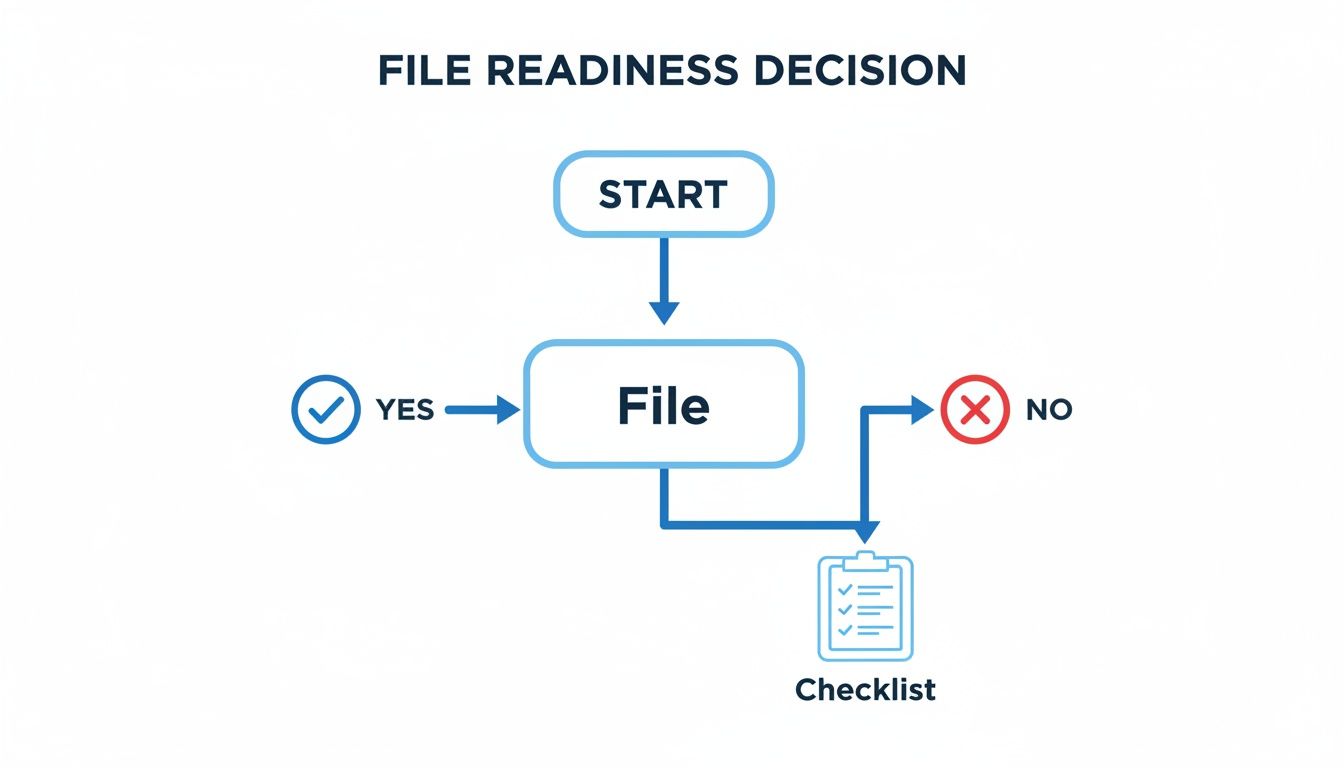
As the guide shows, a clean, properly formatted source file is the foundation. Messy input will give you a messy output, no matter how smart the AI is.
Scenarios for Basic vs. Pro Models
Let’s talk through some real-world examples. Say you’ve written a straightforward contemporary romance. The language is direct, the dialogue feels modern, and the story moves right along. For a book like this, a Basic plan on a platform like BookTranslator.ai is usually a perfect match. It’s affordable and incredibly good at handling clear prose, giving you a solid translation that captures the story without much fuss.
Now, let's switch gears. Imagine your book is a historical fiction novel set in 15th-century Spain. It’s loaded with period-specific language, winding sentences, and deep cultural nuances. This is exactly where a Pro plan proves its worth. The more advanced AI models in these plans are trained to grasp and replicate intricate styles, preserve subtle shifts in tone, and handle the sophisticated vocabulary that makes your book unique.
Choosing a plan isn't just a technical choice; it's a creative one. You're selecting a translation partner whose skills align with the artistic demands of your manuscript. The goal is to minimize friction and maximize faithfulness to your original vision.
Comparing Your Translation Options
To make the right call, you need to see what each option brings to the table. Don't think of it as "good vs. better," but more like a toolkit with different instruments for different jobs. Your project's specific needs and budget will point you in the right direction.
Here’s how the plans often stack up when you’re looking at AI book translation services.
Comparing BookTranslator.ai Plans for Spanish Translation
This table breaks down the key differences between the Basic and Pro plans to help you align your book’s needs with the right tool.
| Feature | Basic Plan ($5.99/100k words) | Pro Plan ($9.99/100k words) |
|---|---|---|
| Ideal Genre | Thrillers, Romance, Sci-Fi, How-To Guides, Contemporary Fiction | Literary Fiction, Historical Fiction, Poetry, Academic Texts, Complex Narratives |
| Model Sophistication | Highly accurate for clear, direct prose and common vocabulary. | Excels at capturing nuance, subtext, and complex sentence structures. |
| Voice Preservation | Very good at maintaining a consistent authorial tone and style. | Superior ability to replicate unique, stylized, or poetic writing voices. |
| Post-Editing Effort | May require more editing for idiomatic expressions or cultural references. | Reduces post-editing time by providing a more polished first draft. |
| Best For | Authors on a tight budget needing a fast, reliable translation. | Authors who prioritize the highest level of linguistic and stylistic fidelity. |
At the end of the day, the best AI Spanish translation tool is the one that respects your work. For a clean, plot-driven story, the Basic model delivers incredible value. But for a manuscript where every word was chosen for its artistic impact, upgrading to a Pro model is a smart investment. It ensures that nuance and depth are carried over into Spanish, giving your new readers the richest experience possible.
From Upload to Download: Your Translation Workflow
Alright, you've got your prepped EPUB file and you've picked your plan. Now for the main event. Getting your manuscript translated into Spanish is a surprisingly straightforward journey these days. These platforms are designed to feel natural, turning what was once a monumental project into a few simple clicks.
Let's walk through the typical steps on a service like BookTranslator.ai. The goal here is to show you how every part of the process is built to protect your hard work—from the specific formatting you chose to the unique sound of your authorial voice.
Kicking Off Your Translation Project
First thing's first: create an account and start a new project. This is usually as simple as signing up and finding a button that says something like "Translate New Book."
You’ll be prompted to upload your file. This is where that meticulously prepared EPUB comes in. Just drag and drop it into the uploader, and the system will immediately get to work analyzing the text.
Within moments, the software scans your manuscript to calculate the total word count, which is what determines the final cost. I love this part—you see the exact price before you commit a single dollar. No surprises.
Dialing in Your Language Settings
Once the system has analyzed your file, you'll land on a configuration screen. This is where you tell the AI exactly what you need. It’s pretty simple:
- Source Language: Confirm the original language of your book (e.g., English).
- Target Language: Select the language you want to translate into—in our case, Spanish.
- Plan Selection: Double-check that the plan you chose earlier (like Basic or Pro) is selected.
Most user interfaces are designed for total clarity. You'll likely see something that looks clean and simple, like this:
The whole point is to remove any technical guesswork. It’s all about getting your book translated without a fuss.
After you confirm the settings, you’ll handle the payment. For an 80,000-word novel on a Pro plan, you're looking at around $8. Once that's done, the translation kicks off almost instantly.
What's happening behind the scenes is pretty amazing. The AI isn't just doing a simple word-for-word swap. It's parsing sentence structures, figuring out the context, and actively trying to replicate your original intent in Spanish. It's a powerful combination of raw computing power and a sophisticated linguistic model.
Keeping Your Book’s Layout and Style Intact
This is a big one. One of the greatest fears authors have is that their carefully crafted structure will be lost in translation, resulting in an unreadable wall of text. Thankfully, platforms built specifically for book translation are designed to prevent exactly that.
Because you’re working with an EPUB, the AI can read the underlying code that dictates your layout. This means it works to maintain everything that makes your book look like your book:
- Chapter Breaks: Your chapters stay separate and properly ordered.
- Headings and Subheadings: The H1, H2, and H3 hierarchy you set up is preserved.
- Text Styling: Italicized thoughts, bolded exclamations, and other intentional formatting choices are carried over.
This intelligent formatting is a core feature, and it saves you from hours upon hours of manual reconstruction. The system is engineered to give you a Spanish EPUB that mirrors the professional layout of your original file. If you're curious about the tech, we break it down in our guide on how AI speeds up translation timelines.
Downloading Your Translated Masterpiece
The translation itself is incredibly quick. For a full-length novel, you should expect it to take anywhere from five to fifteen minutes.
You’ll get a notification as soon as it's finished. From your dashboard, you can download the final Spanish EPUB file.
This new file is now ready for the most crucial step: your human review and post-editing. The AI has delivered a fantastic, structurally sound first draft, but that final artistic polish can only come from a human touch. This workflow lets technology do the heavy lifting, freeing you up to focus on the creative nuances that matter most.
The Human Touch: Mastering Post-Editing for Quality
Let's get one thing straight: AI translation is your professional partner, not a magic wand. It produces a shockingly good first draft—often getting you 98% of the way there—but that final 2% is where the real work happens. This is the post-editing stage, and it's absolutely non-negotiable if you want a book that feels authentic and truly connects with Spanish-speaking readers.
Think of the AI as a brilliant but incredibly literal assistant. It nails the grammar, syntax, and direct meaning. Your job is to come in as the creative director to make sure the soul of your story—its unique voice, cultural heartbeat, and artistic nuance—shines through in Spanish. Skipping this step is what separates a technically correct translation from a beautifully crafted story that readers will love.
The demand for this kind of work is massive. The global language services sector is projected to hit $76.23 billion in 2025 and is on a trajectory to reach $147.48 billion by 2034. Within that, AI translation is becoming a key player, with its own market share expected to reach $15 billion in 2025 alone. With nearly 68 million people in the U.S. speaking a language other than English at home—and Spanish being one of the most common—the opportunity for authors couldn't be clearer. You can dive deeper into the growth of the language services market on fortunebusinessinsights.com.
Building Your Post-Editing Framework
Going in with a system will save you a ton of time and keep you from getting lost in the details. Instead of just reading the whole manuscript from front to back over and over, break your review down into focused "passes," with each pass having a single goal.
For instance, you could dedicate your first pass entirely to dialogue. This is where your characters' personalities live, and it’s often packed with the kind of subtext and idioms that need a careful human eye. Reading only the spoken lines helps you immediately spot awkward phrasing or conversations that just don't sound natural.
On another pass, you could zero in on consistency. Did the AI translate a key term one way in Chapter 2 and a different way in Chapter 10? This is your chance to build a unified glossary for your book’s world, making sure terms like "spellcaster" or "hyperdrive" are handled the same way every single time.
Post-editing isn’t about finding fault with the AI; it's about collaboration. The machine lays the linguistic foundation, and you provide the creative and cultural context that brings the text to life.
What to Hunt for During Your Review
Knowing what to look for is half the battle. Certain parts of language are notoriously tricky for AI to get just right. If you focus your attention on these specific areas, your review process will be way more efficient and effective.
Here’s a quick checklist of things to keep an eye on:
- Cultural Nuances: A reference that’s perfectly clear to an American reader might fall completely flat—or worse, be confusing—for someone in Spain or Colombia. Hunt for cultural touchstones like holidays, specific foods, or brand names and decide if they need to be adapted or briefly explained.
- Idiomatic Expressions: A phrase like "he spilled the beans" can be translated literally by an AI, creating a very weird mental image. Your job is to find the right Spanish equivalent that captures the meaning ("revelar el secreto"), not just the words.
- Character Voice: Does your gruff, hard-boiled detective sound just as tough in Spanish? Does your witty protagonist’s sarcasm still land? A great trick is to read the dialogue out loud to make sure each character’s unique voice has made the journey intact.
- Tone and Rhythm: The AI is good with sentence structure, but you are the master of the story's pacing and flow. Don't be afraid to tweak sentences to preserve that rhythm. Shorten one for punch, or combine two for a more lyrical feel, just like you would in your original manuscript.
Getting a Native Speaker's Eyes on It
You don't have to go it alone. In fact, one of the best things you can do is bring a native Spanish speaker into the process. This doesn’t have to mean hiring an expensive professional editor, though that’s certainly an option.
Consider finding a Spanish-speaking "beta reader." You could offer them a free copy of the book or a small payment in exchange for their feedback. They can give you priceless insights on whether a joke is actually funny, if a metaphor makes sense, or if a cultural reference feels natural. Their perspective is your ultimate test for authenticity.
This collaborative approach ensures your AI Spanish translation hits the highest possible standard. You can learn more about finding that perfect blend of technology and human oversight in our article on balancing accuracy and style in AI translation. Once you master the post-editing process, you’re not just translating your book—you’re creating a genuine work of art for a whole new audience.
Got Questions About AI Book Translation? Let's Talk.
Diving into any new technology can feel like a leap of faith, especially when your manuscript is on the line. It's smart to have questions. When it comes to using an AI Spanish translation tool for your book, you need to know it will do justice to all your hard work.
Let’s get into the nitty-gritty of what authors really ask. We’ll cover everything from preserving your unique voice to the real-world costs and technical quirks. Getting these answers upfront will help you move forward with confidence.
Will an AI Butcher My Unique Writing Voice?
This is the big one, isn't it? It's the number one concern for almost every creative writer, and for good reason. The good news is that modern AI models are surprisingly adept at maintaining an author's tone, style, and rhythm. They've been trained on massive libraries of literature, so they can recognize and replicate stylistic patterns with impressive accuracy.
Think of the AI as a highly skilled but literal-minded co-translator. It does the heavy lifting, getting you about 98% of the way there while keeping the core of your voice intact. But your creative intent? That's deeply personal. The final polish comes from you during the post-editing stage. That's your chance to tweak a specific phrase or swap a word choice to make sure the translation sings exactly the way you want it to.
The AI preserves the voice; you perfect it.
What Happens to My Formatting?
You’ve spent hours, maybe days, getting the structure and presentation of your book just right. The last thing you want is for all that effort to disappear. Fortunately, platforms like BookTranslator.ai are built specifically to handle EPUB files, which are designed to hold onto your book’s layout.
This means the important stuff is usually maintained without a hitch:
- Chapter Breaks: Your chapters will stay separate and in the correct order.
- Headings and Subheadings: The structural hierarchy you created is carried over.
- Basic Styling: Things like italics and bold text are generally preserved.
For most text-heavy novels, the process is incredibly smooth. Now, if your book is more complex—packed with embedded images, fancy tables, or lots of footnotes—the AI will still translate the associated text (like image captions). For the best results with highly visual layouts, though, it’s a good idea to simplify the file before you upload it.
A dedicated book translation tool is designed to give you back a file that mirrors your original. It’s built to prevent that dreaded "wall of text" and save you from the nightmare of manually reformatting everything.
What's the Real Cost to Translate a Full Novel?
This is where AI translation really changes the game. One of its biggest advantages is the massive cost savings compared to traditional methods. The pricing is completely transparent—it’s based on your book's word count, so you won't get hit with any hidden fees.
Let’s look at a real-world example. For a standard 80,000-word novel, translating it with a Pro plan costs about $8. That's a tiny fraction of what you’d pay a human translator, which could easily set you back several thousand dollars for a book that size.
Before you spend a dime, you can just upload your file and get a precise, no-obligation quote. This affordability is what's cracking the door open for so many indie authors to finally reach a global audience.
Can I Translate from Another Language into Spanish?
Absolutely. While this guide is focused on English-to-Spanish, these AI platforms are multilingual. Most services support dozens of languages, meaning you can translate your book from French, German, Portuguese, or many others directly into Spanish.
The process is exactly the same:
- Upload your original EPUB file.
- Select your book’s source language.
- Choose Spanish as your target language.
- Pick your translation plan (like Basic or Pro).
The AI models underneath it all are trained on incredibly diverse linguistic datasets. This ensures a high-quality translation no matter the starting point, making it a powerful tool for authors anywhere in the world who want to tap into the massive Spanish-speaking market.
Ready to share your story with millions of new readers? BookTranslator.ai is a fast, affordable, and high-quality way to bring your book to the Spanish-speaking world. Upload your EPUB and get started today.