
How AI Breaks Language Barriers in Literature
AI is transforming how books are translated, making global literature more accessible than ever. Traditionally, translating a book has been expensive and time-consuming, costing $8,000–$20,000 and taking months. This has limited the diversity of translated works, with only 3% of books published in the U.S. being translations. AI-powered tools are now addressing these challenges by offering faster, cheaper, and more accurate translations, enabling authors and publishers to reach international audiences.
Key Points:
- Cost and Speed: AI tools can translate entire books in hours or days, reducing costs to a fraction of traditional methods.
- Hybrid Approach: Combining AI with human editing ensures translations retain nuance and context.
- Global Reach: AI opens access to books from underrepresented languages, broadening literary diversity.
- Platforms like BookTranslator.ai: Translate books into 99+ languages, starting at $5.99 per 100,000 words.
AI is reshaping the literary world, making it easier for readers to discover stories from around the globe and for authors to share their work internationally.
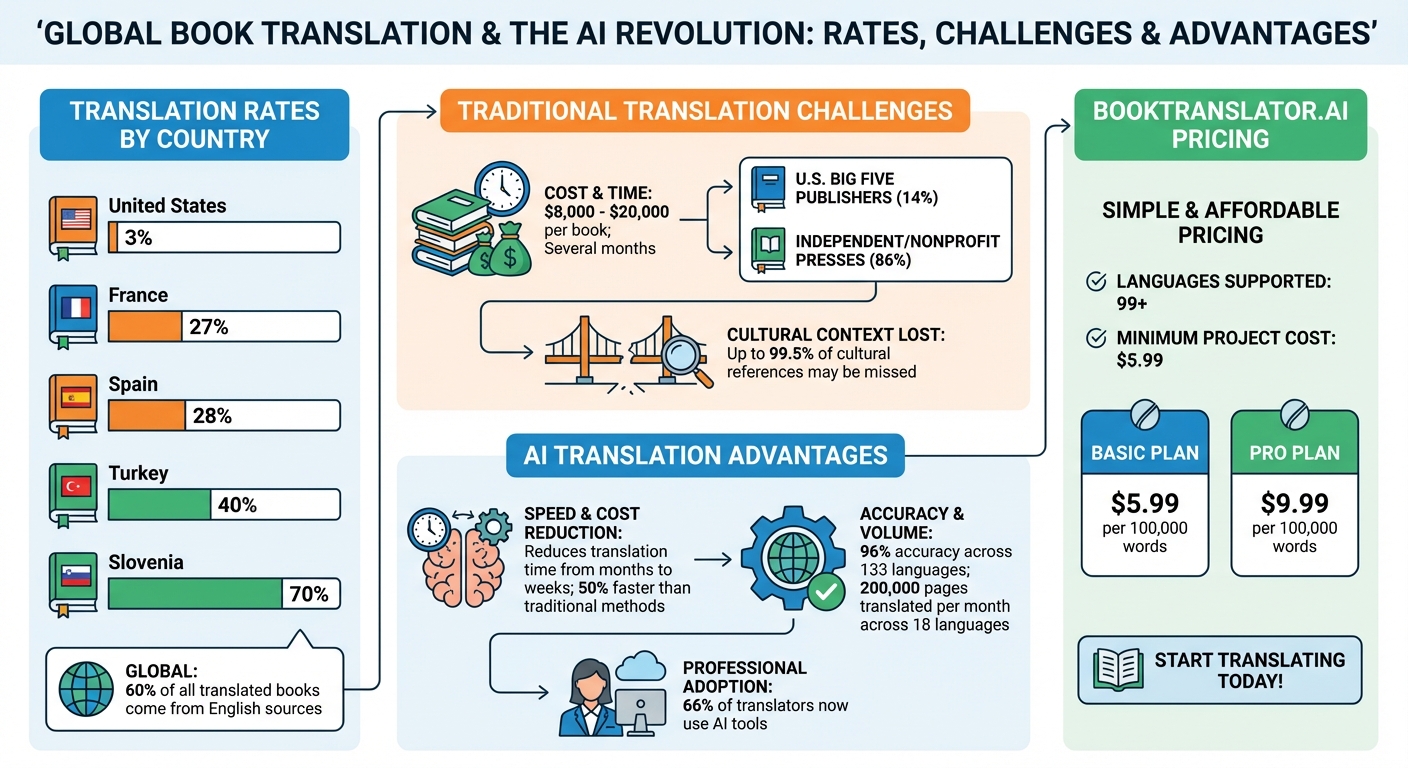
Global Book Translation Statistics: AI vs Traditional Methods
The Problem: Language Barriers in Global Literature
Most Books Never Get Translated
The numbers tell a striking story: only 3% of books published in the United States are translations. Compare that to 27% in France, 28% in Spain, 40% in Turkey, and a staggering 70% in Slovenia. Globally, around 60% of all translated books come from English sources[2][3][4][5]. This heavy tilt toward English highlights a troubling reality - many literary voices from around the world struggle to reach an international audience.
Big commercial publishers see translations as a risky investment. In the U.S., the "Big Five" publishers handle just 14% of translated works, leaving smaller nonprofit and independent presses to shoulder the remaining 86%[3]. Why? Many editors at these large firms don't speak the languages of the manuscripts they receive. They rely on sample translations, which often come at a high cost - expenses that frequently fall on the authors themselves. This system makes it incredibly hard for emerging or less-wealthy writers to break into English-speaking markets. For publishers, the risks and costs of translation only reinforce their reluctance to take chances on foreign works.
Traditional Translation Is Expensive and Slow
The process of traditional translation is anything but efficient. Publishers usually follow a "one shot" rule: they invest in a single translation, which often becomes the definitive version of the work for decades[3]. This all-or-nothing approach, combined with declining U.S. fiction sales since 2013, has made publishers even more hesitant to take on translated books.
Manual Translation Often Loses Cultural Context
Cost and speed aren’t the only issues. Traditional translation often struggles to maintain the cultural depth of the original work. Andrei, the founder of The Untranslated, points out that readers of translated works may miss as much as 99.5% of the cultural references in books originally written in languages like Russian or Japanese[7]. Translators face a constant tug-of-war: should they "domesticate" the text to make it more relatable for local readers, or "foreignize" it to preserve its original essence? Too often, the result is a watered-down version of the story[7].
"You'd be surprised to learn how much of the original text sometimes gets left out in the translation. I mean, whole sentences are just omitted", Andrei notes[7].
In some cases, translations even alter key elements - like character names or plot points - to better fit local preferences. As Writer vs the World reflects:
"When I read, sometimes I wonder how much the original story was changed to please my American mindset or aesthetic"[6].
This leads to what writer and translator D. P. Snyder calls "literary monovision", which:
"ill-equips us to develop the empathy, openness, knowledge, and interpretive skills that a global reality requires"[4].
These challenges reveal the limitations of traditional translation methods. However, advancements in AI translation may offer a way to bridge the gap - preserving both efficiency and the rich cultural layers of global literature.
sbb-itb-0c0385d
Can AI Be Useful in Book Translation?
How AI Translation Solves These Problems
Modern AI translation relies on neural machine translation (NMT) systems trained on millions of professionally translated texts. These systems go beyond simply swapping words between languages - they learn to recognize storytelling patterns, dialogue flow, and character voices. Recent data highlights AI translation achieving an impressive 96% accuracy across 133 languages, making it capable of handling even complex literary texts while preserving tone and context nuances [8]. This level of precision has transformed the speed and reliability of translation processes.
Author Steve Anderson notes that AI-assisted tools have drastically reduced translation timelines, cutting projects from months to just weeks [1]. This quicker turnaround also enhances consistency, as uniform outputs can be reviewed more efficiently for accuracy.
AI excels at maintaining consistency throughout a manuscript, ensuring that names, fantasy terms, and technical jargon are rendered uniformly. Advanced NMT models even create a "mathematical map" of the narrative, which helps retain plot details and ensures characters' voices remain consistent from start to finish.
The industry has widely adopted a hybrid approach called Machine Translation Post-Editing (MTPE). According to a 2024 survey of over 750 professional translators, two-thirds reported using AI tools in their work over the past year [9]. Translator Peter Breum described this shift as:
"an exciting new era from which there's no turning back" [1].
This combination of speed, accuracy, and scalability has opened doors for books from underrepresented languages to reach global audiences. Publishers can now test multiple language markets simultaneously without the steep costs that once made such efforts risky. By streamlining the translation process, AI makes global literature more accessible while breaking down language barriers. At the same time, it allows human translators to focus their expertise on sections where cultural context and literary nuance are most critical [1].
BookTranslator.ai: An AI-Powered Translation Platform
BookTranslator.ai breaks down language barriers for readers and publishers, offering seamless translation of EPUB files up to 50 MB into over 99 languages. Whether it's popular languages like Spanish, Chinese, and French, or rarer ones often overlooked by traditional publishers, this platform makes books accessible like never before.
Main Features of BookTranslator.ai
The platform’s one-click translation simplifies the process entirely. Just upload your EPUB file, choose a target language, and let the AI do the heavy lifting. It even preserves formatting, maintaining chapter headings, dialogue markers, paragraph spacing, and layout exactly as they should be.
What sets BookTranslator.ai apart is its contextual memory, which ensures character consistency and narrative style throughout the book. By combining the speed of AI with expert refinement, the platform delivers translations that stay true to the original story while respecting cultural nuances. This hybrid workflow - AI followed by human review - ensures polished results that resonate with readers [9].
Pricing Options and Plans
BookTranslator.ai uses a pay-per-book model, charging based on word count instead of a subscription fee. This makes it flexible and cost-effective for both casual readers and publishers.
Pricing Comparison Table
| Plan Name | Price per 100,000 Words | Key Features | Best For |
|---|---|---|---|
| Basic | $5.99 | High-quality AI translation, formatting preservation | General literature readers |
| Pro | $9.99 | Enhanced accuracy and formatting consistency | Complex literary works |
The minimum cost is $5.99 per project, which means translating an 80,000-word novel costs just a fraction of what traditional services charge. Plus, there’s a money-back guarantee if the results don’t meet expectations.
Benefits for Readers and Publishers
This pricing model opens up translation opportunities to a broader audience, benefiting both readers and publishers in unique ways.
Readers can now access books that might never have been translated otherwise. Whether it’s a Japanese mystery or a French historical novel, you no longer have to wait years for a publisher to invest in translation - you can do it yourself in just a few hours. And the best part? You retain 100% copyright of the translated version.
For publishers, the platform is a game-changer. It allows them to test multiple language markets simultaneously without the hefty financial commitments that translation traditionally requires. For example, instead of spending tens of thousands of dollars translating a book into German, a publisher can invest less than $10 to gauge interest from German readers. This quick, low-cost market testing helps identify where full human localization might be worth pursuing. Additionally, the platform ensures consistency in technical terms, character names, and even fantasy vocabulary, something that typically demands extensive style guides in traditional workflows.
The Wider Impact of AI on Literary Access
AI's role in translation goes beyond just breaking language barriers - it opens doors to global perspectives and creates highly personalized reading experiences.
AI Enables Cross-Cultural Understanding
AI is reshaping how we discover global literature by tackling language barriers that have historically limited access. In the U.S., nearly half of all translated books come from just three languages - French, Spanish, and German. This leaves vast literary traditions from regions like Asia, Africa, and Eastern Europe largely out of reach for English-speaking readers [1]. AI is starting to change this by making it feasible to translate works from languages that traditional publishers often ignore.
Take Nuanxed, for example - a Swedish startup specializing in book translations. By 2025, they’ve completed over 900 translations across more than 60 language combinations, helping publishers in multiple countries expand their offerings [1]. This kind of scale simply wasn’t achievable a few years ago. Now, readers can dive into Japanese mystery novels, Polish historical fiction, or Nigerian contemporary stories in their own language. This not only broadens access but also provides a deeper appreciation of diverse storytelling styles, societal issues, and cultural viewpoints.
This global reach is just the beginning. AI also brings literature closer to readers on a personal level.
Reading in Your Native Language
On top of broadening cultural horizons, AI ensures that readers can enjoy books in the language they connect with most - often their native tongue. Gone are the days of waiting years for translations. AI tools like BookTranslator.ai, which supports over 99 languages, make it possible for readers to access stories in the language they think and feel in. This boosts both comprehension and emotional engagement.
The benefits extend beyond individual readers. Independent authors and small publishers, who might have balked at the $8,000 to $20,000+ cost of traditional translations, can now reach global audiences without breaking the bank. They can test their works in different markets, see where their stories resonate, and later invest in professional human editing for the most promising opportunities.
This shift in accessibility is setting the stage for a future where AI and human expertise work hand-in-hand.
The Future: Combining AI and Human Expertise
The future of translation lies in collaboration - pairing the efficiency of AI with the nuance of human translators. A 2024 Slator survey of over 750 translators found that two-thirds of professionals used AI tools in the past year, with over 30% using them to suggest alternative text and about 16% for tone adjustments or proofreading [9].
This approach, known as Machine Translation Post-Editing (MTPE), allows translators to focus on the creative and cultural aspects of their work rather than the mechanics of sentence-by-sentence conversion. Projects that once took months can now be completed in weeks [1]. This hybrid process not only speeds up timelines but also reduces costs, making literary translation more accessible to a wider range of authors and publishers.
Conclusion
AI translation is opening new doors to global literary access. Traditional translation methods often came with high costs and lengthy timelines, making it challenging for many works to reach a worldwide audience. Today, platforms like BookTranslator.ai are changing the game by offering translation services that are fast, affordable, and accessible. These tools are helping independent authors and readers alike connect with stories in their preferred language, breaking down barriers that once seemed insurmountable.
With modern AI tools now translating 200,000 pages per month across 18 languages, the process is not only faster but also more efficient than ever before, cutting translation times in half when compared to older methods[10]. Interestingly, two-thirds of professional translators have adopted AI in their work over the last year, using it to refine phrasing, tone, and even to proofread[9]. This doesn't replace human creativity but instead combines the efficiency of AI with the cultural understanding and expertise of human translators. This hybrid approach, known as Machine Translation Post-Editing (MTPE), ensures that literary nuances are preserved while dramatically speeding up the translation process.
The impact goes beyond efficiency. When Japanese mystery novels, Polish historical fiction, or Nigerian contemporary stories become accessible in other languages, readers gain more than entertainment - they gain insight into new perspectives, traditions, and ways of thinking. Independent authors, who previously faced prohibitive costs, can now explore international markets with ease, connecting with readers across the globe and sharing their stories widely. By making literature more accessible, these tools are fostering a deeper sense of connection and understanding among diverse cultures.
AI translation is tearing down the walls that once limited global connections. As these technologies continue to evolve and gain acceptance, we are moving closer to a world where every story can find its way to every reader, no matter the language in which it was originally written.
FAQs
Will AI translations preserve an author’s voice?
AI translations have come a long way, especially in handling style, formatting, and maintaining consistency. But when it comes to preserving an author’s unique voice - things like emotional depth, idiomatic expressions, and those subtle cultural touches - AI still struggles. This is where a hybrid approach shines. By blending AI’s speed and accuracy with human expertise, you can ensure the final translation stays true to the author’s intent. While AI can mimic many stylistic features, human involvement is often key to capturing the finer details and context.
How much human editing does AI translation need?
AI translation offers speed and affordability, but it still falls short when it comes to capturing nuance, style, and emotional depth. While it's great at processing large amounts of text quickly, it often stumbles over subtleties like conveying emotions, interpreting idiomatic phrases, or understanding cultural nuances. For literary texts, human editors step in to fine-tune the draft, ensuring the author's unique voice and tone remain intact. By blending AI's efficiency with human expertise, a hybrid approach often delivers the most polished and accurate translations.
Who owns the copyright of an AI-translated book?
Copyright ownership for an AI-translated book often hinges on the level of human involvement. Under U.S. law, copyright protection requires a degree of human creativity, meaning works created entirely by AI generally aren't eligible. However, if a person actively participates in the translation process - by refining, editing, or guiding the AI - the rights usually belong to that individual or remain with the original copyright holder.