
Ethics of AI in Book Translation
AI has transformed book translation by making it faster and cheaper, but it introduces ethical concerns. While AI tools like Neural Machine Translation (NMT) and Machine Translation Post-Editing (MTPE) allow authors and publishers to translate books at a fraction of the cost and time, they often struggle with nuances like idioms, tone, and cultural references. This can lead to inaccurate translations, biased outputs, and loss of an author’s voice.
Key challenges include:
- Accuracy: AI often misses subtleties like humor, metaphors, and emotional depth.
- Bias: Training data can reinforce stereotypes, such as gender roles, and marginalize less-represented languages.
- Accountability: Without human oversight, AI risks altering the meaning of the original text.
- Copyright: Authors must protect their rights, as AI systems may use copyrighted works without consent.
The solution lies in combining AI with human expertise. By using MTPE, human translators refine AI drafts to ensure quality while preserving the author’s intent. Ethical practices, such as using diverse training data, protecting intellectual property, and maintaining transparency, are essential for fair and accurate translations. While AI enhances efficiency, human oversight remains critical to retaining the depth and integrity of literary works.
Is AI in Translation Ethical or Just Cheaper?
sbb-itb-0c0385d
Accuracy Challenges in AI Book Translation
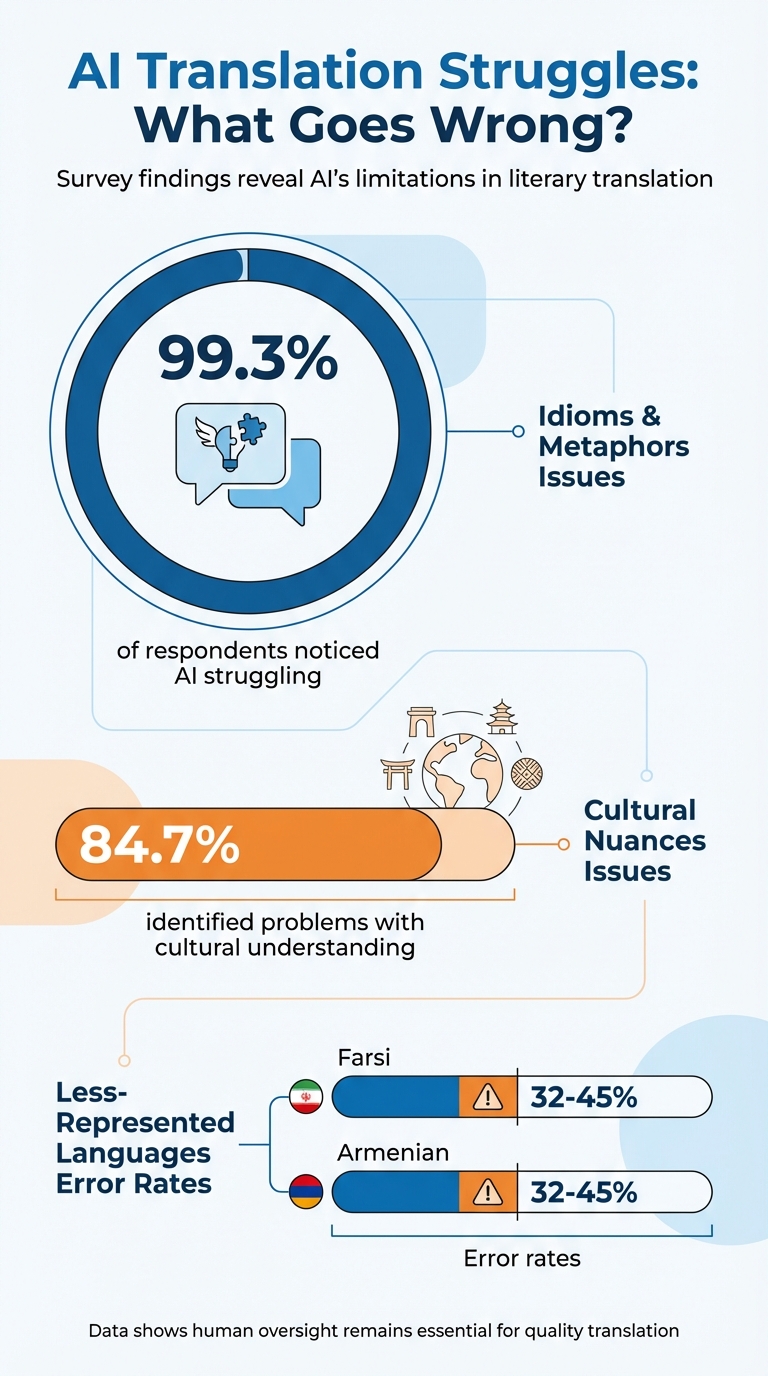
AI Translation Challenges: Survey Results on Accuracy and Cultural Issues
What Translation Accuracy Means
Getting translation right isn’t just a technical hurdle - it’s about staying true to the author’s intent. Accuracy in book translation goes beyond word-for-word correctness. It’s about preserving the meaning, style, and context of the original work. A technically correct translation that misses the tone or emotional weight of the text feels hollow and incomplete.
Literary works thrive on nuance. The sharp humor of a satirist or the poetic flow of a romance novelist carries the essence of their storytelling. When a translator captures these elements, they preserve the work’s identity. Human translators bring creativity and judgment to their work, making intentional choices to reflect the deeper layers of a text. AI, on the other hand, often produces translations that, while linguistically accurate, lack the emotional or stylistic depth needed to truly reflect the original[1][3].
These challenges become even more apparent when dealing with expressions that carry heavy cultural or emotional weight, as discussed below.
Where AI Struggles with Context
AI faces its biggest hurdles when dealing with idioms, metaphors, cultural references, and complex sentence structures. A recent survey found that 99.3% of respondents noticed AI struggling with idioms and metaphors, while 84.7% identified issues with cultural nuances[1]. These gaps highlight AI's difficulty in grasping deeper meanings.
Regional dialects add another layer of complexity. AI often produces clunky, overly literal translations that strip away the cultural richness of these dialects. Liesl Yamaguchi, a translation expert, has pointed out that poor AI translations can create a false sense of accessibility, masking the need for genuine literary understanding[2].
The challenges are even greater with less-represented languages. Limited training data leads to error rates as high as 32–45% for languages like Farsi and Armenian[4]. This not only results in inaccurate translations but also perpetuates inequalities by failing to represent voices from the Global South accurately. These voices, rich in cultural and literary significance, deserve translations that honor their integrity.
These shortcomings emphasize the importance of human involvement to ensure that literary works retain their authenticity and depth. AI alone cannot yet meet this standard.
Bias and Representation in AI Translations
Where Bias Comes From in AI Training Data
AI translation systems are built on massive datasets, often pulled from books, websites, and pre-existing translations. The problem? These datasets can reflect societal biases and cultural imbalances, which the AI then learns as "normal." Neural Machine Translation (NMT) systems, for example, frequently rely on copyrighted literary works and human translations that may already carry cultural biases[5].
One of the clearest examples of this is gender stereotyping. Research shows that tools like Google Translate often default to stereotypes, such as translating "He works, she cooks" from gender-neutral languages[5]. A case in point: In Turkish, the gender-neutral phrase "O bir doktor" (They are a doctor) is often translated as "He is a doctor", while "O bir hemşire" (They are a nurse) becomes "She is a nurse"[6]. This happens because the training data lacks gender balance, reinforcing outdated roles.
On top of that, algorithmic processing can strip away cultural subtleties and reinforce existing social hierarchies, even when the original text avoids them[5]. Bo Li, a researcher at Lingnan University, highlights the ethical challenges here: "Copyright ethics is an indispensable part of AI-enabled literary translation since training data and participatory NMT involve copyright issues"[5]. AI post-editing can also simplify or homogenize linguistic styles, which risks losing the unique voice of the original author. This flattening of style undermines the literary richness essential to accurate translations.
Ultimately, these biases don’t just stay in the training data - they shape the final product, influencing how characters, themes, and cultural nuances are portrayed.
How Bias Affects Literary Translation
The impact of biased translations goes far beyond awkward phrasing. They can fundamentally alter how characters are perceived, distort themes, and erase cultural depth. For instance, when AI assigns gender to neutral pronouns based on stereotypes, professional roles often default to outdated norms. Doctors are typically rendered as male, while nurses or assistants are often female[6]. These assumptions can significantly affect how readers view characters and their roles.
Cultural expressions also take a hit. Consider a Japanese character politely declining an invitation with a humble phrase. AI might translate this as a blunt "No", which could make the character seem rude rather than respectful[6]. Political language is another minefield. For example, a term like "freedom fighter" in one language might be translated as "terrorist" if the AI's training data skews toward a particular political bias[6].
"AI might be fast, but it doesn't understand consequence. Only a human can assess whether a translation is appropriate for a particular audience or situation." – Gergana Toleva, 1StopAsia[6]
Because AI training data often overrepresents dominant cultures, minority voices and dialects are pushed to the margins. This leads to a "flattening" of cultural diversity in translated works, where distinct regional expressions and underrepresented languages lose their vibrancy[6]. For authors and publishers, this isn’t just a creative issue - it’s a real risk. Biased translations can lead to public backlash, damage reputations, and even spark legal trouble if the content is seen as offensive or discriminatory[6].
Accountability and Human Oversight
Combining AI with Human Translators
In the world of ethical AI translation, Machine Translation Post-Editing (MTPE) has become the gold standard. This approach blends the speed of AI with the expertise of human translators. AI produces an initial draft, and human professionals refine it, ensuring the final product is polished and accurate. The result? Faster turnaround times without sacrificing quality.
The process unfolds in a few key steps. First, bilingual editors review the AI's output alongside the original text, focusing on capturing subtleties that algorithms often miss. They also adapt idioms, humor, and other culturally specific elements to ensure the translation resonates as intended. Next, a proofreader steps in, correcting technical issues like typos and punctuation. When necessary, native beta readers add an extra layer of scrutiny, ensuring the emotional depth of the original text is preserved.
"The solution lies in a carefully orchestrated collaboration that leverages the best of both worlds." – Translated.com [7]
To keep everything consistent, editors rely on style guides and glossaries established before the project begins. Clean EPUB files are also crucial, as they prevent hidden formatting issues that could introduce errors. This structured collaboration ensures the narrative's essence is maintained while technical accuracy is upheld.
Building Accountability into AI Workflows
Modern translation platforms are now using advanced metrics to measure the efficiency and accuracy of AI-human collaborations. For example, Time to Edit (TTE) tracks how many seconds are spent editing each segment, while Errors Per Thousand (EPT) measures the number of objective errors per 1,000 words [7]. These metrics provide clear insights into the quality of the workflow.
Some systems go a step further with AI-powered tools like T-Rank, which matches editors with specific genre expertise. This ensures the reviewer is well-suited to the text's unique demands. Feedback loops also play a critical role - editor corrections are fed back into the system, helping the AI learn and reduce recurring mistakes over time.
Platforms like BookTranslator.ai have embraced these accountability measures, creating a seamless partnership between AI and human experts. By allowing AI to handle repetitive tasks, human translators can focus on the creative and nuanced aspects of the work. This ensures every translation maintains technical precision while honoring the original's emotional and artistic integrity.
Intellectual Property and Author Rights
Copyright Issues in AI Translation
AI-generated translations often result in what copyright law defines as a "derivative work", meaning authors must retain control over these translations and how they are used. This becomes even more complicated when considering how AI systems are trained. Many large language models rely on enormous datasets scraped from the internet, which may include copyrighted literary works used without proper consent from authors or publishers [9][5].
Another critical issue is data security. Consumer-grade AI tools might use submitted text for training purposes, potentially exposing unpublished manuscripts or other sensitive materials [9]. To avoid these risks, authors and publishers should choose enterprise-grade tools that explicitly guarantee non-training policies and provide strong encryption to safeguard intellectual property. Advocacy groups like the European Council of Literary Translators' Associations are pushing for stronger protections as laws surrounding AI-generated content continue to develop [9].
"The future of AI adoption depends on trust, ethics and human expertise." – Slator [9]
To further safeguard your work, ensure service agreements specify that you retain full ownership of translated content. Secure a unique ISBN for each language edition, and limit foreign licensing to specific regions and a term of 5–7 years. While legal measures help protect ownership, maintaining the author’s distinct voice requires careful editorial attention.
Maintaining Author Voice with AI
Protecting an author’s creative expression goes beyond legal rights - it’s about preserving their unique artistic style.
AI systems are excellent at ensuring terminology consistency across lengthy manuscripts, but they often fall short when it comes to capturing the creative elements that make an author’s work stand out. Features like wordplay, puns, and highly stylized prose can be difficult for AI to replicate accurately [8]. Emotional depth and cultural subtleties also require the touch of human expertise.
Preparation is key to maintaining the author’s voice. Start by creating glossaries of essential terms, character names, and settings, and develop detailed style guides that outline tone, speech patterns, and other stylistic elements. This helps both AI tools and human editors stay true to the author’s original intent. Using clean, validated EPUB files instead of Word documents can also preserve important formatting, such as italics and structural elements. Finally, involve bilingual editors and native beta readers to ensure the translation retains its emotional resonance and cultural context.
Best Practices for Ethical AI Book Translation
Transparency in AI Translation
Accountability and transparency go hand in hand when it comes to ethical AI translation. For readers and authors alike, understanding how AI makes translation decisions is crucial. Explainable AI can shed light on why certain words, phrases, or interpretations are chosen. This kind of clarity not only builds trust but also allows localization managers to catch potential problems early.
For instance, if authors are aware that AI is great at maintaining consistent terminology but might falter with idiomatic expressions or subtle cultural references, they can plan for human editorial input where needed. Confidentiality is another key concern - strict data-handling policies should be in place to reassure authors that their manuscripts won’t be reused for further AI training. Together, these transparency practices ensure that AI enhances, rather than diminishes, the delicate art of literary translation. They also complement earlier efforts to address issues like bias and oversight.
Creating Ethical Guidelines for AI Platforms
To strengthen ethical AI translation practices, clear and robust guidelines are indispensable. Preserving an author’s voice and accurately conveying context depend on solid ethical frameworks. A strong starting point is focusing on training data - high-quality, diverse datasets are essential for reducing bias and improving accuracy, especially for underrepresented languages. Training AI to process entire documents, rather than isolated sentences, also helps maintain narrative continuity and the author’s unique style.
Incorporating skilled bilingual editors into the process is another critical step. These professionals can ensure that cultural subtleties are respected and any biases are addressed. As Professor Kaisa Koskinen of Tampere University aptly notes:
"Ethics can never be resolved once and for all since moral aspects need to be continuously renegotiated and conditions and situations change." [10]
Platforms should also protect intellectual property by guaranteeing that authors retain full copyright ownership of AI-assisted translations. Tools like glossaries, validated EPUB files, and a structured two-tier review system can further safeguard the author’s creative voice throughout the translation process.
Conclusion: The Future of Ethics in AI Book Translation
Key Points
Ethical AI book translation hinges on three main principles: accuracy, accountability, and fair representation. Achieving contextual accuracy means capturing the full essence of a text, including its tone and cultural subtleties. Accountability thrives when human experts collaborate with AI to refine its outputs. Fair representation requires balanced training data to prevent marginalization of minority languages and avoid perpetuating stereotypes. Together, these elements help build trust in AI-driven translations.
These principles lay the groundwork for the future of AI translation.
What's Next for AI Translation
The future of ethical AI translation is being shaped by the development of specialized large language models trained on carefully selected literary datasets. This shift prioritizes the quality and diversity of training materials over simply advancing algorithmic complexity. By incorporating continuous learning - where systems adapt based on real-world use and human feedback - translation tools can stay attuned to cultural and linguistic changes. These advancements align with the ongoing goal of maintaining literary integrity through ethically guided technology. Explainable AI will play a key role in ensuring transparency in how translation decisions are made.
To move forward, it's essential for platforms to expand datasets to include less widely spoken languages, making translation tools more inclusive and fair. Human oversight will remain critical, as expert translators bring the cultural understanding and emotional depth that AI alone cannot replicate. By combining technological advancements with a human-centered approach, AI translation can protect intellectual property, preserve an author’s voice, and create translations that respect both the original work and the target audience.
BookTranslator.ai is dedicated to these ethical principles, equipping expert translators with cutting-edge tools to enhance their productivity while delivering translations that are accurate, culturally aware, and meaningful for readers across the United States.
FAQs
When is AI translation “good enough” for a book?
AI translation is deemed "good enough" when it successfully captures the meaning, style, and formatting of the original text. However, it often falls short in conveying nuance and emotional depth. It performs well with technical or simple content, particularly when paired with human editing. For literary works, AI can be helpful for creating initial drafts or improving accessibility, but human translators are crucial for retaining idiomatic expressions, emotional impact, and cultural subtleties.
How can authors check for bias in AI-translated text?
Authors can spot bias in AI-translated text by comparing how sensitive terms or phrases are rendered versus human translations. Pay close attention to areas like idioms, metaphors, and references to social norms, as these can often reveal subtle cultural or linguistic biases. It's important to ensure that the translation not only stays true to the original meaning but also respects the cultural context for accuracy and sensitivity.
What should a translation contract include about AI and copyright?
A translation contract needs to address the use of AI-generated translations with clear guidelines. This includes specifying copyright ownership and intellectual property rights, as well as determining who is accountable for the final output. The agreement should also detail how AI tools will be used, ensure the original work's integrity remains intact, and clearly define the responsibilities of all parties involved in the process.