
Why Context Matters in AI Book Translation
When translating books, context is everything. AI tools have improved significantly, but they still struggle with maintaining the tone, idioms, and emotional depth of the original text. For example, phrases like "kick the bucket" often lose their meaning when translated literally. This is why human involvement remains critical in refining AI translations to preserve the author’s voice and intent.
Key points:
- AI tools analyze context better than before but still falter with humor, idioms, and subtle nuances.
- Literal translations fail to convey the deeper meaning, emotional tone, or cultural references of the original work.
- Human translators refine AI output, ensuring consistency, tone, and the "soul" of the story are preserved.
The best approach combines AI for speed and consistency with human expertise to polish and perfect the final translation.
What Context Means in AI Translation
Defining Contextual Understanding
Contextual understanding in AI translation goes beyond interpreting individual words. It’s about grasping the meaning of words within the larger narrative. Modern AI systems, particularly those using Neural Machine Translation (NMT), analyze entire sentences and surrounding paragraphs instead of treating words in isolation. This approach helps maintain the flow of a story, ensuring the tone, characters, and overall narrative remain consistent. Earlier models struggled with this, often losing the thread of a text, especially in works like literature where tone shifts and emotional depth are critical. By focusing on context, modern AI can better preserve the author’s voice and the emotional resonance of the text, which are often lost in overly literal translations.
Why Word-for-Word Translation Doesn't Work
Word-for-word translation models approach sentences as standalone units, leading to frequent errors. For instance, a phrase like "Are we good?" can mean vastly different things depending on the situation, yet literal systems often fail to adapt to these nuances. As Ryan Cherian aptly put it:
"The translation comes back technically correct, word by word, and yet somehow completely wrong." [2]
Issues arise especially with languages that drop subjects, like Japanese, Korean, and Chinese, or with English pronouns such as "it", "this", or "they." These systems often lack the memory needed to track references across a text.
Moreover, cultural and linguistic subtleties pose additional challenges. For example, metaphors and idiomatic expressions can easily lose their meaning without a deeper understanding of context. A 2025 study highlighted that GPT-class models significantly outperformed traditional NMT engines in maintaining sentiment and meaning, particularly with complex expressions and cultural nuances [2]. Context-aware AI recognizes distinctions like "a run in her stocking" versus "run for office", understanding that the same word can carry entirely different meanings. This level of nuance is something word-for-word systems simply cannot achieve.
sbb-itb-0c0385d
Common Context Problems in Book Translation
How Mistranslations Affect Literature
Beyond the challenges of literal translation, context-related problems highlight just how tricky book translation can be. Literary translation isn't just about swapping words between languages - it's about preserving the author's voice, tone, and subtle nuances. When context is mishandled, sarcasm can be taken literally, conversations may lose their natural flow, and characters can feel inconsistent or one-dimensional. These issues disrupt the continuity that keeps readers engaged.
The ripple effect of poor context handling goes far beyond isolated sentences. It can break the immersive experience by distorting tone, losing metaphors, and creating inconsistencies. For instance, when AI systems process text in chunks, character names might change between chapters, plot details can become muddled, and the writing style might shift unexpectedly. This lack of coherence can make a story feel fragmented and alienate readers, especially when cultural references are misinterpreted or fall flat. As linguist Emily M. Bender aptly put it, literary translation is "skilled and artistic work" requiring a deep understanding of subtlety and nuance - something that statistical language models simply can't replicate [4][5].
These aren't just hypothetical concerns - real-world examples show how poor contextual translation can completely alter a reader's experience.
Real Examples of Context Errors in AI Translations
AI translation tools often stumble when interpreting place names. A striking example shared by Emily M. Bender involved "Amsterdam" being mistranslated as "Washington, D.C." or "London" [4]. This happened because the AI relied on statistical patterns rather than understanding the specific context of the text. Such errors don't just confuse readers - they fundamentally change the cultural backdrop and setting of a story.
Idiomatic expressions and figurative language reveal even deeper flaws. Phrases like "kick the bucket" often get translated word-for-word, losing their intended meaning. Similarly, puns such as "Time flies like an arrow; fruit flies like a banana" are stripped of their humor and cleverness [5][3]. These missteps strip away the humor, symbolism, or poetic qualities that the author worked hard to create.
Fragmented processing is another major issue. AI systems often handle texts in isolated chunks, which leads to inconsistencies in terminology, character voice, and thematic elements. Unlike shorter texts, where these issues might be less noticeable, in longer works like novels, the lack of cohesion can completely undermine the reader's experience [3][1].
How BookTranslator.ai Maintains Context
AI-Powered Context Accuracy
BookTranslator.ai tackles the tricky challenge of maintaining context by leveraging foundation models and attention mechanisms. Instead of just matching words, these tools dive into the deeper meaning of the text. This allows the platform to handle idiomatic expressions, keep character voices consistent, and respect cultural subtleties across long texts in over 99 languages. Whether it's sarcasm, metaphors, or tone, the platform ensures these elements stay true to the original work [1][3][4]. By focusing on key words and phrases, the attention mechanisms enhance accuracy, especially in complex sentences, maintaining the intended context throughout entire books. This approach ensures that idioms, character nuances, and cultural references remain intact.
One-Click Translation That Keeps Formatting
A standout feature of BookTranslator.ai is its ability to preserve the original EPUB formatting. From chapter breaks and spacing to essential stylistic details, the platform ensures that the translated text retains the book's readability and structure. The one-click process can handle files as large as 50MB, translating entire books without compromising their layout. By safeguarding both the meaning and the design, BookTranslator.ai delivers translations that feel authentic to the original work. These technical strengths have already proven their value in the publishing world.
Success Stories of Context-Aware Translations
AI-powered translation has significantly shortened the time required for book translations, cutting the process from months to just weeks [4]. Importantly, this speed doesn't come at the cost of quality when context-aware systems are used effectively. Publishers are increasingly turning to AI for literary translations, with hundreds of books already benefiting from this technology. By blending AI's efficiency with human oversight, more books are becoming accessible to global audiences. BookTranslator.ai's ability to interpret figurative language based on meaning, rather than translating word-for-word, makes it especially well-suited for literary works where nuance is critical [3][4].
AI Translation Just Leveled Up
Combining AI with Human Review for Better Context
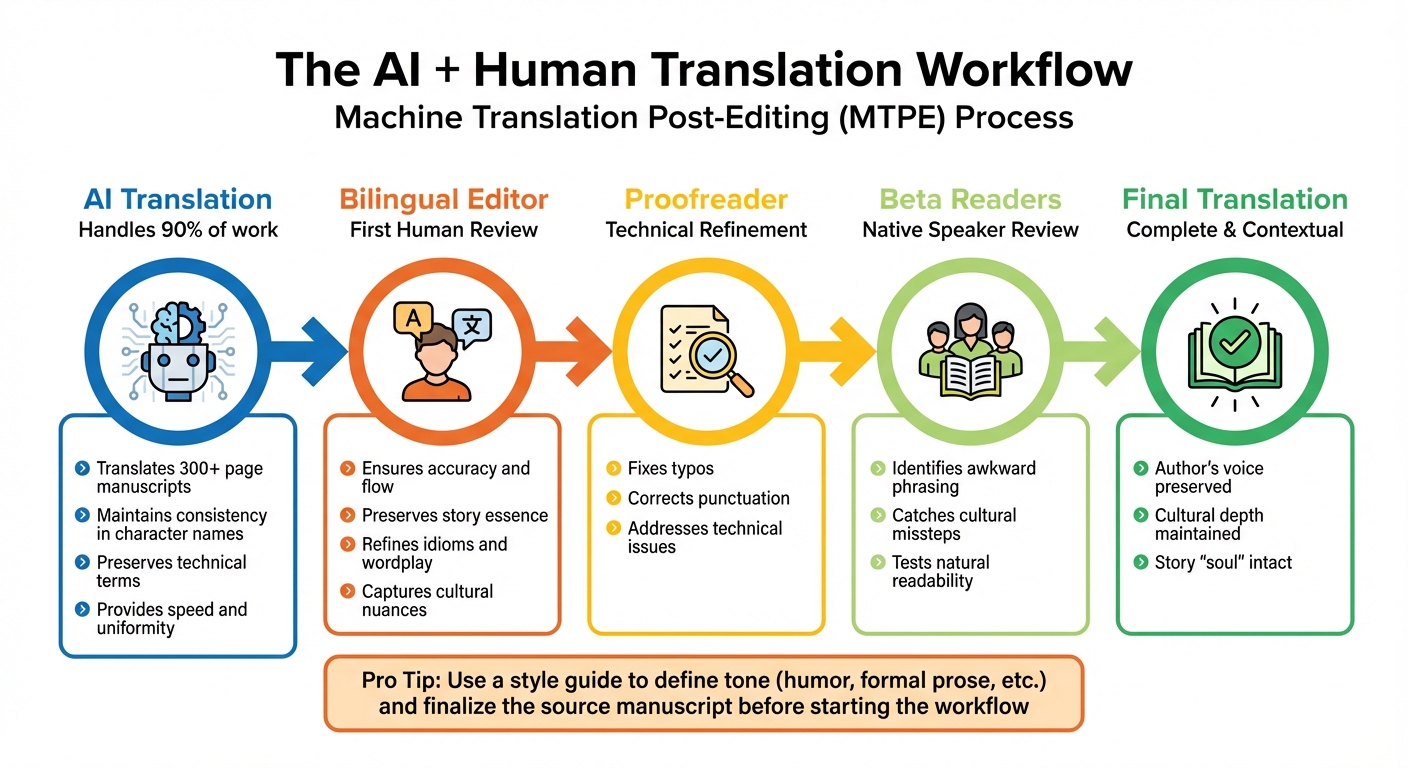
AI and Human Collaboration in Book Translation Workflow
Pairing AI Speed with Human Knowledge
The best translation workflows embrace a Human-in-the-Loop (HITL) approach. Here, AI kicks things off with an initial translation, and human experts step in to refine and polish the results. This process, called Machine Translation Post-Editing (MTPE), is now the go-to method for translating literary works. AI handles about 90% of the heavy lifting, ensuring consistency in things like character names and technical terms across a lengthy manuscript - say, 300 pages. Then, human reviewers take over, focusing on the artistic and cultural elements that breathe life into the story.
AI brings efficiency and consistency to the table, while humans add the necessary nuance. AI is fantastic at maintaining a steady pace and uniformity, but it struggles with idioms, wordplay, and pop-culture references, often translating them too literally and losing their charm. Humans step in to catch those subtleties, like the humor in a pun or the layered meanings in a mystery novel. While AI can recognize patterns and follow a narrative structure, it’s the human touch that preserves the "soul" of the story - those implicit meanings and deliberate ambiguities that make certain genres shine. This collaboration ensures the translation stays true to the author’s voice, blending speed with contextual depth. After AI’s initial work, multiple human reviews ensure the final product aligns with cultural and linguistic nuances.
Refining Translations Through Multiple Reviews
Once AI provides the groundwork, human reviewers refine the translation through multiple layers. First, a bilingual editor steps in to focus on accuracy and flow, ensuring the story’s core essence is preserved from one language to another. Then, a proofreader takes over, tackling typos, punctuation errors, and any minor technical issues that might have been overlooked.
To further perfect the translation, beta readers - native speakers of the target language - highlight awkward phrasing or cultural missteps. Authors can also help shape the process by providing a style guide. This guide outlines the book’s tone, whether it leans toward dry humor or formal prose, helping human reviewers fine-tune the AI’s output to better match the author’s voice. A key piece of advice: finalize the source manuscript before starting the AI-human workflow. Fixing an error in the original text is much simpler than correcting it across multiple translated versions. This approach ensures a smoother and more accurate translation process.
Conclusion
Context is the backbone of preserving the essence and subtleties of literature. It's what makes a translation resonate, ensuring it captures the original tone and meaning. Without context, AI translations often fall flat - producing stiff, unnatural text that misses idiomatic expressions, cultural subtleties, and the distinct voice of the author. As linguist Emily M. Bender aptly states, literary translation is "skilled and artistic work" that goes far beyond "what you would expect to come out of statistical correspondences" [4].
The best approach doesn’t pit AI against human translators - it combines their strengths. BookTranslator.ai exemplifies this synergy by translating books into over 99 languages with remarkable consistency. Human reviewers then step in to polish the translation, refining idioms, cultural references, and stylistic elements that AI alone can't perfect. This partnership merges the speed of AI with the precision of human expertise, creating translations that are both efficient and nuanced.
Looking ahead, AI models are expected to improve their ability to handle "context beyond individual sentences" [1], delivering smoother, more cohesive translations across entire chapters. Even so, the human element will remain irreplaceable for capturing the humor, emotion, and subtle layers that breathe life into literature.
For publishers and authors seeking a global reach, this balanced approach is the way forward. By leveraging AI for speed and human expertise for refinement, they can achieve translations that are both timely and true to the original work.
FAQs
Why do idioms and humor break in AI translations?
Idioms and humor often don't translate well with AI because they depend heavily on context and a deep understanding of culture. AI often misses the intended meaning or emotional undertones, as it tends to translate phrases literally, leading to awkward or inaccurate results. To keep these elements intact and make the translation feel natural, it's always a good idea to have a human review the work.
How much human editing does an AI-translated book need?
The amount of editing needed for AI-generated translations varies based on the text's complexity, cultural context, and the desired quality. For straightforward content, a quick proofread might suffice. However, more intricate pieces often demand deeper revisions to refine tone, correct errors, and incorporate cultural subtleties. While AI can streamline the process, human editors are still crucial for delivering translations that are accurate, culturally appropriate, and emotionally impactful.
How does BookTranslator.ai preserve context and EPUB formatting?
BookTranslator.ai carefully extracts text from books while preserving the original structure, layout, and style. After translating the content, it seamlessly reintegrates it into the original format and ensures it works smoothly across various devices. This approach helps maintain both the meaning and visual presentation of the book in its translated form.