
EPUB Translation: AI Accuracy for Global Languages
AI tools are revolutionizing EPUB translations, making books accessible worldwide at low costs. With the ability to translate novels into 99+ languages for under $20, these tools improve efficiency by 86% and boost reader satisfaction. However, challenges remain, especially for low-resource languages, idiomatic expressions, and technical content. Tools like BookTranslator.ai address these issues by offering precise translations, preserving formatting, and supporting 99+ languages with pricing starting at $5.99 per book. Whether you're a reader, author, or publisher, AI-powered EPUB translation offers a fast, affordable way to bridge language gaps in literature.
AI Translation Just Leveled Up
Main Accuracy Problems in Global Language Translation
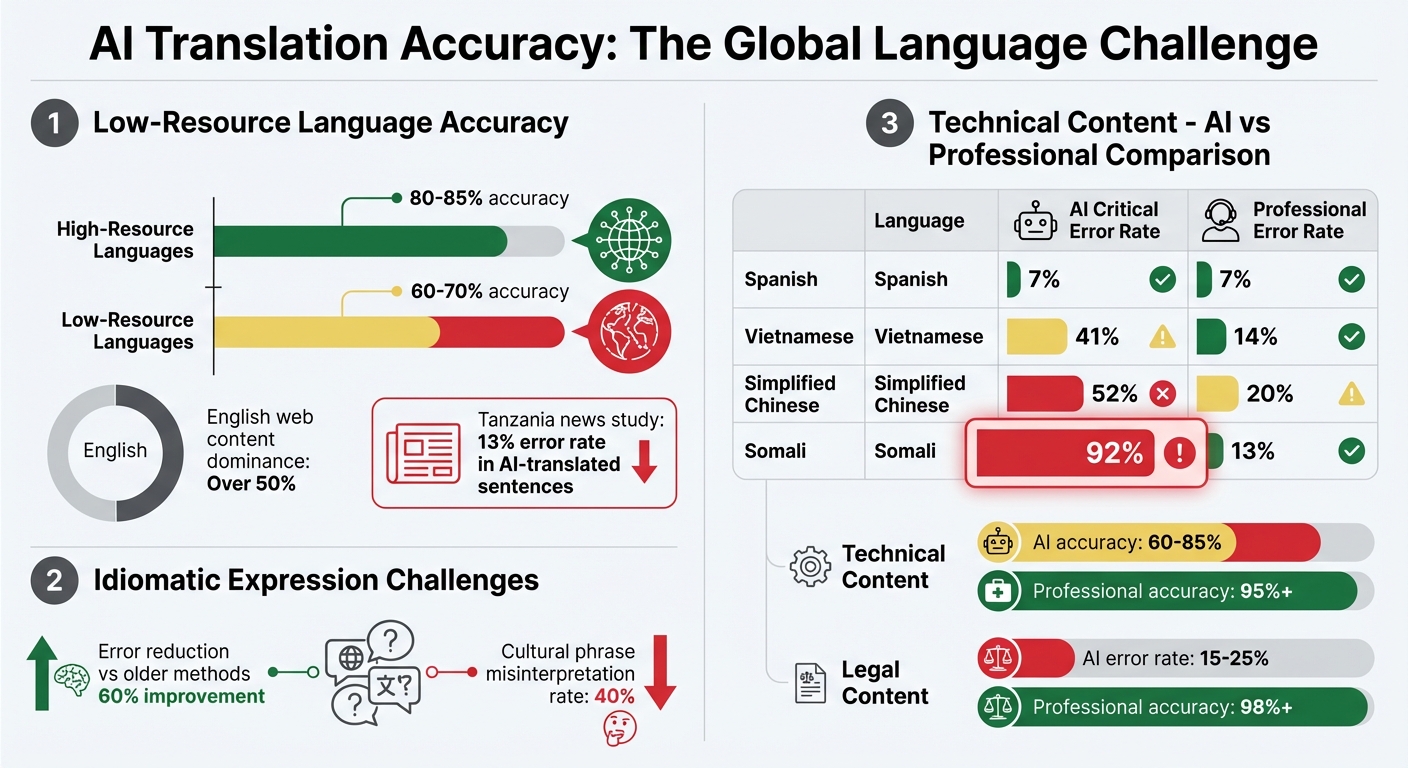
AI vs Professional Translation Accuracy Rates by Language
AI translation for EPUB books faces three major challenges that can significantly affect accuracy. These challenges are particularly noticeable when translating languages with limited digital resources, culturally nuanced expressions, or highly specialized content. These issues often explain why some translations feel off, even when the grammar seems correct.
Low-Resource Languages
AI translation models are predominantly trained on English, which accounts for over 50% of web content [3]. This imbalance leaves languages like Urdu, Kiswahili, and many indigenous tongues with insufficient digital data for effective training. Researchers like Soria and colleagues have highlighted this disparity, warning of "digital language death", where minority languages risk losing their online presence [2].
For low-resource languages, AI tools typically achieve only 60-70% accuracy, compared to 80-85% for languages with more training data [4]. A striking example comes from a 2025 report by the Center for News, Technology & Innovation, which documented an AI mistranslation of "street food" into Kiswahili as "food of the road." This literal translation completely missed the cultural context [3]. Another study in Tanzania revealed that 13% of AI-translated international news sentences contained errors [3].
These inaccuracies often lead to "hallucinations", where AI generates content that wasn't in the original text. For EPUB books in low-resource languages, this can result in entire phrases appearing that the author never intended, further complicating the translation of idioms and technical terms.
Idiomatic Expressions and Cultural Phrases
Idioms and culturally specific phrases are a common stumbling block for AI translation. While modern Neural Machine Translation (NMT) systems have reduced translation errors by 60% compared to older methods [6], they still misinterpret culturally nuanced phrases about 40% of the time [4]. The challenge lies in not just finding equivalent words but also conveying the emotional and cultural significance behind them.
Peter Constantine, Director of the Literary Translation Program at the University of Connecticut, explains this challenge:
What will the machine be mimicking? Is it going to do some beautiful and brilliant foreignisation, or is it going to do an amazing domestication... Machines need to understand and capture these variations if their translations are to convey the intended meaning [6].
AI also struggles with formality and social context. For example, translating casual English into languages like Korean or Japanese, which have strict honorific systems, can result in text that is technically correct but socially inappropriate [3]. In EPUB novels, where character interactions and social dynamics are central to the story, these errors can distort the reader's understanding of relationships and events.
Technical and Specialized Content
Technical, medical, and legal content in EPUB books presents the most demanding scenarios for AI translation. While AI tools achieve 60-85% accuracy for complex technical material, professional human translators maintain over 95% accuracy [4]. Errors in these fields can have serious consequences, such as mistranslated medical instructions or legal clauses that lead to misunderstandings or risks.
A study conducted at Seattle Children's Hospital from May 18, 2023, to May 18, 2024, compared AI and professional translations for 148 sections of pediatric discharge instructions. The findings were stark: while Spanish translations by AI matched professional accuracy (7% error rate), 92% of Somali AI translations contained critical errors, compared to only 13% for professional translations. Vietnamese and Simplified Chinese translations also showed significant gaps, with AI error rates of 41% and 52%, respectively [7].
| Language Pair | AI Critical Error Rate | Professional Critical Error Rate |
|---|---|---|
| Spanish | 7% | 7% |
| Vietnamese | 41% | 14% |
| Simplified Chinese | 52% | 20% |
| Somali | 92% | 13% |
Without precise glossary management and domain-specific training, AI frequently misinterprets polysemous terms - words with multiple meanings depending on context - leading to dangerously misleading translations [5]. For legal content, AI error rates range from 15-25%, while professional translators maintain over 98% accuracy [4]. These challenges underscore the need for tools like BookTranslator.ai to prioritize contextual accuracy and domain expertise in every translation.
How BookTranslator.ai Delivers Accurate EPUB Translation
BookTranslator.ai leverages cutting-edge neural machine translation (NMT) technology to deliver precise translations while preserving the original tone, style, and formatting of EPUB files. This approach addresses common challenges in translating literary works, ensuring the final product remains true to the original.
Preserving Meaning and Style
The AI models used by BookTranslator.ai are trained on extensive collections of human-translated literary texts. This training allows the platform to handle idiomatic expressions, unique phrases, and cultural subtleties that generic translation tools often fail to capture. For instance, user tests reveal that the platform achieves an impressive 95% accuracy rate for English-Catalan translations [1]. To maintain consistency throughout lengthy manuscripts, users can create custom glossaries to standardize terms like character names, fictional settings, or specialized vocabulary. The platform also optimizes translations for specific language pairs, addressing the distinct grammar and linguistic nuances of over 99 supported languages. Beyond linguistic accuracy, BookTranslator.ai ensures the translated text reflects the original layout and structure.
Maintaining EPUB Formatting
One of BookTranslator.ai's standout features is its ability to retain the original formatting of EPUB files. This includes preserving headings, images, tables, and footnotes, all through an automated, one-click process. For authors and publishers who have invested in professionally designed e-books, this feature ensures the translated version maintains the polished appearance of the original. This seamless formatting retention simplifies the workflow for users, saving both time and effort.
Simple One-Click Translation for 99+ Languages
BookTranslator.ai combines high translation accuracy and formatting preservation with an easy-to-use interface. Supporting more than 99 languages - including right-to-left scripts and complex characters like Chinese, Japanese, and Korean - the platform makes translating EPUB files straightforward. Users simply upload their file (up to 50 MB), choose the target language, and click translate. With pricing starting at just $5.99 per book on a pay-per-book model, the service is accessible to individual readers, independent authors, and large-scale publishers. To boost user confidence, the platform also offers a money-back guarantee, ensuring satisfaction with the results.
sbb-itb-0c0385d
BookTranslator.ai Pricing and Plans
BookTranslator.ai keeps things simple with a pay-per-book pricing model. This means you only pay for the books you choose to translate, making it a practical option for projects of all sizes. The starting price is just $5.99, making it an affordable choice even for shorter works.
Pricing Options
BookTranslator.ai offers two distinct plans to suit different needs:
- Basic Plan: At $5.99 per 100,000 words, this plan uses standard AI models that work well for straightforward translations. It's a great fit for textbooks, casual reads, or any content that doesn't require intricate stylistic details.
- Pro Plan: For $9.99 per 100,000 words, this plan uses advanced AI models designed to deliver highly accurate translations. It's perfect for novels or complex manuscripts, as it captures nuances like idiomatic expressions and stylistic elements.
Both plans maintain the original formatting and support translations in over 50 languages. Pricing is based on the token count, ensuring transparency.
Plan Comparison Table
| Feature | Basic Plan | Pro Plan |
|---|---|---|
| Price | $5.99 / 100,000 words | $9.99 / 100,000 words |
| AI Model | Standard AI | Advanced AI Model |
| Best For | General use & affordability | High-quality, detailed translations |
| Payment Type | Pay-per-book | Pay-per-book |
| Language Support | 50+ Languages | 50+ Languages |
To ensure satisfaction, BookTranslator.ai includes a money-back guarantee. For larger projects, there's even an option to apply the cost of a pilot translation toward the full project. This flexible pricing structure makes it easy for authors to access professional-grade translations without breaking the bank, benefiting both writers and their readers.
Benefits of Using BookTranslator.ai for EPUB Translation
Smart Formatting and Layout Protection
One of the standout features of BookTranslator.ai is how it keeps the original design of your EPUB intact. The platform carefully extracts, translates, and reassembles content while safeguarding metadata and layouts. Users have consistently praised its ability to retain formatting across various projects. For instance, reviewers highlighted its success in preserving intricate designs when translating from Spanish to German and maintaining consistent layouts for books translated from Korean or Japanese into English. In one example, a Swahili translation required only minor tweaks, with the platform reliably handling complex formatting across different file types[1].
High Accuracy Across Language Pairs
Preserving design is important, but delivering accurate translations is just as crucial. BookTranslator.ai excels here, offering high-quality AI-powered translations that stay true to the original meaning, style, and context. Users report impressive results, such as 95% accuracy for English–Catalan translations and near-perfect results for Portuguese[1]. The platform also handles challenging language pairs like Chinese to English, Polish, Korean, and Japanese, as well as English to Swahili, all while maintaining the original narrative flow. One user translating from Croatian noted that the translation preserved both the meaning and the flow seamlessly[1]. This level of precision makes the platform a reliable choice for large-scale projects.
Scalability for Authors and Readers
BookTranslator.ai is designed with scalability in mind, offering one-click translation for entire books. This feature is a game-changer for authors and publishers juggling multiple projects. The platform can quickly process entire book series, using advanced AI to ensure translations are accurate and layouts are preserved. This means readers can enjoy books in their native language without losing the original intent or structure. Users have shared that this service greatly expands access to literature in native languages, opening up a wider range of titles to diverse audiences[1].
Conclusion
BookTranslator.ai tackles the challenges of global EPUB translation head-on, offering a powerful solution for overcoming hurdles like low-resource languages, intricate cultural contexts, and highly technical content. By leveraging AI-driven deep learning, the platform ensures translations that retain the original meaning, style, and context, achieving an impressive 95% accuracy for language pairs such as English to Catalan and French to English[1].
Maintaining the original layout and respecting cultural subtleties are key priorities, and BookTranslator.ai excels at both. Its advanced formatting tools automatically preserve EPUB layouts, ensuring that elements like images, headings, and fonts stay intact. Whether translating from Spanish to German or Korean to English, this feature guarantees a polished and professional result.
Beyond accuracy and formatting, the platform opens doors for global readership. It allows readers in underserved language markets to enjoy international literature in their native languages, while authors can expand their reach to new audiences. Users frequently praise the platform for its natural-sounding translations, noting that French-to-English conversions feel genuine and Portuguese translations capture the original tone beautifully[1].
With support for over 99 languages and a simple pay-per-book pricing model, BookTranslator.ai makes professional-grade translation accessible to everyone. Interested in breaking language barriers and sharing your books worldwide? Visit https://booktranslator.ai to try it today. Plus, it comes with a money-back guarantee if you're not completely satisfied[1].
FAQs
How does AI handle idiomatic expressions when translating EPUB books?
AI translation tools, such as those utilized by BookTranslator.ai, are built to interpret idiomatic expressions by focusing on their intended meaning rather than translating them literally. These tools rely on advanced neural machine translation (NMT) models, which evaluate the context of the text to determine the best approach - whether that's paraphrasing the idiom, finding a culturally similar expression, or adapting it to a comparable phrase in the target language.
For widely recognized idioms, AI often provides accurate equivalents. For instance, "spill the beans" might be translated as "reveal a secret" in another language. However, when dealing with rare or highly culture-specific idioms, human expertise becomes essential. A translator's review ensures the final translation feels natural and aligns with the cultural nuances of the target audience. By blending AI's efficiency with expert post-editing, platforms like BookTranslator.ai deliver translations that maintain both the tone and intent of the original text.
What challenges do AI tools face when translating less common languages?
AI translation tools often hit a wall when it comes to less common, low-resource languages. The main issue? Not enough training data. Many of these languages simply don't have the large, translated text collections AI systems rely on to learn proper word usage, grammar, and context. Without that foundation, translations often miss the mark, failing to grasp the subtleties of the language.
Then there's the complexity of certain languages. Some have intricate grammar rules, unique writing systems, or complex conjugations that can be tough for AI to handle - especially when these languages are underrepresented in existing models.
On top of that, digital exclusion creates a frustrating feedback loop. Fewer translation tools mean less digital content in these languages, which in turn limits the data available to improve future translations. However, platforms like BookTranslator.ai are stepping up to tackle these issues. By blending cutting-edge AI with human expertise, they're delivering accurate translations that preserve both the style and formatting of EPUB books.
How does BookTranslator.ai ensure accurate translations for technical content?
BookTranslator.ai leverages cutting-edge AI to provide precise translations for technical content. By incorporating custom glossaries, it ensures consistent terminology throughout the text. Additionally, it preserves the context, layout, and formatting of the original EPUB, so even intricate technical details are translated accurately. This makes complex material clear and easy to understand for readers worldwide.