
Imagine your story in the hands of millions of new readers. When you translate books to English, you're not just crossing a language barrier; you're unlocking the single largest literary market on the planet. It's a massive opportunity, yet surprisingly few authors take the leap. This guide is here to show you exactly how to do it.
Why Bother Translating Your Book Into English?

If you're an author writing in a language other than English, the global stage can feel impossibly distant. But here's the good news: bringing your work to an English-speaking audience is more achievable now than at any point in history. It represents a genuine chance for explosive growth, wider recognition, and a significant boost in sales.
The English-language book market is enormous. We're not just talking about the United States and the United Kingdom; it includes a colossal global readership where English is a first or second language. You're looking at a potential audience of over 1.5 billion people.
Turning the "3% Problem" Into Your Advantage
In publishing circles, you'll often hear about the "3% problem." This refers to a startling statistic: only about 3% of all books published in the U.S. are works in translation. At first glance, that might sound discouraging, but I see it as a massive opening.
What this really means is that the market has an unmet appetite for fresh, international stories and diverse perspectives.
When you translate your book, you're not just another voice in an already crowded room. You're offering something new, something distinct, to an audience hungry for different narratives.
This gap is even more apparent when you look at the most influential bestseller lists. A fascinating analysis of the New York Times bestsellers from 1931 to 2020 revealed that only 2.4% of fiction bestsellers were translations. While that number is small, it proves that when a translated book breaks through, it can achieve spectacular success. For a deep dive into how international bestsellers have made their mark, check out this detailed study.
The Real-World Benefits of Going Global
Breaking into the English market offers a lot more than just a bump in royalties. The advantages of a well-done English translation can fundamentally change the trajectory of your career.
Here's what you stand to gain:
- A Vastly Expanded Readership: You instantly multiply your potential reader base, reaching people you never could have before.
- New Revenue Streams: More markets mean more opportunities for book sales, audio rights, and even merchandising.
- A Stronger Author Platform: A successful English launch elevates your entire profile, attracting international media attention and speaking engagements.
Of course, navigating this new landscape requires a plan. Many authors find that finding a literary agent for your book is a critical step. And thankfully, modern tools are making the translation process itself far more accessible. You can discover more on how AI book translation is a key to global reader engagement in our other article.
From preparing your manuscript to the final polish, this guide will walk you through it all.
Getting Your Manuscript Ready for Translation
Before you even touch a translation tool, there's some critical prep work to do. This upfront effort is honestly the single biggest thing you can do to guarantee the quality of your final English edition.
Skipping this stage is like trying to build a house on a shaky foundation. It's just asking for a world of headaches, frustrating revisions, and extra costs down the road.
The prep work really boils down to two things: polishing your original text so it makes sense to a global audience, and getting your digital file technically perfect. Nailing this ensures your unique authorial voice, story structure, and style all make the leap into English intact. A clean manuscript gives any translator—human or AI—the best possible shot at success.
Polish Your Source Text for Clarity
Every language is packed with its own unique flavor—idioms, cultural inside jokes, and clever wordplay. These are the things that make your writing sing for a native speaker, but they can become serious roadblocks in translation. Your first job is to reread your manuscript through the eyes of an international reader.
Let's say a character in your story uses a common idiom in your language, something like "He kicked the bucket." A direct, literal translation into English could be completely baffling or, worse, unintentionally hilarious. The goal isn't to sterilize your writing, but to spot these potential friction points and smooth them out before they become translation errors.
Here's what that pre-editing process looks like:
- Simplify Tricky Idioms: Look for hyper-local sayings and swap them for more universal phrasing. You don't have to kill the sentiment, just rephrase it in a way that travels well.
- Explain Cultural Nuances: If a scene hinges on a specific tradition, holiday, or historical event, ask yourself if a reader from another country would be lost. Sometimes a short, embedded explanation is all it takes.
- Hunt Down Ambiguity: Read sentences that could have a double meaning. What's perfectly clear in your native language can often become a muddle when translated literally.
Get Your EPUB Formatting Right
Once the text is polished, it's time to get technical and focus on your EPUB file. This is the standard format for most e-books, and it's the file you'll most likely use to translate books to English. I can't stress this enough: messy formatting is the number one cause of jumbled, unreadable translations.
Think of the EPUB's underlying code as the blueprint for your book. If that blueprint is smudged or has inconsistent markings, the final build is going to be a mess. I once worked with an author who used manual line breaks and random font sizes for chapter titles instead of proper heading styles. When the AI translation came back, it couldn't tell where one chapter ended and the next began, merging them into one giant, chaotic text block.
A clean EPUB isn't just a "nice-to-have." It is the technical bedrock of a successful translation. It's what tells the software how to preserve your book's structure—from chapter breaks to italicized thoughts—so the English version perfectly mirrors the original's layout.
To sidestep these nightmares, you need to create a structurally sound file.
Your Essential EPUB Checklist
- Use Proper Heading Styles: Mark all chapter titles and subheadings with designated styles (like Heading 1, Heading 2). This creates a clear hierarchy for the translation software to follow.
- Implement Clean Chapter Breaks: Always use the official "page break" or "section break" feature to separate chapters. Never just hit the "Enter" key a bunch of times.
- Check Special Formatting: Make sure italics, bolding, and blockquotes are applied as styles, not as one-off manual font changes.
- Remove Junk Code: If you converted your manuscript from another format (like a Word doc), it's smart to use a tool like Calibre to scrub any messy, hidden HTML code from the background.
Following these steps ensures that when you're finally ready to translate, the system can read and replicate your book's structure flawlessly. Trust me, it will save you countless hours of cleanup on the other side.
Choosing Your Path: AI vs. Human Translation
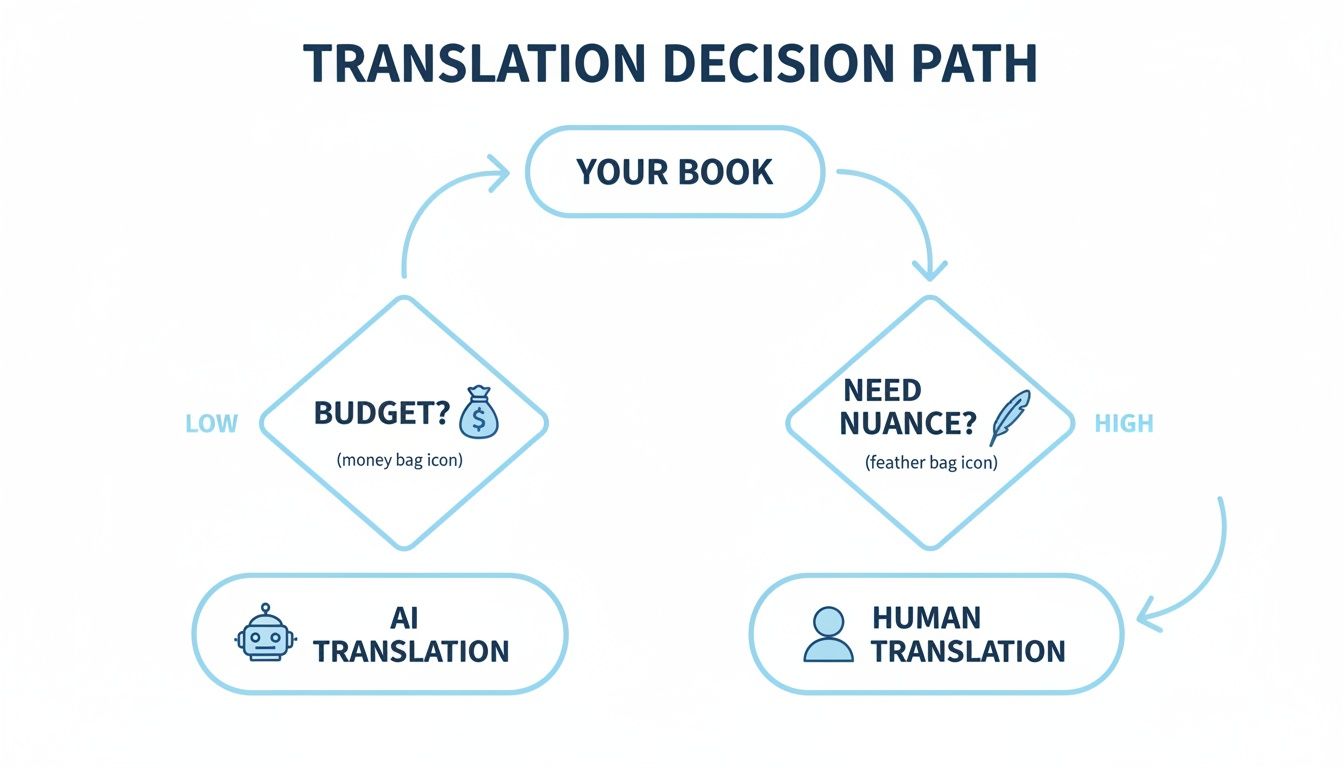
So, you've polished your manuscript and your EPUB file is ready to go. Now comes the biggest decision of the entire project: how will you actually translate your book to English? Will you go the traditional route with a human literary translator, or will you take advantage of the speed and power of an AI tool?
There's no one-size-fits-all answer here. Honestly, the best choice really boils down to your specific book, your budget, your timeline, and what you hope to achieve. Let's cut through the noise and look at the real-world pros and cons of each path.
The Case for Human Translation
A professional human translator isn't just a fluent speaker; they're a literary artist in their own right. Their real magic lies in capturing the soul of your work—the subtle cultural jokes, the clever wordplay, and the unique authorial voice that makes your story yours.
If you've written deeply literary fiction, poetry, or a book where every word is loaded with subtext, a human translator's touch is hard to beat. They can find a culturally relevant equivalent for a hyper-local idiom, preserve a tricky double entendre, and make sure the rhythm of your prose sings in English.
But this level of artistry comes with a hefty price tag and a long wait.
- Cost: Professional literary translators usually charge by the word, with rates falling somewhere between $0.10 and $0.25. For a typical 80,000-word novel, you're looking at an upfront investment of $8,000 to $20,000.
- Time: This is a meticulous, slow process. A skilled professional might take anywhere from three to twelve months—sometimes longer—to translate a full-length book, depending on their workload and the text's complexity.
This path is often best for authors who have serious financial backing or a traditional publishing deal footing the bill. For most indie authors, those numbers are simply out of reach.
The Rise of High-Quality AI Translation
Not long ago, "machine translation" meant clunky, literal, and often comical results that were useless for anything creative. That's not the world we live in anymore. Today's AI models, like the ones that power BookTranslator.ai, are trained on massive libraries of literature. This allows them to grasp context, tone, and style with frankly stunning accuracy.
The biggest wins for AI translation are its incredible speed and rock-bottom cost. These two factors have blown the doors wide open for authors who were previously locked out of the global market.
The decision to use AI isn't just about saving money; it's about making global distribution a viable reality. For the cost of a few cups of coffee, an indie author can now achieve what was once only possible for major publishing houses.
Instead of waiting months, you can have a complete translation in minutes. Instead of spending thousands, the cost can be as low as $10 or less. This game-changing shift means you can test your books in new markets, translate your entire backlist, and reach a worldwide audience without breaking the bank.
AI vs Human Translation: A Head-to-Head Comparison
Choosing between these two powerful options requires a clear understanding of what each brings to the table. The table below breaks down the key differences to help you decide which approach, or combination of approaches, is the right fit for your project.
| Factor | AI Translation (e.g., BookTranslator.ai) | Human Translation |
|---|---|---|
| Speed | Minutes to hours | Months to a year |
| Cost | Typically under $10 for a full novel | $8,000 - $20,000+ per novel |
| Best For | Genre fiction, non-fiction, technical manuals, and authors on a budget. | Literary fiction, poetry, and works with deep cultural subtext. |
| Workflow | Instant translation followed by human post-editing for polish. | A long, collaborative process with a dedicated professional. |
Ultimately, the best approach is often a pragmatic one. A hybrid model—where AI generates a high-quality first draft and a human editor provides the final polish—is quickly becoming the new industry standard for smart, budget-conscious authors. It gives you the best of both worlds: speed and affordability from the AI, with the nuance and artistry of a human expert.
Modern AI does an exceptional job of preserving literary style, but it's a nuanced process. If you want to dive deeper, you might find our guide on how AI and human translators work to preserve literary style really helpful.
At the end of the day, AI has made it possible for nearly any author to translate books to English. It offers a powerful, fast, and affordable foundation that, when paired with a final human touch, delivers a professional-quality book ready for readers around the world.
Bringing Your Book to Life with an AI Translator
Alright, your manuscript is prepped and ready to go. Now for the fun part: the actual translation. When you're working with a modern AI platform, this step is surprisingly straightforward. I'll walk you through the process using a tool like BookTranslator.ai, which gives a great real-world feel for how these services operate.
The whole point of these platforms is to get the tech out of your way. Forget about coding or clunky software. If you have your clean EPUB file, you have everything you need. The experience is designed to be as simple as uploading a file to Google Drive, so it's accessible even if you're not a computer whiz.
Getting Your Book Into the System
First things first, you need to hand your book over to the AI. This is where all that prep work you did earlier really pays off. A properly formatted EPUB doesn't just upload without a hitch; it lets the AI instantly see the book's skeleton—the chapters, the headings, and all that special formatting like italics or block quotes.
When you upload your EPUB, the platform gives it a quick once-over, calculating the word count and making sure the file is sound. On BookTranslator.ai, for example, you're met with a simple drag-and-drop box. No fuss.
This is the kind of clean interface you should expect.
The design is all about one thing: getting your file uploaded. It's an intuitive first step that takes just a few seconds and sets you up for a smooth translation run. A clean file here prevents a world of headaches later, like jumbled chapters or missing text.
Choosing the Right Engine for Your Story
Not all stories are the same, and neither are AI models. Once your book is uploaded, you'll get to pick the "engine" that does the heavy lifting. This is a critical choice that directly shapes the tone and quality of your translation.
Think of it like picking a narrator for your audiobook. One might have a crisp, clear voice perfect for non-fiction, while another has the dramatic flair needed for a gripping thriller. AI models have similar specialties.
- Standard Models: These are workhorses, perfect for non-fiction, technical guides, and most genre fiction. They're incredibly fast, accurate, and get the job done when the plot and information are the most important things.
- Advanced Models: If you've written literary fiction, poetry, or anything with a distinct stylistic voice, you'll want to lean toward an advanced model. These newer AIs have been trained on vast libraries of literature, so they have a much better grasp of subtext, metaphor, and that hard-to-define authorial flair.
Often, it's a simple trade-off between cost and creative need. Advanced models might cost a little more, but for a book where nuance is everything—say, a complex historical novel—that investment is easily justified. For a straightforward sci-fi adventure, a standard model will likely serve you perfectly.
How AI Keeps Your Layout and Voice Intact
After you've picked your model and hit "go," the AI gets to work. This is where the magic happens. A good translation tool doesn't just perform a word-for-word swap. It reads the underlying code of your EPUB file.
This means the AI understands that "Chapter 1" is a major heading and that an italicized phrase represents a character's inner monologue. As it translates the text, it rebuilds your book in English, carefully slotting everything back into its original place.
The AI works as both a linguist and a typesetter. It ensures the English version isn't just a wall of text but a fully formatted book that mirrors the original reading experience.
In just a few minutes, you'll receive a brand-new EPUB file. This isn't just a document; it's a market-ready e-book, formatted and structured just like the original. The process to translate books to English is no longer a project that takes months—it's something you can accomplish in an afternoon.
The Crucial Role of Post-Translation Editing

So, the AI has delivered your translated EPUB, perfectly formatted and ready to go. It's a fantastic feeling, but the job isn't quite done yet. This next step—what we call post-translation editing—is what separates a good translation from a truly great one.
Think of this phase less like "fixing mistakes" and more like applying that final, human polish. The AI gets you an incredibly solid foundation, often over 95% of the way there. Your role is to add that last 5% of nuance, artistry, and cultural resonance that only a person can bring to the table.
This is how you ensure your unique authorial voice shines through, creating an authentic connection with a brand-new English-speaking audience.
What to Look for During the Editing Pass
Your main goal here is simple: read the book as if you were the target reader. Does it flow naturally? Does it sound like it was written in English from the very beginning? This is your chance to smooth out any slightly robotic phrasing and elevate the prose.
While you're focusing on the language, don't forget how much a professional editor can polish your manuscript. It's worth learning how to hire freelance book editors who specialize in this kind of refinement after the heavy lifting of translation is done.
A focused editing pass transforms your translated text into a seamless, enjoyable reading experience.
The post-editing phase is where you blend AI's efficiency with human creativity. It's not about correcting the machine; it's about collaborating with it to produce a final manuscript that feels both authentic and polished.
This human touch is absolutely vital. The global translation industry is booming, and it's projected to shoot past $70 billion in 2025. Machine translation alone is expected to hit $3 billion by 2027. With cross-border e-commerce on the rise, getting your content into English gives you access to 80% of global online purchasing power.
Your Post-Translation Editing Checklist
To keep this process from feeling overwhelming, I recommend a systematic approach. Don't try to fix everything at once. Instead, make several passes, each with a specific focus.
- Consistency Check: First, just scan for consistency. Are all character names, key locations, and unique terms spelled the same way from chapter one to the end?
- Dialogue Polish: Read every line of dialogue out loud. Seriously. Does it sound like something a real person would say? Tweak any clunky or overly formal bits to make them sound natural.
- Cultural Sensitivity Review: Be on the lookout for any concepts, jokes, or cultural references that might not land well with an English-speaking audience. You might need to adapt them slightly to fit the new context.
- Tone and Voice Alignment: Does the translation feel like the original? If your prose is witty and fast-paced, make sure the English version has that same energy.
This structured method helps you catch the subtle details that make a huge difference. You can also explore our guide on how providing feedback improves AI book translations to get even better results on future projects.
A Real-World Editing Example
Let's see this in action. Imagine a raw AI translation produced this sentence:
- Before: He looked at the sky, which was a canvas of late afternoon, with the sun performing its descent.
Grammatically, it's flawless. But it feels a bit stiff, almost academic. A human editor can easily restore the author's intended voice with a small adjustment.
- After: He glanced at the late afternoon sky as the sun began its descent.
See the difference? The "after" version is more concise, active, and just sounds better. It carries the same information but with a more fluid, literary feel. This is exactly the kind of subtle but powerful improvement you're aiming for when you translate books to English and give them that final human touch.
Your Top Questions About Book Translation, Answered
Once you start seriously thinking about translating your book, a lot of questions pop up. It's totally normal. You're suddenly dealing with legal fine print, budgeting, and the very real concern of whether your authorial voice will survive the jump to a new language.
Let's cut through the noise. Here are some clear, direct answers to the most common questions I hear from authors and publishers looking to translate their books to English.
What Are the Copyright Rules for a Translated Book?
Copyright can feel like a legal minefield, but it's actually pretty straightforward when it comes to translations.
If you wrote the book, you own the copyright. Simple as that. When you pay for a translation, you're just creating what's legally called a "derivative work." You maintain full ownership of that new English version.
Now, if you're planning to translate someone else's book, the rules flip entirely.
- You absolutely must get permission. Translating a book you don't own without a formal agreement from the copyright holder isn't just a bad idea—it's copyright infringement.
- A licensing agreement is non-negotiable. This is the legal document where you'll hash out royalties, distribution rights, and all the other terms with the original author or publisher.
- The translation becomes its own copyrighted work. The translated text is considered a new creative piece, and the copyright is typically held by whoever commissioned and paid for it (in this case, you).
How Much Does It Really Cost to Translate a Book?
The investment needed to translate a book can be anything from a few cups of coffee to the price of a small car. The biggest factor, by far, is whether you go with a human translator or an AI-powered service.
A professional literary translator usually charges by the word. You can expect rates anywhere from $0.10 to $0.25 per word, sometimes more, depending on their experience and how complex your manuscript is. For a standard 80,000-word novel, you're looking at a bill between $8,000 and $20,000.
This is where AI has completely changed the game. Services like BookTranslator.ai can translate an entire 80,000-word novel for a flat fee, often under $100. Suddenly, going global isn't a dream—it's a practical next step for almost any author.
One thing to always budget for, no matter which path you take, is post-translation editing. A good editor can cost anywhere from a few hundred to a few thousand dollars, but that final polish is what makes a good translation great.
Can AI Truly Capture an Author's Unique Voice?
This is the big one, isn't it? The question every author asks. And the answer, honestly, is yes—modern AI has gotten incredibly good at understanding and preserving an author's voice.
Forget the clunky, literal translations of a few years ago. Today's best AI models have been trained on massive libraries of literature. They don't just swap words; they grasp context, tone, and nuance. They can tell if your style is sharp and witty, dark and suspenseful, or warm and conversational, and they'll aim to replicate that in English.
For most non-fiction and genre fiction, the first draft you get back from a top-tier AI is often over 90% of the way there. It gives you a fantastic foundation that just needs a human touch-up. While highly lyrical prose or poetry will always need a skilled human editor to perfect, AI handles the heavy lifting beautifully while honoring your original intent.
What Is the "3% Problem" in Publishing?
You might hear people in the industry talk about the "3% problem." It's a striking statistic: only about 3% of all books published in the major English-speaking markets are works in translation. It sounds discouraging, right?
Wrong. For you, the non-English author, this isn't a barrier. It's a wide-open door.
The market isn't oversaturated with international voices; it's starving for them. English-speaking readers are missing out on a world of incredible stories. By choosing to translate your books to English, you aren't just another voice in the crowd. You're bringing something fresh, different, and exciting to the world's biggest book market.
Ready to bring your story to a global audience? With BookTranslator.ai, you can get a professional-quality translation of your entire book in minutes, for a fraction of the traditional cost. Preserve your unique voice and original layout while reaching millions of new readers. Translate your book today!