
AI Localization for Multilingual Publishing
Publishing globally is easier than ever with AI localization tools. These tools go beyond translation - they adjust content for local nuances, tone, and context. This approach saves time and money compared to traditional methods, making international publishing accessible for independent authors and small publishers.
Here's the key takeaway:
- AI localization combines machine translation with human editing for accurate, localized content.
- Tools like BookTranslator.ai offer affordable, fast solutions, translating 100,000 words for as low as $5.99.
- Multilingual publishing helps authors reach global readers, expand their audience, and boost sales.
- AI translation engines use advanced models to deliver natural, fluent translations in over 99 languages.
- Human post-editing ensures quality, refining tone and meaning for specific audiences.
If you're an author or publisher, start small - translate a single book, track its performance, and scale up. With AI localization, global publishing is no longer a costly or time-consuming challenge.
Core Elements of AI Localization
How AI Translation Engines Work
Modern AI translation engines have transformed the way we handle multilingual content. These systems, powered by neural machine translation (NMT) technology, rely on advanced language models like OpenAI's GPT or Google Gemini, which are trained on billions of sentence pairs. By leveraging transformer architectures, these engines analyze entire sentences and paragraphs, considering context, grammar, and semantics all at once. The result? Translations that feel natural and fluent in the target language.
Here's how it works: the engine breaks down text into tokens, converts them into mathematical vectors, and then reassembles them into the target language. This process not only ensures grammatical accuracy but also captures subtle nuances. For example, the engine can differentiate between multiple meanings of a word based on context or translate idioms and expressions appropriately. A real-world example of this efficiency is Polhus, which localized 1.6 million words into seven languages between 2023 and 2024 using AI. They achieved a 75% approval rate for translations that required no human editing, saving around $80,000 and countless hours compared to traditional methods [3].
Many AI platforms also offer tools like glossaries and style guides to align translations with a brand's tone and voice. Feedback loops further enhance these systems, retraining models to improve accuracy based on editor corrections [1][2]. However, translation isn't just about accuracy - it's also about adapting content to connect with diverse audiences on a deeper level.
Adapting Content for Different Cultures
Localization goes beyond just translating words; it's about making content resonate with the target audience. This often involves replacing idioms, cultural references, or imagery that may not translate well or could even offend. AI translation engines use their contextual understanding to suggest culturally appropriate alternatives, but challenges persist. Humor, for instance, often gets lost in translation, and symbols can carry vastly different meanings depending on the culture.
To address these issues, many platforms offer terminology management and in-context editing tools. These allow users to preview how content will appear after adaptation, ensuring it aligns with local expectations. Providing detailed prompts, glossaries, and context to AI models can guide them toward better choices while preserving the original tone and intent [1][5]. However, for nuanced content - like marketing campaigns or emotionally charged narratives - manual review is crucial to catch subtleties that AI might overlook. Human input ensures these adaptations truly connect with the intended audience.
Human Review and Quality Control
Even with AI handling the heavy lifting, human expertise remains essential for delivering polished, high-quality translations. AI can struggle with cultural nuances, subtext, humor, and maintaining an author's unique voice. This is where Machine Translation Post-Editing (MTPE) steps in. Bilingual editors check the translation for accuracy against the source text, while native speakers refine the output for natural flow and readability.
For example, a wellness brand adopted an AI-driven workflow that reduced translation costs by 60% and achieved a 99.7% on-time delivery rate [4]. Quality control in such workflows often includes bilingual reviews by local experts, automated checks for consistency through translation management systems, and feedback loops to update glossaries with editor corrections [1][3]. This hybrid approach balances speed and cost-effectiveness with the quality needed for publication-ready results.
sbb-itb-0c0385d
How Language Translation AI Helps Authors Reach Global Audiences with Ease
Creating an AI Localization Workflow
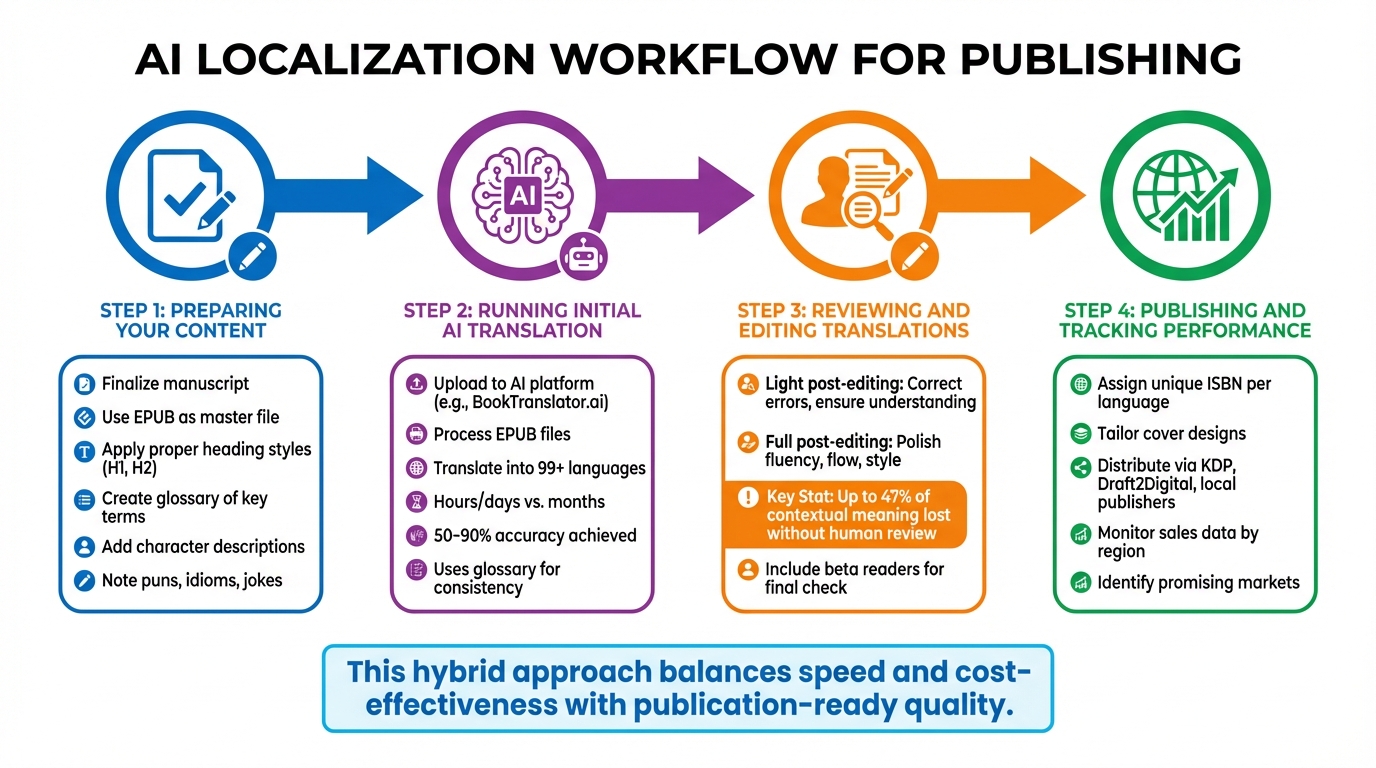
4-Step AI Localization Workflow for Global Publishing
Building an effective AI localization workflow involves four key steps: preparing your content, running AI translation, refining with human post-editing, and tracking performance. This approach combines the speed and precision of AI with the nuanced touch of human expertise, making it scalable for global publishing.
Step 1: Preparing Your Content
Before diving into translation, make sure your manuscript is finalized. Unpolished content can lead to unnecessary revisions later. Use EPUB as your master file to ensure formatting stays intact. Clean up your document by using built-in word processor tools - apply heading styles (H1 for titles, H2 for chapters) instead of manually bolding or adding spaces. Eliminate stray comments, fix styling inconsistencies, and properly anchor images within the text.
Another crucial step is creating a glossary of key terms. Include character names, fictional locations, technical terms, and any unique concepts that need to remain consistent. For fiction, you can even add short character descriptions that highlight their tone or speech style (e.g., formal or casual). If your work contains puns, idioms, or jokes, provide notes explaining their intended meaning to help the AI handle them more appropriately.
Once your manuscript and glossary are polished, you're ready to move forward with AI translation.
Step 2: Running Initial AI Translation
Upload your finalized file to an AI translation platform. Modern neural machine translation (NMT) systems, like BookTranslator.ai, can process EPUB files and maintain your formatting while translating into over 99 languages. What used to take months can now be done in just hours or days.
The AI uses your glossary and style guide to ensure consistency in names, tone, and other key elements. The result is a first draft that typically achieves between 50% and 90% accuracy, depending on the complexity of your content and the language pair.
This draft serves as a solid foundation for the next stage: human review.
Step 3: Reviewing and Editing Translations
Human post-editing is essential to refine the AI's output. A bilingual editor should first verify that the meaning is accurate and then focus on improving fluency and style. Native proofreaders can help ensure the text feels natural and error-free.
You can choose between two levels of post-editing based on your goals and budget:
- Light post-editing: Focuses on correcting errors and ensuring the content is understandable.
- Full post-editing: Polishes the text for fluency, smooth flow, and stylistic quality.
Studies suggest that without this human review, up to 47% of contextual meaning can be lost [7].
"Post-editing is (and always will be) a human task: it's easy to forget how humans write in these challenging times, even for linguists!" - Rebecca Iacone, Post-Editor [6]
To catch any remaining issues, consider having native-speaking beta readers review the text. They can flag awkward phrasing or cultural references that don't land well. After editing, let the text sit for a day before your final review - this pause can help you spot mistakes you might have missed during intense editing sessions.
Once the post-editing is complete, you're ready to publish and track your results.
Step 4: Publishing and Tracking Performance
Assign a unique ISBN to each language version of your book. This is crucial for accurately tracking sales and inventory across global markets. You maintain full copyright over AI-generated translations, as these are considered derivative works owned by you as the original creator.
Tailor your cover designs and marketing materials to fit the preferences of your target audience. For example, imagery and taglines that resonate in one region may need adjustments for another. Distribute your translated books through platforms like Amazon KDP, aggregators like Draft2Digital, or by partnering with local publishers, depending on your strategy.
Finally, monitor your sales data to identify promising markets. Tools like Amazon KDP's reporting feature can reveal where international sales are gaining traction. For instance, unexpected success in Italy might signal an opportunity to focus on that market for your next project or to invest in targeted marketing there. Tracking these insights not only helps optimize your current efforts but also guides future expansions into new languages and regions.
Scaling to Multiple Languages and Markets
Once you've got the workflow for one language down, the next step is tackling multiple markets. The challenge? It's not small. The good news is that AI localization tools make this process far easier than the old-school methods. Instead of juggling dozens of translators and waiting months, you can now roll out releases in several languages in just a few weeks.
Managing Large Translation Projects
Start by standardizing your source files using EPUB. Why? It keeps the layout and formatting consistent across all languages, sparing you the headache of dealing with different file types for every market.
Next, create a centralized library of linguistic assets - this includes your glossary and style guide. This ensures that character names, technical terms, and tone stay consistent across translations. As your work evolves, updating this library means every new translation benefits from the latest refinements.
The hybrid workflow is key here. AI takes care of the bulk of the translation work across all languages at once, while human editors step in to fine-tune the details. In fact, more than 75% of organizations now rely on generative AI for translation and localization tasks [11]. This approach allows for simultaneous releases in multiple languages - like German, Spanish, French, Italian, and Portuguese - something that used to be both expensive and time-consuming with traditional methods.
This streamlined process naturally ties into improving your online visibility, which we'll explore in the next section on SEO for localized content.
SEO for Localized Content
If you want strong search rankings in international markets, you'll need more than just a translated book description. Start by implementing hreflang tags with proper self-referencing and bidirectional links so your pages display correctly for international audiences. Surprisingly, about 75% of international websites get hreflang tags wrong, which can mess up search rankings [9].
For your URL structure, stick to subdirectories (like yoursite.com/de/ for German or yoursite.com/es/ for Spanish). This setup keeps everything under one domain, making it easier to manage while also boosting your overall search authority.
Don't just translate keywords - do regional keyword research. For example, how someone searches for "fantasy romance" in English might be completely different in Spanish or Japanese. Look into local search habits and terms to find the keywords your audience actually uses [8][10]. Companies targeting three or more international markets with localized content often see 40–60% of their organic traffic coming from outside their primary market within 18 months [9].
These steps lay the groundwork for understanding the real impact, as shown in the case study below.
Case Study: Reducing Costs with AI
Traditional translation methods are both pricey and slow. Enter BookTranslator.ai. With this tool, translating a 100,000-word novel costs just $5.99 per 100,000 words and takes only a few days - even with human post-editing included.
The speed is just as important as the savings. Releasing in multiple languages simultaneously allows you to ride the wave of launch momentum across all your markets at once. Instead of staggering releases over months, you can create global buzz as readers from different countries discover your work at the same time. This strategy not only amplifies your marketing efforts but also helps you identify which regions are worth further investment and which ones might need less attention.
Measuring AI Localization Performance
Once you've launched your multilingual content, it's crucial to measure its performance. This ensures your AI-driven workflow is delivering on its promises of cost efficiency, broader audience reach, and high-quality translations.
Metrics to Track
Start by evaluating quality metrics. Automated scores like BLEU or COMET provide a baseline for translation accuracy, but for more nuanced content, involve human reviewers using Linguistic Quality Assurance (LQA) scoring. The LQA formula is: ((Total points – Errors) / Total points) × 100 [13]. Keep in mind that continuous monitoring is more effective than a one-time assessment - what worked last quarter may not reflect current performance [12].
On the operational side, focus on metrics like cost per word, turnaround time (TAT), and Translation Memory (TM) leverage. Higher TM usage typically translates to lower costs over time [13]. Another key metric is Time to Edit (TTE), which measures how long editors spend refining AI outputs. A decrease in TTE is a sign that your AI engine is learning and improving [16].
For business impact, track conversion rate increases by locale - localized content can convert 2–4x better than English-only pages. Monitor customer retention in new markets, regional revenue growth, and engagement metrics like clicks and shares for localized material. Additionally, use Net Promoter Score (NPS) to gauge customer satisfaction [13][15].
These metrics don't just measure success - they also highlight areas where your workflow can improve.
Improving Your Workflow
Performance metrics can guide you in fine-tuning your workflow. For instance, set up automated routing that flags low-confidence translations for human review, while allowing high-quality output to go live without intervention [12]. Prioritize human review for high-stakes content, like legal disclaimers or UI text, while letting AI handle lower-risk material [12].
To identify bottlenecks, compare TAT and cost per word across different language pairs. If German translations, for example, consistently take longer or cost more, investigate whether the issue lies in terminology, process inefficiencies, or even prompt engineering. Before making changes, establish a baseline by documenting your current costs, timelines, and error rates. This will help you measure the impact of improvements accurately [14].
Calculating ROI
To calculate ROI, use the formula: ROI = (Net Profit / Translation Costs) × 100. Include factors like new revenue, cost savings, and opportunity value to get a complete picture [13][15].
Here's an example: A project management SaaS company invested $81,800 to localize content into Spanish, French, and German using AI workflows. By the end of Year 1, they generated $670,000 in new revenue, saved $45,000 in support costs (localized products often see 66% fewer support tickets from non-English users), and saved $38,000 in developer time. The result? An impressive 820% ROI [15].
"Translation and localization helps you enable revenue and engagement. It rarely causes revenue by itself, but it's essential for international growth." - POEditor [13]
Remember, ROI should be evaluated over quarters or years, not just individual projects. Translation Memory, for instance, delivers increasing value over time - after six months, it can cut costs by 30–50% [15]. The longer you use AI localization, the better your returns.
This kind of ROI clearly demonstrates how blending AI efficiency with targeted human oversight can drive global success in publishing.
Conclusion
AI localization is reshaping global publishing by offering a blend of AI-powered translation tools and strategic human involvement. With this approach, content can be translated into over 99 languages while preserving its original meaning, tone, and structure - all at a fraction of the cost and time compared to traditional methods. For example, one publisher significantly reduced both costs and timelines by approving the majority of AI-generated translations without requiring edits [3].
The process is simple: start by preparing your content with clear glossaries and style guides. Then, use AI tools for translation, route critical materials for human review, and track key metrics like cost per word and turnaround time. This hybrid model allows you to scale your operations without compromising on quality, making it a practical and low-risk way to test the waters.
To get started, consider experimenting with BookTranslator.ai on a smaller project, such as translating a single EPUB book. With its one-click setup, it can translate 100,000 words into 99+ languages for just $5.99. Use this trial to evaluate approval rates and editing times, refining your process before scaling up to your full catalog. Additionally, leveraging Translation Memory over time can drive further cost reductions, as noted earlier in this guide [15].
FAQs
When should I use human post-editing vs. AI-only translation?
AI translation shines for large-scale projects that demand speed and lower costs. It's particularly effective for handling straightforward, high-volume texts. However, AI often stumbles when it comes to interpreting idioms, subtle meanings, or culturally specific nuances. It's also not ideal for creative or highly specialized content.
For tasks requiring absolute precision - like literary translations or legal documents - human post-editing becomes essential. A popular middle ground is a hybrid approach: using AI to generate a first draft and then having a human refine it. This method combines the efficiency of AI with the nuanced touch of human expertise, making it a solid choice for more complex or nuanced content.
How do I keep character names and key terms consistent across languages?
Creating consistency for character names and key terms in multilingual publishing starts with building detailed character profiles. These profiles should cover aspects like appearance, style, and key identifiers. To streamline the process, leverage AI tools that can store and reuse this information, ensuring uniformity across all languages. By pairing these profiles with AI's capability to maintain style and key details, you can guarantee that names and terms stay consistent throughout translations.
What metrics should I track to know if localization is paying off?
To gauge the success of your localization efforts, it's important to track a mix of quantitative and qualitative metrics. Here are some key areas to focus on:
- Market expansion revenue: Look at sales growth in newly localized regions to see how well your content resonates with the target audience.
- Cost savings: Measure reductions in translation and localization expenses, which can show improved efficiency.
- Speed of localization: Evaluate how quickly your workflows enable you to publish localized content, ensuring you stay competitive.
On the qualitative side, consider:
- Reader engagement: Pay attention to multilingual readership data and feedback to understand how well your content connects with diverse audiences.
- Long-term ROI: Monitor factors like market share growth and increased brand recognition in localized markets.
Together, these metrics provide a comprehensive look at how localization impacts your business and highlights its overall value.