# 5 Ways to Measure AI Localization ROI
AI localization can turn translation from a cost into a growth driver. Here's how to measure its ROI:
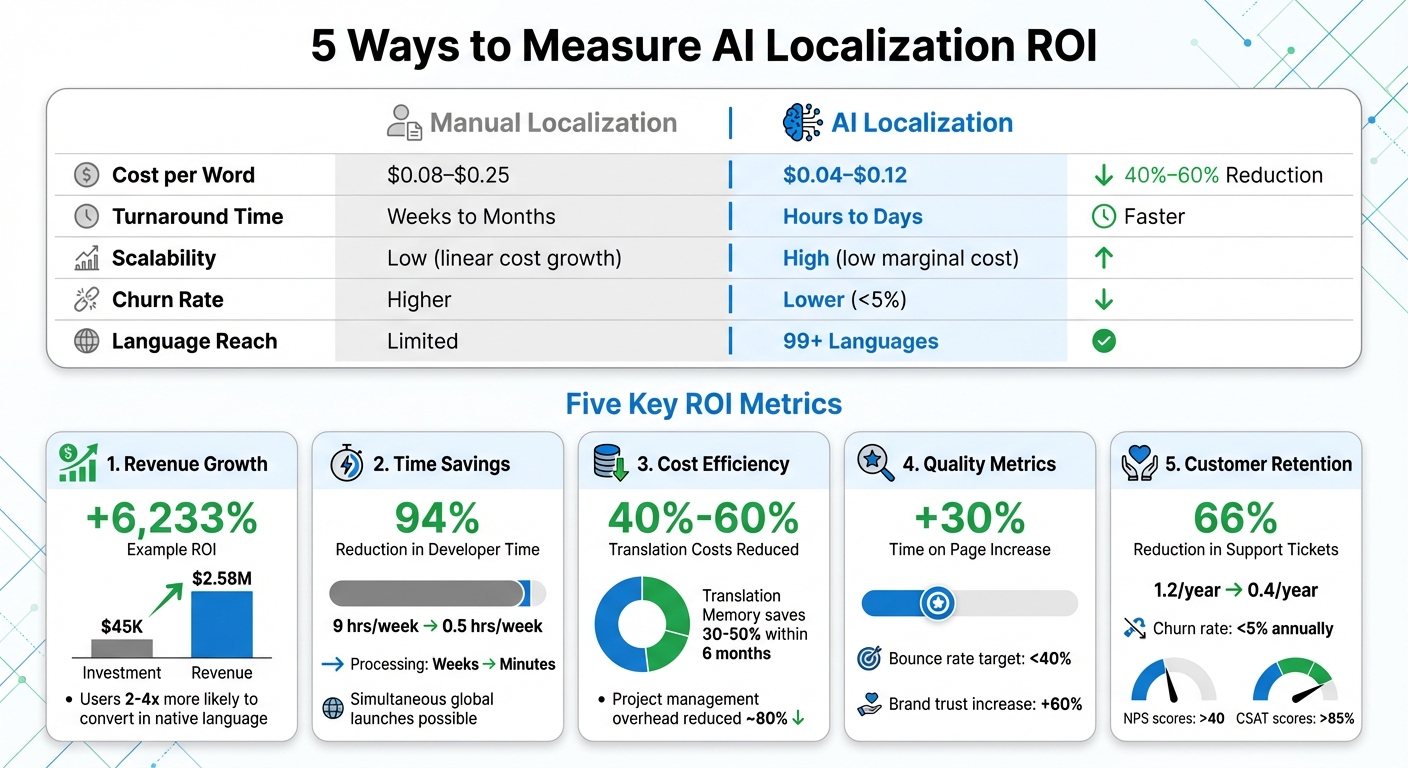
- **Revenue Growth**: Track sales increases in new markets. Example: A $45,000 investment brought $2.58M in revenue - a 6,233% ROI.
- **Time Savings**: AI reduces turnaround from weeks to days, saving time for faster global launches.
- **Cost Efficiency**: AI cuts costs by 40%-60%, lowering translation from $0.08–$0.25/word to $0.04–$0.12/word.
- **Quality Metrics**: Monitor engagement (bounce rates, time-on-page) to ensure localized content resonates.
- **Customer Retention**: Localized users churn less and trust brands more, boosting loyalty and long-term value.
**Quick Comparison**:
| Metric | Manual Localization | AI Localization |
|--------|-------------------|-----------------|
| Cost per Word | $0.08–$0.25 | $0.04–$0.12 |
| Turnaround Time | Weeks to Months | Hours to Days |
| Scalability | Low (linear cost growth) | High (low marginal cost) |
| Churn Rate | Higher | Lower (<5%) |
| Language Reach | Limited | 99+ Languages |
AI-powered tools like **[BookTranslator.ai](https://booktranslator.ai/)** make localization faster, cheaper, and more effective, helping businesses grow globally. Start by tracking costs, time, and engagement to measure your ROI.
Manual vs AI Localization: Cost and Performance Comparison
## 1. Track Revenue Growth from New Markets
### Revenue impact (e.g., sales or subscriptions)
One of the clearest ways to gauge the ROI of AI localization is by monitoring **revenue growth in newly localized markets**. Use tools like [Google Analytics](https://marketingplatform.google.com/about/analytics/) to set up geographic segmentation and compare revenue before and after launching localized content. To dig deeper, tag your marketing campaigns with specific UTM parameters (e.g., `utm_campaign=french-localization`) to directly link conversions to your localization efforts [[4]](https://intlpull.com/blog/measuring-localization-roi-complete-guide-2026).
Here's a real-world example: In 2025, a project management software company spent $81,800 to localize into Spanish, French, and German. That investment brought in **$670,000 in revenue from new markets** and saved $83,000 in developer and support costs - resulting in an **820% ROI** [[4]](https://intlpull.com/blog/measuring-localization-roi-complete-guide-2026). Meanwhile, a fashion e-commerce brand invested $120,000 in French and Italian versions of their site and earned **$1,270,000 in new revenue**, plus $180,000 in SEO traffic value. Their ROI hit an impressive **1,163%** [[4]](https://intlpull.com/blog/measuring-localization-roi-complete-guide-2026).
Research shows that users who engage with content in their native language are **2 to 4 times more likely to convert** compared to those viewing non-localized content [[4]](https://intlpull.com/blog/measuring-localization-roi-complete-guide-2026). For instance, a fitness app gained 43,000 new subscribers, generating **$2.58 million in annual revenue** from a $45,000 localization investment. That's a staggering **6,233% ROI** [[4]](https://intlpull.com/blog/measuring-localization-roi-complete-guide-2026). SaaS companies typically see Year 1 ROI ranging from 300-800%, while e-commerce businesses often achieve 500-1,500% [[4]](https://intlpull.com/blog/measuring-localization-roi-complete-guide-2026).
> "To earn continued investment, localization needs to show how it fuels strategic outcomes like faster launches and global customer engagement - not just operational efficiency." - Summer Zhao, Global Localization Manager, Zoom [[2]](https://www.smartling.com/blog/prove-the-roi-of-ai-powered-localization)
Beyond initial sales, don't overlook **Customer Lifetime Value (LTV)** by language. Localized customers tend to have a **30% higher LTV**, thanks to better product understanding, reduced churn, and increased engagement [[4]](https://intlpull.com/blog/measuring-localization-roi-complete-guide-2026). Tools like **BookTranslator.ai** make it possible for publishers to release books in over 99 languages simultaneously, enabling revenue generation across multiple markets from day one instead of waiting for staggered rollouts.
The next step? Evaluate how localization streamlines your processes and saves time.
## 2. Calculate Time Savings and Efficiency Gains
### Time and Labor Savings (Efficiency Metrics)
After examining revenue benchmarks, it's equally important to assess how much time you can save with AI localization. Efficiency often plays a key role in determining ROI.
AI localization streamlines workflows by eliminating tedious manual tasks. Think about the hours spent copy-pasting content into spreadsheets, managing email handoffs, or juggling translation logistics. These repetitive, non-linguistic tasks can eat up a huge chunk of a project timeline in traditional setups [[3]](https://www.translate.one/how-to-measure-the-roi-of-ai-assisted-translation)[[9]](https://smartling.com/blog/5-benefits-to-consider-when-measuring-roi-of-translation-technology).
With AI-powered platforms, content extraction and synchronization happen automatically, cutting processing times from *weeks* to mere *minutes* [[4]](https://intlpull.com/blog/measuring-localization-roi-complete-guide-2026).
For example, automated workflows integrated with CI/CD pipelines can reduce developer time from 9 hours a week to just 30 minutes. At the same time, translation memory technology can lower both effort and costs by 30–50% within six months [[2]](https://www.smartling.com/blog/prove-the-roi-of-ai-powered-localization)[[4]](https://intlpull.com/blog/measuring-localization-roi-complete-guide-2026). And when paired with human review, AI-driven processes can wrap up in half the time it would take using a human-only approach [[2]](https://www.smartling.com/blog/prove-the-roi-of-ai-powered-localization).
This kind of speed has a direct impact on revenue. Instead of rolling out launches market by market, AI makes simultaneous global launches possible. That means no waiting months to tap into new regions - revenue starts flowing from day one. Publishers using BookTranslator.ai, for instance, can release books in over 99 languages at once, capturing global reader interest immediately rather than through staggered releases [[4]](https://intlpull.com/blog/measuring-localization-roi-complete-guide-2026).
To measure your gains, start by documenting your current turnaround times, developer hours, and manual coordination efforts. These time savings not only reduce costs but also free up resources to focus on improving quality and deepening audience engagement [[3]](https://www.translate.one/how-to-measure-the-roi-of-ai-assisted-translation)[[4]](https://intlpull.com/blog/measuring-localization-roi-complete-guide-2026).
## 3. Analyze Cost Per Word Reductions
### Cost Reductions (Per Word or Project)
After evaluating time savings, the next step is to assess how much you're spending per word. This metric is crucial for understanding the financial impact of adopting AI-driven workflows.
Traditional manual translations typically cost between **$0.08 and $0.25 per word** [[4]](https://intlpull.com/blog/measuring-localization-roi-complete-guide-2026). By integrating AI, costs can drop below **$0.10 per word** [[4]](https://intlpull.com/blog/measuring-localization-roi-complete-guide-2026), fundamentally reshaping localization budgets.
These savings come from three key areas:
- **MTPE (Machine Translation Post-Editing)**: AI generates the initial draft, which is then refined by human editors. This approach lowers per-word costs while maintaining quality [[3]](https://www.translate.one/how-to-measure-the-roi-of-ai-assisted-translation).
- **Translation Memory (TM)**: TM stores previously translated segments, reducing the need for repetitive work. Over time, this can cut localization costs by **30% to 50%** after just six months of implementation [[4]](https://intlpull.com/blog/measuring-localization-roi-complete-guide-2026).
- **Automation**: By automating tasks like file transfers and project handoffs, companies eliminate billable hours spent on manual processes [[5]](https://xtm.cloud/blog/localization-roi).
For example, [HP](https://www.hp.com/us-en/home.html) reported a **25% reduction in costs** on software and firmware localization projects by adopting MTPE workflows [[1]](https://localizationlab.com/en/localization-roi). Similarly, in April 2025, [Allround Service](https://allroundservice-team.de/en/about-us/) boosted its translated word volume by **10%** using [XTM Cloud](https://xtm.cloud/xtm-cloud/)'s automation and machine translation tools. Features like TM and automated rate cards ensured consistent cost management [[5]](https://xtm.cloud/blog/localization-roi).
> "Lower upfront costs can be misleading if poor quality leads to errors, delays, or compliance risks. True ROI balances cost reduction with quality assurance." - Translate.One [[3]](https://www.translate.one/how-to-measure-the-roi-of-ai-assisted-translation)
To calculate your potential savings, start by documenting your current per-word rates, turnaround times, and internal labor costs. Then, compare these metrics after implementing AI solutions. A smart approach is to reinvest savings from low-stakes projects - like FAQs or internal documents - into high-value content that benefits from human-in-the-loop AI translation [[4]](https://intlpull.com/blog/measuring-localization-roi-complete-guide-2026). For publishers using platforms like [BookTranslator.ai](https://booktranslator.ai), translating entire EPUB books across 99+ languages can dramatically lower per-word costs, especially for full-length manuscripts compared to traditional project-based pricing.
Tracking cost per word, combined with revenue and efficiency improvements, provides a deeper understanding of ROI. The next step is exploring how these cost savings, paired with quality enhancements, drive even greater returns.
## 4. Measure Quality and Reader Engagement
### Quality Improvements (Reader Engagement, Satisfaction)
Saving costs on localization means little if the content doesn't connect with its audience. Quality metrics help determine whether AI localization delivers more than just technical accuracy - does it resonate with the target audience? Metrics like high bounce rates or low time-on-page can signal a lack of connection with the audience's expectations [[4]](https://intlpull.com/blog/measuring-localization-roi-complete-guide-2026)[[11]](https://translated.com/resources/performance-metrics-for-global-translation-measuring-success). Research shows that users are **2–4 times more likely** to convert when content is in their native language [[4]](https://intlpull.com/blog/measuring-localization-roi-complete-guide-2026). Additionally, **76% of potential customers** will leave a brand if information isn't available in their language [[1]](https://localizationlab.com/en/localization-roi).
To evaluate the effectiveness of AI localization, focus on these four engagement metrics:
- **Bounce rate:** A successful localized page should keep this below **40%** [[4]](https://intlpull.com/blog/measuring-localization-roi-complete-guide-2026).
- **Time on page:** Look for at least a **30% increase** compared to the English version [[4]](https://intlpull.com/blog/measuring-localization-roi-complete-guide-2026).
- **Completion rates:** Localized content should perform as well as or better than the original [[4]](https://intlpull.com/blog/measuring-localization-roi-complete-guide-2026)[[3]](https://www.translate.one/how-to-measure-the-roi-of-ai-assisted-translation).
- **Time to Edit (TTE):** Track how many hours linguists spend refining AI translations. A decreasing TTE over time suggests the AI is improving [[11]](https://translated.com/resources/performance-metrics-for-global-translation-measuring-success).
These indicators can provide a clear picture of how well your localized content is performing in practical scenarios.
For instance, in 2025, [DISH Digital Solutions](https://support.dish.co/) launched a multilingual knowledge base, which led to a **15% drop in support tickets** within three months. This shift redirected over **1,000 tickets per month** to self-service tools [[1]](https://localizationlab.com/en/localization-roi). Similarly, British knitwear company [John Smedley](https://www.johnsmedley.com/) experienced a **230% increase** in conversion rates for French customers after fully localizing their eCommerce platform [[10]](https://www.getblend.com/blog/the-roi-of-localization-measuring-impact-with-metrics-that-matter). These examples highlight how effective localization can enhance both user satisfaction and revenue.
> "Localized brands are perceived as 60% more trustworthy." - CSA Research [[4]](https://intlpull.com/blog/measuring-localization-roi-complete-guide-2026)
For publishers using tools like [BookTranslator.ai](https://booktranslator.ai), tracking reader engagement can help ensure translated books maintain their emotional depth and storytelling essence. Metrics like completion rates, reviews, and repeat purchases across different languages can pinpoint where AI excels and where human expertise might still be needed.
## 5. Monitor Customer Retention and Brand Performance
### Long-term Scalability and Retention
The true value of AI localization becomes clear when you look at how long customers stay engaged with your brand. Localized customers tend to stick around longer because they grasp the product more easily, need less support, and feel a stronger connection to the brand's message and values [[4]](https://intlpull.com/blog/measuring-localization-roi-complete-guide-2026).
As your translation memories grow and AI systems improve their accuracy, the return on investment (ROI) climbs even higher [[8]](https://poeditor.com/blog/translation-roi). What might start as a cost-saving initiative can evolve into a **powerful growth driver**. To measure this, break down your analytics by language and watch churn rates closely - a good benchmark for localized markets is a churn rate of **under 5% annually** [[4]](https://intlpull.com/blog/measuring-localization-roi-complete-guide-2026). You can calculate retention improvements using the formula: `[(Post - Pre) / Pre] x 100` [[8]](https://poeditor.com/blog/translation-roi).
> "Localization's true value runs deeper. It makes customers feel understood and valued, and it builds trust in your brand across different cultures and regions." - Acclaro [[6]](https://www.acclaro.com/blog/proving-the-roi-of-localization)
Localization doesn't just improve retention - it builds trust. Research shows it increases consumer trust by **60%** [[4]](https://intlpull.com/blog/measuring-localization-roi-complete-guide-2026). This trust translates into strong metrics: localized markets often achieve Net Promoter Scores (NPS) above 40 and Customer Satisfaction (CSAT) scores exceeding 85% [[4]](https://intlpull.com/blog/measuring-localization-roi-complete-guide-2026)[[8]](https://poeditor.com/blog/translation-roi). For example, publishers using [BookTranslator.ai](https://booktranslator.ai) can evaluate retention by tracking repeat purchases and reader reviews in various languages. These insights reveal whether translated books maintain their emotional resonance and keep readers coming back for more.
Support data offers another perspective on retention. Non-English users typically generate **1.2 support tickets per year** when using English-only products. Once localized, this figure drops to just **0.4 tickets per year** [[4]](https://intlpull.com/blog/measuring-localization-roi-complete-guide-2026). Fewer support requests mean customers are more self-sufficient and satisfied - two key ingredients for long-term loyalty. These retention improvements highlight the strategic value of AI localization, paving the way to compare its cost advantages with traditional manual methods.
## Can you really measure localization ROI? (w/ Kevin O'Donnell) | Bridging the Gap #7, S02
## Cost Comparison: Manual vs. AI Localization
When comparing localization workflows, the cost differences between manual and AI-assisted methods are striking. Traditional manual translation typically costs between **$0.08 and $0.25 per word**, while AI-assisted methods can significantly reduce this to **$0.04 to $0.12 per word** - a savings of 40% to 60% [[4]](https://intlpull.com/blog/measuring-localization-roi-complete-guide-2026)[[12]](https://translated.com/resources/cost-benefit-analysis-of-translation-automation). For example, translating a 100,000-word book manually could cost anywhere from **$8,000 to $25,000**, but with AI-powered tools like [BookTranslator.ai](https://booktranslator.ai), the cost drops to **$4,000 to $12,000**.
AI-driven localization also slashes labor and project management costs. Developer time, for instance, decreases from **9 hours per week to just 0.5 hours per week** - a 94% reduction [[4]](https://intlpull.com/blog/measuring-localization-roi-complete-guide-2026). At an average rate of $100 per hour, this translates to annual savings of **$44,200** (from $46,800 to $2,600). Project management also becomes more efficient, with overhead reduced by approximately **80%** as automated workflows eliminate manual tasks like file preparation and content coordination [[12]](https://translated.com/resources/cost-benefit-analysis-of-translation-automation). These savings, combined with reduced customer support needs and faster time-to-market, highlight the overall efficiency of AI localization.
Here's a breakdown of the key cost differences:
| Cost Type | Manual Localization | AI-Powered Localization | Estimated Savings |
|-----------|-------------------|------------------------|-------------------|
| Translation (Per Word) | $0.08–$0.25 | $0.04–$0.12 | 40%–60% |
| Developer Labor | 9 hours/week (~$46,800/year) | 0.5 hours/week (~$2,600/year) | 94% |
| Project Management | High (manual file prep and routing) | Low (automated workflows) | ~80% |
| Customer Support | 1.2 tickets per user/year | 0.4 tickets per user/year | 66% |
| Time-to-Market | Sequential launches | Simultaneous global launches | 20%–30% faster |
Real-world examples further illustrate these savings. HP, for instance, reduced software and firmware localization costs by **25%** by using machine translation with post-editing [[1]](https://localizationlab.com/en/localization-roi). Similarly, [Gemini](https://www.gemini-translation.com/) achieved **twice the speed** in project turnaround by transitioning from a human-only process to an AI-assisted workflow [[2]](https://www.smartling.com/blog/prove-the-roi-of-ai-powered-localization). On top of that, translation memory technology can cut costs by **30% to 50%** within six months by reducing repetitive translation work [[4]](https://intlpull.com/blog/measuring-localization-roi-complete-guide-2026)[[12]](https://translated.com/resources/cost-benefit-analysis-of-translation-automation).
> "Thanks to a significant cost reduction and freeing up our translators' time, we can now take on new translation projects, so it looks like our translation volume will continue to grow - it could even double or triple in the coming months."
>
> - Jakub Kalina, Head of Localization, [Alza](https://www.alza.cz/) [[13]](http://deepl.com/en/teams/localization)
AI localization doesn't just reduce direct costs - it also lowers indirect expenses. Proper localization leads to a **66% drop in customer support tickets**, and companies can speed up their time-to-market by **20% to 30%** by launching in multiple languages simultaneously instead of one at a time. In fact, businesses that implement translation management systems have seen an ROI of up to **252% in under 12 months** [[12]](https://translated.com/resources/cost-benefit-analysis-of-translation-automation). These combined savings reinforce the strategic value of AI localization, making it a powerful tool for businesses looking to optimize their global reach.
## Conclusion
Measuring the ROI of AI localization isn't just about crunching numbers - it's about shifting the perspective. Instead of seeing translation as a cost, it's time to recognize it as an investment in growth. The five methods outlined here provide a solid framework: revenue growth from new markets shows expansion success, time savings highlight operational efficiency, cost-per-word reductions reflect budget optimization, quality metrics safeguard your brand, and retention data confirms long-term customer loyalty.
The data speaks volumes. Customers are **2 to 4 times more likely to convert** when engaging with content in their native language [[4]](https://intlpull.com/blog/measuring-localization-roi-complete-guide-2026). Over **75% prefer buying products in their own language**, and nearly **40% of global consumers avoid websites that only offer English** [[7]](https://smartling.com/blog/winning-your-budget-conversation). These figures underline how critical localization is for driving both revenue and market growth.
AI-powered platforms like [BookTranslator.ai](https://booktranslator.ai) are changing the game. With pricing as low as **$5.99 per 100,000 words** and support for **99+ languages**, this tool makes it affordable for publishers and authors to enter markets that were once out of reach. The platform delivers cost savings and faster turnarounds without sacrificing quality, giving you the tools to achieve both speed and excellence.
> "The trap is being seen as a cost center. Instead, tie localization spend to business outcomes." - Gavin Grimes, VP of Language Services, Smartling [[7]](https://smartling.com/blog/winning-your-budget-conversation)
The secret to success lies in preparation. Start by establishing baseline metrics - costs, turnaround times, and error rates - before adopting AI tools. Use these benchmarks to track progress and create a dashboard that showcases both cost savings and revenue gains. This approach not only demonstrates ROI but also provides a roadmap for scaling into new markets. With AI localization, initial savings can evolve into sustained growth [[4]](https://intlpull.com/blog/measuring-localization-roi-complete-guide-2026)[[7]](https://smartling.com/blog/winning-your-budget-conversation).
## FAQs
### What baseline metrics should I capture before using AI localization?
Before diving into AI localization, it's essential to track a few key baseline metrics. These will give you a clear picture of where you stand and help you gauge the impact of AI on your processes later:
- **Current localization costs**: This includes everything from translation fees to vendor charges, as well as internal expenses like project management efforts.
- **Revenue from localized content**: Understanding how much income your localized content generates can reveal its role in driving business growth.
- **Operational efficiency**: Look at metrics like turnaround times and productivity levels to see how smoothly your localization workflows are running.
- **Market expansion indicators**: Metrics such as user engagement rates or the volume of support tickets can highlight how well your localized content resonates with different audiences.
By capturing these data points upfront, you'll be in a strong position to compare pre- and post-AI performance and calculate ROI effectively.
### How do I attribute new revenue to localization by language?
To connect new revenue directly to localization efforts by language, start by analyzing revenue from markets where your content has been localized. Use analytics tools to track key metrics like engagement, conversion rates, and sales in each language-specific market. Then, calculate the ROI by dividing the revenue generated in a particular language market by the costs of localizing content for that language. Comparing these metrics across different languages can reveal which localization strategies are delivering the highest returns.
### When should I add human review to AI translations?
When content demands **high-quality, nuanced, or context-sensitive translations**, relying solely on AI might not cut it. This is particularly true for professional or sensitive materials where precision, tone, and cultural context are key.
To ensure the best results, consider incorporating human review based on your quality goals. Options like light or full post-editing can help refine translations, ensuring they align with your brand's voice, resonate culturally, and deliver a polished final product.